Friday, 29 November 2024

Composing a verse - another quiz.

Suppose we had to compose a verse, one that was missing and had to be reconstructed from the Greek or some other version.  Well there is at least one such candidate. In psalm 145 the verse between 13 and 14, Nun, is missing. We know it's missing because the four acrostics in book 4 of the psalms are perfect. So why is one of them missing a verse? (The four acrostics in book 1 are all flawed. Maybe we could find some of those missing verses too. Then we would need to understand the conventions and the customs of this accent system to get something to match.)

Here is a reconstruction based on the Septuagint and the DSS. What sort of errors are in it?

Questions
  1. Bar 3 has a potential error. What action would you take to fix it?
  2. Bar 5 is suspicious -- is it wrong?
  3. Bar 7 -- where is the end of the verse?
  4. Bar 9 -- where is the caesura?
  5. What is the ornament in bar 9?

Two verses in one -- restoring the music of a missing verse

Psalms 145: (Verses 13 to 13) Syllables: 35; Longest recitation: 6; Tenor: e 51.43%;
Ornament density: 14.3%; Average phrase length: 8.8.

13 Making your reign a reign for every era,
and your governance in all generations.
Note that faithful is Yahweh in his words,
and merciful in all his deeds. (1-4-1)
יג מֽלכותך֗ מלכ֥ות כל־עֽלמ֑ים
ו֝מֽמשלתך֗ בכל־ד֥ור ודֽור
נאמ֗ן יהו֣ה בדבר֑יו
וחס֡יד בכ֥ול מעשֽיו
9
10
8
8
ig mlcutç mlcut cl-yolmim
ummwltç bcl-dor vdor
namn ihvh bdbriv
vksid bcol mywiv


Solutions
  1. Check the silluq against the Aleppo codex. Remove the silluq from עֽלמ֑ים. Bar 5 now bar 4 agrees with Aleppo.
  2. Check the silluq in bar 5 above against the Aleppo codex. It's there. So no change. But the question still is: how often does this interval occur on the ornament that leads back to the tonic from the subdominant.
  3. Put in a rest or a break if you can't renumber the verses for historical reasons.
  4. This is two verses, not one, so mark the caesura between the last syllable of the word that has the atnah and the first syllable of the rest of the verse.
  5. The ornament is pazer. The pazer is never used after the atnah in the three poetry books, so don't use it. Replace it with revia-mugrash if you want to use that poetic ornament that prepares for the return to the tonic. 
Corrections
Consequences
Questions we've all been thinking about :)

What ornaments occur or not before or after a cadence? The ornaments used in the poetry are qadma, revia, tsinnor, pazer, zarqa, geresh, shalshelet, revia-mugrash, illuy, ole.

We know about ole. It occurs exclusively with merkha following and is called ole veyored. Ole occurs on several reciting notes and is always followed by its paired merkha which moves the recitation to f#. We know about revia-mugrash. It occurs only as part of the return to the tonic in a verse.

The amount of data is too large to display with any degree of useful abstraction. I have a query that will summarize it by verse type but statistics with a summary for each accent is beyond me to reduce to anything useful. These are the observations for the poetry.
  1. 1-1 shape: what ornaments and notes are used in verses where there is no internal cadence. All the poetic ornaments occur in this type of verse. There are 68 patterns for the 147 such verses in the psalms.
  2. 1-2-1 shape: leading to the ole-veyored and returning to the tonic where there is no atnah. There are 45 such verses with 32 patterns leading to the mid-verse cadence and 30 distinct patterns returning to the tonic. Pazer occurs in the second part but tsinnor does not.
  3. 1-4-1 is the most common verse-type (2,037 occurrences): All ornaments can appear in the first part of a verse except the combination revia-mugrash which if it is used, appears only in the last phrase of a verse. All ornaments appear in one or other of these verses following the atnah except tsinnor and pazer. 
  4. 1-2-4-1 the tricolon, occurs 298 times in the psalms. There are 131 distinct patterns leading to the ole veyored, 46 distinct patterns leading from the cadence on the supertonic to the cadence on the subdominant, and 34 distinct patterns leading to the tonic.
There is overlap between the opening frames of the 1-2-1 and the 1-2-4-1 and the closing frames of 1-4-1 and the 1-2-4-1. See the data details in the next post.

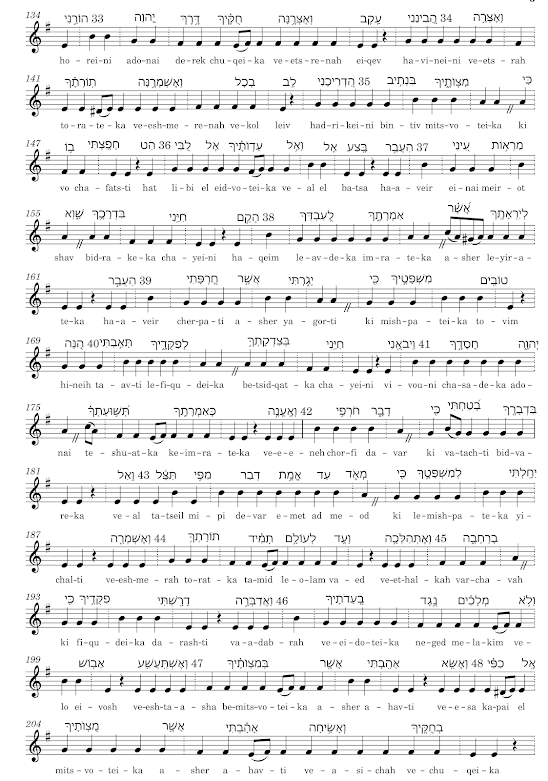
Psalm 119 - parts 5 to 8 - verses 33-64

Psalms 119: (Verses 33 to 48) Syllables: 272; Longest recitation: 10; Tenor: e 25.83%;
Ornament density: 5.2%; Average phrase length: 10.8.

(Verses 33 to 40) Syllables: 130; Longest recitation: 9; Tenor: g 30.77%;
Ornament density: 3.8%; Average phrase length: 10.
(Verses 41 to 48) Syllables: 142; Longest recitation: 10; Tenor:  e  30.28%;
Ornament density: 6.4%; Average phrase length: 11.8.

33 Help me learn Yahweh the way of your statutes and I will observe with foot firmly planted. (1-1)
לג הור֣ני י֭הוה ד֥רך חק֗יך ואצר֥נה עֽקב 16
lg horni ihvh drç kuqiç vaxrnh yqb
34 ♪g Have me understand and I will observe your instruction, and I will keep it with a whole heart. (g-1-1)
לד ה֭בינני ואצר֥ה תֽורת֗ך ואשמר֥נה בכל־לֽב 19
ld hbinni vaxrh tortç vawmrnh bcl-lb
35 ♪g Have me go in the pathway of your commandments,
for in it I have delighted. (g-1-4-1)
לה ה֭דריכני בנת֣יב מצות֑יך
כי־ב֥ו חפֽצתי
10
4
lh hdricni bntib mxvotiç
ci-bo kpxti
36 Hearten me to your testimonies and not to extortion. (1-1)
לו הט־ל֭בי אל־עדות֗יך וא֣ל אל־בֽצע 13
lv hT-libi al-ydvotiç val al-bxy
37 Hide my eyes from seeing vanity.
In your way give me life. (1-4-1)
לז העב֣ר ע֭יני מרא֣ות ש֑וא
בדרכ֥ך חיֽני
8
7
lz hybr yinii mraot wva
bdrcç kiini
38 Hold high to your servant your promise,
which is to your fear. (1-4-1)
לח הק֣ם ל֭עבדך אמרת֑ך
א֝ש֗ר ליראתֽך
10
7
lk hqm lybdç amrtç
awr liratç
39 Hide my reproach that I am afraid of,
for your judgments are good. (1-4-1)
לט העב֣ר ח֭רפתי אש֣ר יג֑רתי
כ֖י משפט֣יך טובֽים
11
7
lT hybr krpti awr igorti
ci mwpTiç Tobim
40 ♪g Here I have longed for your precepts.
In your righteousness give me life. (g-1-4-1)
מ ה֭נה תא֣בתי לפקד֑יך
בצדקתך֥ חיֽני
10
7
m hnh tabti lpiqudiç
bxdqtç kiini

41
Well come to me is your mercy, Yahweh,
your salvation as your promise. (1-4-1)
מא וֽיבא֣ני חסד֣ך יהו֑ה
ת֝ש֥ועתך֗ כאמרתֽך
9
9
ma viboauni ksdiç ihvh
twuytç camrtç
42 With which I will answer a word to one reproaching me,
for I trust in your word. (1-4-1)
מב ואֽענ֣ה חרפ֣י דב֑ר
כ֖י־ב֝טחתי בדברֽך
8
7
mb vaynh korpi dbr
ci-bTkti bdbrç
43 Word of truth do not remove from my mouth utterly,
for of your judgments, I have hope. (1-4-1)
מג וֽאל־תצ֬ל מפ֣י דבר־אמ֣ת עד־מא֑ד
כ֖י למשפט֣ך יחֽלתי
13
9
mg val-txl mpi dbr-amt yd-maod
ci lmwpTiç iiklti
44 Watch over your instruction I will continually forever and ever. (1-1)
מד ואשמר֖ה תורתך֥ תמ֗יד לעול֥ם ועֽד 14
md vawmrh tortç tmid lyolm vyd
45 Walk in a spacious room I will,
for your precepts I have searched out. (1-4-1)
מה ואתהלכ֥ה ברחב֑ה
כ֖י פקד֣יך דרֽשתי
7
8
mh vathlch brkbh
ci piqudiç drwti
46 Words I will have of your testimonies before kings and I will not be ashamed. (1-1)
מו ואדבר֣ה ב֭עדתיך נ֥גד מלכ֗ים ול֣א אבֽוש 18
mv vadbrh bydotiç ngd mlcim vla abow
47 Wherefore my revel will be in your commandments which I have loved. (1-1)
מז ואשתֽעש֥ע במצות֗יך אש֣ר אהֽבתי 15
mz vawtywy bmxvotiç awr ahbti
48 Wave my palms I will to your commandments, which I have loved and I will ponder on your statutes. (1-1)
מח ואשֽא־כפ֗י אֽל־מ֭צותיך אש֥ר אה֗בתי ואש֥יחה בחקֽיך 23
mk vawa-cpii al-mxvotiç awr ahbti vawikh bkuqiç

Psalms 119: (Verses 49 to 64) Syllables: 252; Longest recitation: 8; Tenor: e 21.12%;
Ornament density: 10%; Average phrase length: 9.
(Verses 49 to 56) Syllables: 123; Longest recitation: 7; Tenor: B 22.76%;
Ornament density: 8.9%; Average phrase length: 8.8.
(Verses 57 to 64) Syllables: 129; Longest recitation: 8; Tenor:  f#  24.81%;
Ornament density: 10.9%; Average phrase length: 9.1.

49 You remember a word to your servant,
on which you give me hope. (1-4-1)
מט זכר־דב֥ר לעבד֑ך
ע֝֗ל אש֣ר יֽחלתֽני
8
7
mT zcor-dbr lybdç
yl awr iikltni
50 ♪B Yes - this is my comfort in my poverty,
for your promise gives me life. (B-1-4-1)
נ ז֣את נחמת֣י בעני֑י
כ֖י אמרתך֣ חיֽתני
8
7
n zat nkmti byonii
ci amrtç kiitni
51 ♪g Yet though the presumptuous hold me in much scorn,
from your instruction I have not swerved. (g-1-4-1)
נא ז֭דים הליצ֣ני עד־מא֑ד
מ֝ת֥ורתך֗ ל֣א נטֽיתי
9
8
na zdim hlixuni yd-maod
mtortç la nTiti
52 ♪~ Your judgments I bring to remembrance from of old Yahweh and I comfort myself. (~1-1)
נב ז֘כ֤רתי משפט֖יך מעול֥ם יהו֗ה וֽאתנחֽם 16
nb zcrti mwpTiç myolm ihvh vatnkm
53 Yang of fire grasps me from the wicked,
forsaking your instruction. (1-4-1)
נג זלעפ֣ה א֭חזתני מרשע֑ים
ע֝זב֗י תורתֽך
10
6
ng zlyph akztni mrwyim
yozbi tortç
54 ♪g Yin of psalms your statutes have become to me in the house where I am guest. (g-1-1)
נד ז֭מרות היו־ל֥י חק֗יך בב֣ית מגורֽי 14
nd zmirot hiu-li kuqiç bbit mgurii
55 ♪~ Your name I have remembered in the night, Yahweh.
I have kept your instruction. (~1-4-1)
נה ז֘כ֤רתי בל֣ילה שמך֣ יהו֑ה
וֽ֝אשמר֗ה תורתֽך
10
8
nh zcrti blilh wmç ihvh
vawmrh tortç
56 ♪f You are mine,
for your precepts I have observed. (~1-4-1)
נו ז֥את היתה־ל֑י
כ֖י פקד֣יך נצֽרתי
4
8
nv zat hiith-li
ci piqudiç nxrti

57
Chosen share, mine you are, Yahweh. I have promised to keep your word. (1-1)
נז חלק֖י יהו֥ה אמ֗רתי לשמ֥ר דברֽיך 13
nz klqi ihvh amrti lwmor dbriç
58 Craved have I your presence with a whole heart,
be gracious to me according to your promise. (1-4-1)
נח חל֣יתי פנ֣יך בכל־ל֑ב
ח֝נ֗ני כאמרתֽך
9
8
nk kiliti pniç bcl-lb
konni camrtç
59 Considered have I my ways,
and turned my feet to your testimonies. (1-4-1)
נט חש֥בתי דרכ֑י
ואש֥יבה ר֝גל֗י אל־עדתֽיך
6
11
nT kiwbti drcii
vawibh rglii al-ydotiç
60 ♪g Came quickly I did and I would not linger,
to keep your commandments. (g-1-4-1)
ס ח֭שתי ול֣א התמהמ֑התי
ל֝שמ֗ר מצותֽיך
8
6
s kwti vla htmhmhti
lwmor mxvotiç
61 Companies of the wicked continue around me.
Your instruction I have not forgotten. (1-4-1)
סא חבל֣י רשע֣ים עוד֑ני
ת֥֝ורתך֗ ל֣א שכֽחתי
8
7
sa kbli rwyim yivvduni
tortç la wckti
62 Come midnight I arise to give thanks to you,
over the judgments of your righteousness. (1-4-1)
סב חצֽות־ל֗ילה א֭קום להוד֣ות ל֑ך
ע֝֗ל משפט֥י צדקֽך
10
7
sb kxot-lilh aqum lhodot lç
yl mwpTi xdqç
63 Companion am I to all who fear you,
and are keepers of your precepts. (1-4-1)
סג חב֣ר א֭ני לכל־אש֣ר ירא֑וך
ו֝לשמר֗י פקודֽיך
12
7
sg kbr ani lcl-awr irauç
ulwomri piqudiç
64 Covenant mercy yours, Yahweh, has filled the earth. Your statutes you will teach me. (1-1)
סד חסדך֣ י֭הוה מלא֥ה הא֗רץ חק֥יך למדֽני 16
sd ksdç ihvh mlah harx kuqiç lmdni

The music in these posts is derived from the accents in the Hebrew Bible. Introductions - letters, music, text and music, and terminology, are here.

Psalm 82

Psalms 82: Syllables: 143; Longest recitation: 10; Tenor: f# 27.97%;
Ornament density: 7.7%; Average phrase length: 8.4.

1 A psalm of Asaph.
God takes a stand in the divine assembly,
in the close combat of gods he judges. (1-2-4-1)
א מזמ֗ור לא֫ס֥ף
א‍ֽלה֗ים נצ֥ב בעדת־א֑ל
בק֖רב אלה֣ים ישפֽט
5
8
8
a mzmor lasf
alohim nixb bydt-al
bqrb alohim iwpoT
2 How long will you judge with injustice,
and with the presence of the-many wicked you bear? Selah. (1-4-1)
ב עד־מת֥י תשפטו־ע֑ול
ופנ֥י ר֝שע֗ים תשאו־סֽלה
7
8
b yd-mtii twpTu-yvvl
upni rwyim twau-slh
3 You judge weak and orphan,
poor and those in want. Do what is right. (1-4-1)
ג שפטו־ד֥ל וית֑ום
ענ֖י ור֣ש הצדֽיקו
6
7
g wpTu-dl vitom
yni vrw hxdiqu
4 Secure weak and needy,
from the hand of the-many wicked, deliver. (1-4-1)
ד פלטו־ד֥ל ואבי֑ון
מי֖ד רשע֣ים הצֽילו
6
8
d plTu-dl vabion
mid rwyim hxilu
5 ♪C They do not know and they do not understand. In the darkness they walk.
Dislodged are all the foundations of earth. (C-1-4-1)
ה ל֤א יֽדע֨ו ול֥א יב֗ינו בחשכ֥ה יתהל֑כו
י֝מ֗וטו כל־מ֥וסדי אֽרץ
16
8
h la idyu vla ibinu bkwich ithlcu
iimoTu cl-mosdi arx
6 I myself said, Gods you are,
and children of the Most High all of you. (1-4-1)
ו א‍ֽני־א֭מרתי אלה֣ים את֑ם
ובנ֖י עלי֣ון כלכֽם
9
6
v ani-amrti alohim atm
ubni ylion culcm
7 ♪g Nevertheless as humans you will die,
and as one of the nobility you will fall. (g-1-4-1)
ז א֭כן כאד֣ם תמות֑ון
וכאח֖ד השר֣ים תפֽלו
8
9
z acn cadm tmutun
ucakd hwrim tipolu
8 Arise O God, judge the earth,
for you yourself will inherit among all the nations. (1-4-1)
ח קומ֣ה א֭להים שפט֣ה הא֑רץ
כֽי־את֥ה ת֝נח֗ל בכל־הגויֽם
10
9
k qumh alohim wopTh harx
ci-ath tnkl bcl-hgoiim

The music in these posts is derived from the accents in the Hebrew Bible. Introductions - letters, music, text and music, and terminology, are here.

Psalm 81

Psalms 81: Syllables: 310; Longest recitation: 11; Tenor: A 23.55%;
Ornament density: 11%; Average phrase length: 9.1.

1 For the leader on musing, of Asaph. (1-1)
א למנצ֬ח עֽל־הגת֬ית לאסֽף 11
a lmnxk yl-hgitit lasf
2 ♪g Shout for joy to God our strength.
Raise a shout to the God of Jacob. (g-1-4-1)
ב ה֭רנינו לאלה֣ים עוז֑נו
ה֝ר֗יעו לאלה֥י יעקֽב
9
9
b hrninu lalohim yuznu
hriyu lalohi iyqob
3 Lift up a psalm and play a tambourine,
a pleasant harp with lute. (1-4-1)
ג שֽאו־ז֭מרה ותנו־ת֑ף
כנ֖ור נע֣ים עם־נֽבל
7
7
g wau-zmrh utnu-tof
cinor nyim ym-nbl
4 Sound a shophar in the new moon,
in the full moon on the day of our festive sacrifice. (1-4-1)
ד תקע֣ו בח֣דש שופ֑ר
ב֝כ֗סה לי֣ום חגֽנו
7
8
d tqyu bkodw wopr
bcsh liom kgnu
5 ♪C For a statute to Israel this is,
a judgment of the God of Jacob. (C-1-4-1)
ה כ֤י ח֣ק לישרא֣ל ה֑וא
מ֝שפ֗ט לאלה֥י יעקֽב
7
8
h ci koq liwral hua
mwpT lalohi iyqob
6 ♪C A testimony in Joseph he set up when he went out over the land of Egypt.
A language I did not know, I hear. (C-1-4-1)
ו ע֤דות ביה֘וס֤ף שמ֗ו ב֭צאתו על־א֣רץ מצר֑ים
שפ֖ת לא־יד֣עתי אשמֽע
16
7
v ydut bihosf wmo bxato yl-arx mxriim
wpt la-idyti awmy
7 I put aside his backside from a burden.
His palms passed through from infatuation
. (1-4-1)
ז הסיר֣ותי מס֣בל שכמ֑ו
כ֝פ֗יו מד֥וד תעבֽרנה
9
8
z hsiroti msbl wcmo
cpiv mdud tybornh
8 In trouble you called and I rescued you.
I answered you in the secrecy of thunder.
I tested you over the waters of Meribah.
Selah. (1-2-4-1)
ח בצר֥ה קר֗את ואח֫לצ֥ך
א֭ענך בס֣תר ר֑עם
אבחנך֨ על־מ֖י מריב֣ה סֽלה
11
8
10
k bxrh qrat vaklxç
aynç bstr rym
abknç yl-mi mribh slh
9 Hear my people and I will testify in you,
Israel if you will hear me. (1-4-1)
ט שמ֣ע ע֭מי ואע֣ידה ב֑ך
י֝שרא֗ל אם־תֽשמֽע־לֽי
9
7
T wmy ymi vayidh bç
iwral am-twmy-li
10 There will not be among you a strange god,
and you will not worship an alien god. (1-4-1)
י לֽא־יהי֣ה ב֭ך א֣ל ז֑ר
ול֥א ת֝שתחו֗ה לא֣ל נכֽר
7
10
i la-ihih bç al zr
vla twtkvvh lal ncr
11 I, Yahweh your God, brought you up from the land of Egypt.
Open your mouth wide and I will fill it. (1-4-1)
יא אנכ֨י יה֘ו֤ה אלה֗יך הֽ֭מעלך מא֣רץ מצר֑ים
הרחב־פ֝֗יך ואמלאֽהו
19
9
ia anoci ihvh alohiç hmylç marx mxriim
hrkb-piç vamlahu
12 But my people did not hear my voice,
and Israel did not consent to me. (1-4-1)
יב ולא־שמ֣ע עמ֣י לקול֑י
ו֝ישרא֗ל לא־א֥בה לֽי
8
7
ib vla-wmy ymi lqoli
viwral la-abh li
13 ♪g So I sent them out in the stubbornness of their heart,
and they walk in their own conspiracies. (g-1-4-1)
יג וֽ֭אשלחהו בשריר֣ות לב֑ם
י֝לכ֗ו בֽמועצ֖ותיהֽם
10
8
ig vawlkhu bwrirut libm
ilcu bmoyxotihm
14 ♪~ If only my people heard me,
Israel in my ways would walk. (~1-4-1)
יד ל֗ו ע֭מי שמ֣עֽ ל֑י
י֝שרא֗ל בדרכ֥י יהלֽכו
7
10
id lu ymi womy li
iwral bdrcii ihlcu
15 ♪g In short order I would bring their enemies to heel,
and over their troubles I would turn my hand. (g-1-4-1)
טו כ֭מעט אויביה֣ם אכנ֑יע
וע֥ל צ֝ריה֗ם אש֥יב ידֽי
8
9
Tv cmyT aoibihm acniy
vyl xrihm awib idi
16 Those hating Yahweh would cringe under him,
and their time would be forever. (1-4-1)
טז משנא֣י י֭הוה יכֽחשו־ל֑ו
ויה֖י עת֣ם לעולֽם
9
7
Tz mwnai ihvh ickwu-lo
vihi yitm lyolm
17 ♪g I would feed them from the choicest wheat,
and from the honeyed rock I would satisfy you. (g-1-4-1)
יז וֽ֭יאכילהו מח֣לב חט֑ה
ו֝מצ֗ור דב֣ש אשביעֽך
11
9
iz viacilhu mklb kiTh
umxur dbw awbiyç

The music in these posts is derived from the accents in the Hebrew Bible. Introductions - letters, music, text and music, and terminology, are here.

Psalm 80

Psalms 80: Syllables: 378; Longest recitation: 12; Tenor: A 24.87%;
Ornament density: 10.1%; Average phrase length: 9.1.

1 For the leader. On lilies.
A testimony of Asaph, a psalm. (1-4-1)
א למנצ֥ח אל־ששנ֑ים
עד֖ות לאס֣ף מזמֽור
8
7
a lmnxk al-wownim
ydut lasf mzmor
2 ♪~ Shepherd of Israel give ear, driving Joseph like a flock,
sitting on the cherubim, shine. (~1-4-1)
ב ר֘ע֤ה ישרא֨ל האז֗ינה נה֣ג כצ֣אן יוס֑ף
יש֖ב הכרוב֣ים הופֽיעה
15
8
b royh iwral hazinh nohg cxan iosf
iowb hcrubim hopiyh
3 In the presence of Ephraim, and Benjamin and Manasseh, arouse your valour,
and come now to our salvation. (1-4-1)
ג לפנ֤י אפר֨ים ובני֘מ֤ן ומנש֗ה עורר֥ה את־גבֽורת֑ך
ולכ֖ה לישע֣תה לֽנו
19
8
g lpni apriim ubnimin umnwh yorrh at-gburtç
ulch liwuyth lnu
4 O God turn us,
and reveal your presence, and we will be saved. (1-4-1)
ד אלה֥ים השיב֑נו
והא֥ר פ֝נ֗יך ונושֽעה
7
11
d alohim hwibnu
vhar pniç vnivvwyh
5 Yahweh God of hosts,
how long will you fume in anger with the prayer of your people? (1-4-1)
ה יהו֣ה אלה֣ים צבא֑ות
עד־מת֥י ע֝ש֗נת בתפל֥ת עמֽך
8
12
h ihvh alohim xbaot
yd-mtii ywnt btpilt ymç
6 ♪g You make them eat the bread of tears,
and you make them drink a third measure of tears. (g-1-4-1)
ו ה֭אכלתם ל֣חם דמע֑ה
ו֝תשק֗מו בדמע֥ות שלֽיש
8
9
v hacltm lkm dmyh
vtwqmo bdmyot wliw
7 You set us up as if sentenced by our neighbours,
and our enemies take pleasure in their derision. (1-4-1)
ז תשימ֣נו מ֭דון לשכנ֑ינו
ו֝איב֗ינו ילעגו־לֽמו
10
8
z twimnu mdon lwcninu
vaoibinu ilygu-lmo
8 God of hosts turn us,
and reveal your presence, and we will be saved. (1-4-1)
ח אלה֣ים צבא֣ות השיב֑נו
והא֥ר פ֝נ֗יך ונושֽעה
10
11
k alohim xbaot hwibnu
vhar pniç vnivvwyh
9 ♪g A vine from Egypt you sprung.
You expelled nations to plant her. (g-1-4-1)
ט ג֭פן ממצר֣ים תס֑יע
תגר֥ש ג֝וי֗ם ותטעֽה
8
10
T gpn mmxriim tsiy
tgrw goiim vtiTyha
10 You prepared the soil in her presence.
You rooted her roots, and she filled the land. (1-4-1)
י פנ֥ית לפנ֑יה
ותשר֥ש ש֝רש֗יה ותמלא־אֽרץ
7
12
i pinit lpnih
vtwrw worwih vtmla-arx
11 Her shadow covered hills,
and her boughs God's cedars. (1-4-1)
יא כס֣ו הר֣ים צל֑ה
ו֝ענפ֗יה אֽרזי־אֽל
6
8
ia cosu hrim xilh
vynpih arzi-al
12 She sent her harvest to the sea,
and to the river her nursling shoots. (1-4-1)
יב תשל֣ח קציר֣ה עד־י֑ם
ואל־נ֝ה֗ר יֽונקותֽיה
9
8
ib twlk qxirih yd-im
val-nhr ionqotih
13 ♪g Why breach her fences,
so all may forage who pass through her way? (g-1-4-1)
יג ל֭מה פר֣צת גדר֑יה
ו֝אר֗וה כל־ע֥ברי דֽרך
9
9
ig lmh prxt gdrih
varuh cl-yobri drç
14 The boar wastes her from the forest,
and the wild creature of the field shepherds her. (1-4-1)
יד יכרסמ֣נֽה חז֣יר מי֑ער
וז֖יז שד֣י ירעֽנה
10
7
id icrsmnh kzir miyr
vziz wdii irynh
15 O God of hosts may you return.
Take note from the heavens and see,
and visit this vine, (1-2-4-1)
טו אלה֣ים צבאות֮ שֽ֫וב־נ֥א
הב֣ט משמ֣ים ורא֑ה
ו֝פק֗ד ג֣פן זֽאת
8
7
5
Tv alohim xbaot wub-na
hbT mwmiim urah
upqod gpn zat
16 ♪g and the cane which your right hand planted,
and on the child you assured for yourself. (g-1-4-1)
טז ו֭כנה אשר־נטע֣ה ימינ֑ך
ועל־ב֝֗ן אמ֥צתה לֽך
11
7
Tz vcnh awr-nTyh iminç
vyl-bn aimxt lç
17 Incinerated in the fire, cut away,
from the rebuke of your presence, they perish. (1-4-1)
יז שרפ֣ה בא֣ש כסוח֑ה
מגער֖ת פנ֣יך יאבֽדו
8
10
iz wruph baw csukh
mgyrt pniç iabdu
18 Let your hand be on the person at your right hand,
on the child of humanity you assured for yourself. (1-4-1)
יח תֽהי־י֭דך על־א֣יש ימינ֑ך
על־בן־א֝ד֗ם אמ֥צת לֽך
10
8
ik thi-idç yl-aiw iminç
yl-bn-adm aimxt lç
19 And we will not move away from you.
Let us live and on your name we will call. (1-4-1)
יט ולא־נס֥וג ממ֑ך
ת֝חי֗נו ובשמך֥ נקרֽא
6
9
iT vla-nsog mmç
tkiinu ubwmç nqra
20 Yahweh God of hosts turn us.
Reveal your presence, and we will be saved. (1-4-1)
כ יה֘ו֤ה אלה֣ים צבא֣ות השיב֑נו
הא֥ר פ֝נ֗יך ונושֽעה
12
10
c ihvh alohim xbaot hwibnu
har pniç vnivvwyh

The music in these posts is derived from the accents in the Hebrew Bible. Introductions - letters, music, text and music, and terminology, are here.

Thursday, 28 November 2024

Oral tradition Psalm 19:10 - slightly baffled

Exploring Flender. His first example of the oral tradition is on page 88. He uses psalm 19 verse 10 -- so here is the version as I presented it.

Psalms 19: (Verses 10 to 10) Syllables: 23; Longest recitation: 7; Tenor: C 30.43%;
Ornament density: 13%; Average phrase length: 7.7. 10 words (9 with maqqef).

There is no doubt that this rendition is following the accents. 

10 The fear of Yahweh is clean, standing for ever.
The judgments of Yahweh are true,
righteous altogether. (1-2-4-1)
י ירא֤ת יהו֨ה טהורה֮ עומ֪דת ל֫ע֥ד
מֽשפטי־יהו֥ה אמ֑ת
צדק֥ו יחדֽו
12
8
4
i irat ihvh Thorh yomdt lyd
mwpTi-ihvh amt
xdqu ikdiv

The shape of the music is:

  • five words to the first cadence: e (silluq) C, (mahpakh), qadma, tsinnor, d (galgal), ole-veyored f# (yored = merkha), 
  • two (three) words to the atnah: e f# ^A  (atnah); 
  • then two words to the silluq: f# e.
Generic questions: how is the cadence on the supertonic approached? How do we move from supertonic to subdominant? 

There are 408 verses with 'ole'. Most of these (343) are in the psalms. These are a few observations. I don't know if these are rules. I see there are lots of people over the years who have counted, and sequenced these signs. I'm curious because the musical lines may help us understand the text and how the composer understood it. 
  • If ole veyored is in the verse then it is preceded by tsinnor or revia or both. 
  • The pair, tsinnor, revia occurs in advance of ole twice in the psalms both times preceded by qadma.
  • The pair, revia, tsinnor occurs 23 times in advance of ole, preceded by one or more of several ornaments, pazer, zarqa, illuy, and qadma, (not to mention the accents below the text). All these ornaments are used independently of ole.
  • Revia or tsinnor precedes every occurrence of ole veyored. (Is this a rule of composition or an accident?)
  • We don't see tsinnor after ole, but we do see zarqa, essentially the same ornament in Psalms 2, 5, 14, 18, 49, 72, 106. And we see revia after an ole.
How do we get from ole to atnah? It is not dissimilar to getting to atnah from silluq. You can see that process above in psalm 19 verse 10 -- e f# A, almost as if the first part of the verse was a different verse. I see 42 different patterns, from a single f# directly to A, Psalms 3, 5, 29, 76, 132, to more lengthy phrases like ole, f# e pazer,C qadma,e revia,g B A. (Psalms 79 verse 1). Here we see ornaments between the cadences.

Flender's example is from real life in the oral tradition. He writes that it is "a recording of a free liturgical function, made without an interview in the synagogue זכור אברהם, (Zekhor Avraham) in Jerusalem in 1978." (Flender page 88)

His first example using psalm 19 verse 10 follows. I can read the music he displays, but I am baffled by his explanation and the full score of psalm 19 that is attached to the book as an appendix. I wonder if anyone else has ever read this book from the UVIC library. Maybe they could explain where Flender is coming from. Why would he produce a full score with unreadable Hebrew (too small) and notations in the score that for now I have no explanation. I am a poor reader - impatient, and biased in my expectations of clarity (smile -- I'm sure you have problems with my clarity too). 


Real life oral tradition example from Flender

The oral tradition here is melodic. It ignores the accents:
  • First it ignores the mahpakh, ירא֤ת moves to f#  יהו֨ה without an accent, and ignores the qadma, 
  • has a slur and change of reciting note on the tsinnor טהורה֮
  • moves to a new reciting note (A) on the galgal עומ֪דת and 
  • treats ole-veyored as an appoggiatura ל֫ע֥ד
  • Then after the rest, the melody returns to the starting note on the silluq מֽשפטי (an accidental agreement).
  • The melody then moves without an accent to the g and 
  • then to the A on the last syllable of the Name יהו֥ה where there is a merkha, 
  • then to the f# where the atnah requires a pause on the word true, אמ֑ת but the melody as written does not require a pause. 
  • This verse has a very short section after the atnah, one where the singer might easily ignore the required caesura.
  • The silluq on the xdqu צדק֥ו in the real life score is spurious, the use of A for merkha on the last syllable of the Name and qof (ק֥) of xdqu is consistent in the second and third cola, but inconsistent with the first.
  • The melody returns to f# without an accent and to the g יחדֽו (home?) for the final syllable on the silluq. This is inconsistent with the opening of the second colon where there is a silluq on the mem (מֽ) .
This oral tradition has moved away from the accents. If the deciphering key of Haïk-Vantoura is a guide, it has moved quite some distance.

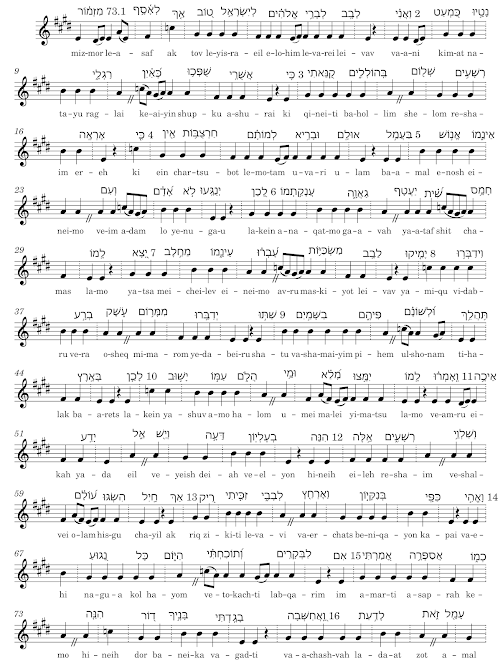
Psalm 73

Psalms 73: Syllables: 472; Longest recitation: 19; Tenor: A 26.48%;
Ornament density: 10%; Average phrase length: 8.4.

1 A psalm of Asaph.
Surely God is good to Israel, to the pure in heart. (1-2-1)
א מזמ֗ור לא֫ס֥ף
א֤ך ט֭וב לישרא֥ל אלה֗ים לבר֥י לבֽב
5
14
a mzmor lasf
aç Tob liwral alohim lbri lbb
2 But I myself, my feet bent as if a little,
as if my steps were not to be poured out, (1-4-1)
ב ואנ֗י כ֭מעט נט֣יו רגל֑י
כ֝א֗ין שפכ֥ו אשרֽי
10
7
b vani cmyT nTiu rglii
cain wupcu awurii
3 for I was jealous of the boasters.
Peace for the wicked I was seeing. (1-4-1)
ג כֽי־ק֭נאתי בֽהולל֑ים
של֖ום רשע֣ים אראֽה
6
7
g ci-qinati bhollim
wlom rwyim arah
4 ♪C For there are no stings in their death, and plenteous is their gut. (C-1-1)
ד כ֤י א֖ין חרצב֥ות למות֗ם ובר֥יא אולֽם 13
d ci ain krxubot lmotm ubria aulm
5 In toil a mortal is nothing to them,
and they are not touched as humans. (1-4-1)
ה בעמ֣ל אנ֣וש אינ֑מו
ועם־א֝ד֗ם ל֣א ינגֽעו
8
9
h byml anow ainmo
vym-adm la inugyu
6 ♪g So they are necklaced with pride,
draped with their cloak of violence. (g-1-4-1)
ו ל֭כן ענק֣תמו גאו֑ה
יעטף־ש֝֗ית חמ֥ס לֽמו
9
8
v lcn ynqtmo gavvh
iyTof-wit kms lmo
7 ♪g Their eyes bulge out.
They go beyond the heart's imagination. (g-1-4-1)
ז י֭צא מח֣לב עינ֑מו
ע֝בר֗ו משכי֥ות לבֽב
8
7
z ixa mklb yinmo
ybru mwciiot lbb
8 They mock and speak in oppressive evil.
From on high they speak. (1-4-1)
ח ימ֤יקו וידבר֣ו בר֣ע ע֑שק
ממר֥ום ידבֽרו
10
7
k imiqu vidbru bry yowq
mmrom idbru
9 They thrust their mouth in the heavens,
and their tongue struts in the earth. (1-4-1)
ט שת֣ו בשמ֣ים פיה֑ם
ו֝לשונ֗ם תֽהל֥ך באֽרץ
7
9
T wtu bwmiim pihm
ulwonm tihlç barx
10 "So! his people will return here,
where they can be fully milked." (1-4-1)
י לכ֤ן יש֣וב עמ֣ו הל֑ם
ומ֥י מ֝ל֗א ימ֥צו לֽמו
8
9
i lcn iwub ymo hlom
umi mla iimxu lmo
11 And they say, How will God know?
So is there knowledge in the Most High? (1-4-1)
יא וֽאמר֗ו איכ֥ה ידֽע־א֑ל
וי֖ש דע֣ה בעליֽון
8
7
ia vamru aich idy-al
viw dyh bylion
12 Behold, these are wicked,
so at ease ever, abounding in wealth. (1-4-1)
יב הנה־א֥לה רשע֑ים
ושלו֥י ע֝ול֗ם השגו־חֽיל
7
8
ib hnh-alh rwyim
vwlvvi yolm hwgu-kil
13 Surely without cause I have cleared my heart,
and I keep on washing my palms in innocence. (1-4-1)
יג אך־ר֭יק זכ֣יתי לבב֑י
וארח֖ץ בנקי֣ון כפֽי
8
9
ig aç-riq ziciti lbbi
varkx bniqion cpii
14 And I am touched all the day long,
with my own correction in the morning. (1-4-1)
יד ואה֣י נ֭גוע כל־הי֑ום
ו֝תוכחת֗י לבקרֽים
9
7
id vahi nguy cl-hiom
vtockti lbqrim
15 If I had said, This is how I will recount it,
then, a generation of your children, I would have betrayed. (1-4-1)
טו אם־א֭מרתי אספר֥ה כמ֑ו
הנ֤ה ד֭ור בנ֣יך בגֽדתי
9
9
Tv am-amrti asprh cmo
hnh dor bniç bgdti
16 ♪g And I reckon that I know this.
Toil it is to my eyes. (g-1-4-1)
טז וֽ֭אחשבה לד֣עת ז֑את
עמ֖ל ה֣וא בעינֽי
8
6
Tz vakwbh ldyt zat
yml hua byinii
17 When I come to God's sanctuaries,
I understand their result. (1-4-1)
יז עד־א֭בוא אל־מקדשי־א֑ל
א֝ב֗ינה לאחריתֽם
8
8
iz yd-aboa al-mqdwi-al
abinh lakritm
18 ♪B Surely in slippery parts you will put them.
You will make them fall into catastrophes. (B-1-4-1)
יח א֣ך ב֭חלקות תש֣ית ל֑מו
ה֝פלת֗ם למשואֽות
9
7
ik aç bklqot twit lmo
hpltm lmwuaot
19 ♪C How in a moment they are desolated,
floundering, filled full from frights. (C-1-4-1)
יט א֤יך הי֣ו לשמ֣ה כר֑גע
ס֥פו ת֝֗מו מן־בלהֽות
9
8
iT aiç hiu lwmh crgy
spu tmu mn-blhot
20 Like awakening from a dream,
My Lord, when you are roused, you will despise their semblance. (1-4-1)
כ כחל֥ום מהק֑יץ
א֝דני בע֤יר צלמ֬ם תבזֽה
6
9
c cklom mhqix
adonii byir xlmm tbzh
21 ♪g For my heart was sour,
and I was sharply taught in my insides. (g-1-4-1)
כא כ֭י יתחמ֣ץ לבב֑י
ו֝כליות֗י אשתונֽן
7
7
ca ci itkmx lbbi
vcliotii awtonn
22 I myself was a brute without knowledge.
Behemoth I was with you. (1-4-1)
כב ואני־ב֭ער ול֣א אד֑ע
ב֝המ֗ות הי֥יתי עמֽך
8
8
cb vani-byr vla ady
bhmot hiiti yimç
23 Even so I myself am continually with you.
You hold fast my right hand. (1-4-1)
כג ואנ֣י תמ֣יד עמ֑ך
א֝ח֗זת ביד־ימינֽי
7
8
cg vani tmid yimç
akzt bid-imini
24 In your counsel you will guide me,
and after you will take me into glory. (1-4-1)
כד בעצתך֥ תנח֑ני
ו֝אח֗ר כב֥וד תקחֽני
7
9
cd byxtç tnkni
vakr cbod tiqkni
25 Who is for me in the heavens?
And with you have I no delight on earth? (1-4-1)
כה מי־ל֥י בשמ֑ים
ו֝עמך֗ לא־חפ֥צתי באֽרץ
6
9
ch mi-li bwmiim
vyimç la-kpxti barx
26 My physical power and my heart find their end.
The rock of my heart and my share is God forever. (1-2-1)
כו כל֥ה שאר֗י ולב֫ב֥י
צור־לבב֥י וחלק֗י אלה֥ים לעולֽם
8
13
cv clh wari ulbbi
xur-lbbi vklqi alohim lyolm
27 For these who are distant from you will perish.
You will annihilate all who prostitute themselves from you. (1-4-1)
כז כֽי־הנ֣ה רחק֣יך יאב֑דו
ה֝צמ֗תה כל־זונ֥ה ממֽך
9
9
cz ci-hnh rkqiç iabdu
hxmt cl-zonh mmç
28 But I myself approach God - to me, good.
I have set my Lord Yahweh as my refuge,
so I will be able to recount all your affairs. (1-2-4-1)
כח ואנ֤י קֽרב֥ת אלה֗ים ל֫י־ט֥וב
שת֤י באדנ֣י יהו֣ה מחס֑י
ל֝ספ֗ר כל־מלאכותֽיך
11
10
9
ck vani qrbt alohim li-Tob
wti badonii ihvh mksi
lspr cl-mlacotiç

The music in these posts is derived from the accents in the Hebrew Bible. Introductions - letters, music, text and music, and terminology, are here.