Showing posts with label poetry. Show all posts

Tuesday, 8 October 2024

Genesis 3 - the exercise

Given some suggestions as to how to categorize accents for pausal value in comments on the previous post, I thought that analyzing Genesis 3 (you need this link to hear or read what's going on the in the music) completely might yield some additional questions and observations. So I first reduced the text to its minimal stich size. And identified each accent that invites a pause or cadence.

It's a long process. I admit to starting with two biases - one is the confusion I felt when I began to read about these accents without the music, and the other is a tendency to sing longer phrases rather than chopping up the text at every accent. Of course that's the problem: what accents demand a pause and which only invite or rather have no pause value. It seems to me that this requires both literary and musical judgment.

Yet the whole remains complex and potentially more multifaceted than I have imagined. The complexity is immediately evident when you begin to do by hand the exercise I suggested a few days ago.

So here is the English with the Hebrew letter following that causes or suggests a line feed. These accents abbreviated in the right column would be the traditionally named disjunctives. Anything else is in a conjunctive roll. In the prose, two of those disjunctives are cadences, A (atnah) on the subdominant, and e (silluq) at the end of each verse on the tonic. Some of the lesser disjunctives lead to commas in the text, and one, the zaqef-qaton, leads, almost all the time, to a breath in the vocal line.

Parentheses note ornaments that are conjunctive in my reading. I have not included the remaining accents below the text. These remaining, excepting atnah (A) and silluq (e), are conjunctive 99% of the time. They define the shape of the sequence of recitation pitches. I confirmed or corrected the syllable counts by counting the beats in the score over the multiple measures themselves defined by the recitation pitches. This is tiring, but it will provide me a checkpoint to correct a module that is failing occasionally.

The Jerusalem Bible (1962) formats verses 14 to 19 excluding 17a as if it were poetry. It's too crafty for me to say if this is legitimate. I have my inarticulate doubts. I am barely at the beginning of this journey after 15 years or more. But look at this archetypical story beginning the explanation of the enmity we have for each other even within the family. This wedge is destroying us.

1 But the snake was crafty ר֔
among all the living of the field ד֔
that Yahweh God constructed, ה֑
and it said to the woman, ש֔
Indeed that God said, ה֔
You will not eat ל֔
from every tree of the garden. גֽ
z-q
z-q
A
z-q
z-q
e
א והנחש֙ הי֣ה ער֔ום
מכל֙ חי֣ת השד֔ה
אש֥ר עש֖ה יהו֣ה אלה֑ים
וי֙אמר֙ אל־ה֣אש֔ה
א֚ף כֽי־אמ֣ר אלה֔ים
ל֣א תֽאכל֔ו
מכ֖ל ע֥ץ הגֽן
8
7
9
=24
7
7
4
5
=23
a vhnkw hih yrum
mcol kit hwdh
awr ywh ihvh alohim
viamr al-haiwh
af ci-amr alohim
la taclu
mcol yx hgn
2 And the woman said to the snake,
From the fruit of the tree of the garden, we eat.
A
e
ב ות֥אמר הֽאש֖ה אל־הנח֑ש
מפר֥י עֽץ־הג֖ן נאכֽל
10
7
b vtamr haiwh al-hnkw
mpri yx-hgn nacl
3 But from the fruit of the tree ץ֮ 
that is in the midst of the garden, ן֒
God said, ה֗
You will not eat from it מ֔
and you will not touch it, ב֑
lest you die. תֽ
tsi
seg
rev
z-q
A
e
ג ומפר֣י העץ֮
אש֣ר בתוך־הגן֒
אמ֣ר אלה֗ים
ל֤א תֽאכלו֙ ממ֔נו
ול֥א תגע֖ו ב֑ו
פן־תמתֽון
5
6
5
7
5
=27


4
g umpri hyx
awr btoç-hgn
amr alohim
la taclu mmnu
vla tigyu bo
pn-tmutun
4 And the snake said to the woman,
Not death you will die.
A
e
ד וי֥אמר הנח֖ש אל־הֽאש֑ה
לֽא־מ֖ות תמתֽון
10
5
d viamr hnkw al-haiwh
la-mot tmutun
5 ♪C Because God knows ה֔
that in the day you eat from it, מ֔
your eyes will be given sight, כ֑
and you will become as God ה֔
knowing good and evil. רֽ
z-q
z-q
A
z-q
e
ה כ֚י יד֣ע אלה֔ים
כ֗י ביום֙ אכלכ֣ם ממ֔נו
ונפקח֖ו עֽיניכ֑ם
והייתם֙ כֽאלה֔ים
ידע֖י ט֥וב ורֽע
7
9
7
=23
6
5
=11
h ci iody alohim
ci biom acolcm mmnu
 vnpqku yinicm
vhiitm calohim
iodyi Tob vry
6 And the woman saw
that good was the tree to eat כ֜
and that desirable it was to the eyes נ֗
and attractive was the tree to have insight כ֔
and she took from its fruit and she ate, כ֑
and she gave even to her man with her and they ate. כֽ
paz
(t-q,qad,) azl 
rev
z-q
A
e
ו ות֣רא הֽאש֡ה
כ֣י טוב֩ הע֨ץ למאכ֜ל
וכ֧י תֽאוה־ה֣וא לעינ֗ים
ונחמ֤ד העץ֙ להשכ֔יל
ותק֥ח מפרי֖ו ותאכ֑ל
ותת֧ן גם־לאיש֛ה עמ֖ה ויאכֽל
6
8
10
8
9
=41

12
v vtra haiwh
ci Tob hyx lmacl
vci tavvh-hua lyiniim
vnkmd hyx lhwcil
vtiqk mpriio vtacl
vtitn gm-laiwh yimh viacl
7 And the eyes of the two of them were given sight, ה֔
and they knew ע֔
that they were naked, ה֑
so they sewed fig leaves together נ֔
and they made for themselves attire. רֽ
z-q
z-q
A
z-q
e

ז ותפק֙חנה֙ עינ֣י שניה֔ם
וי֣דע֔ו
כ֥י עֽירמ֖ם ה֑ם
וֽיתפרו֙ על֣ה תאנ֔ה
ויעש֥ו לה֖ם חגרֽת
10
3
5
=18
9
9
=18
z vtipqknh yini wnihm
viidyu
ci yirumim hm
vitpru yli tanh
viywu lhm kgorot
8 And they heard the voice of Yahweh God walking in the garden in the wind of the day, י֑
and they camouflaged themselves, ב֨
the Adam and his woman, ת֗
from the face of Yahweh God ה֔
in the midst of the tree of the garden. גֽ
(tar, qad) A
(qad) azl
rev 
z-q
e
ח וֽישמע֞ו את־ק֨ול יהו֧ה אלה֛ים מתהל֥ך בג֖ן לר֣וח הי֑ום
ויתחב֨א
הֽאד֜ם ואשת֗ו
מפני֙ יהו֣ה אלה֔ים
בת֖וך ע֥ץ הגֽן
21
4
6
7
5
=22
k viwmyu at-qol ihvh alohim mthlç bgn lruk hiom
vitkba hadm vawto mpni ihvh alohim btoç yx hgn
9 And Yahweh God called to the Adam,
saying to him, Where are you?
A
e
ט ויקר֛א יהו֥ה אלה֖ים אל־הֽאד֑ם
וי֥אמר ל֖ו איֽכה
12
7
T viqra ihvh alohim al-hadm
viamr lo aiiç
10 And it said, I heard your voice in the garden,
and I feared because I am naked so I camouflaged myself.
(z-g) A
e
י וי֕אמר את־קלך֥ שמ֖עתי בג֑ן
ואיר֛א כֽי־עיר֥ם אנ֖כי ואחבֽא
11
12
i viamr at-qolç wmyti bgn
vaira ci-yirom anoci vaikba
11 And he said, Who made it clear to you ך֔
that you are naked? א֑
From the tree that I commanded you not to eat, did you eat? כֽ
(z-g) z-q
A
(rev) e
יא וי֕אמר מ֚י הג֣יד לך֔
כ֥י עיר֖ם א֑תה
המן־הע֗ץ אש֧ר צוית֛יך לבלת֥י אכל־ממ֖נו אכֽלת
8
5
=13
21
ia viamr mi hgid lç ci yirom ath
hmn-hyx awr xivvitiç lblti acol-mmnu aclt
12 And the Adam said, ד֑
The woman that you have given to stand with me, ד֔
she gave to me from the tree and I ate. כֽ
A
z-q
e
יב וי֖אמר הֽאד֑ם
הֽאשה֙ אש֣ר נת֣תה עמד֔י
ה֛וא נֽתנה־ל֥י מן־הע֖ץ ואכֽל
6
11
10
=21
ib viamr hadm
haiwh awr ntt yimdi
hia ntnh-li mn-hyx vaocl
13 And Yahweh God said to the woman,
What is this that you have done? ש֑
and the woman said, ש֔
The snake lured me and I ate. כֽ

g# (rare use of tifha as pause)
(qad) A
(qad, qad) z-q
e

יג וי֨אמר יהו֧ה אלה֛ים לאש֖ה
מה־ז֣את עש֑ית
ות֙אמר֙ הֽאש֔ה
הנח֥ש השיא֖ני ואכֽל
11
4
=15
6
10
=16
ig viamr ihvh alohim laiwh
mh-zat ywit
vtamr haiwh
hnkw hwiani vaocl
14 And Yahweh God said to the snake, ש֮
 Because you have done this, ת֒
cursed you will be above all cattle מ֔
and above all the living of the field. ד֑
On your stomach you will walk ל֔
and dust you will eat all the days of your life. יֽ
(t-q, qad) tsi
seg
z-q
A
z-q
e

יד ויאמר֩ יהו֨ה אלה֥ים אֽל־הנחש֮
כ֣י עש֣ית זאת֒
אר֤ור אתה֙ מכל־הבהמ֔ה
ומכ֖ל חי֣ת השד֑ה
על־גחנך֣ תל֔ך
ועפ֥ר תאכ֖ל כל־ימ֥י חיֽיך
12
5
9
8
=34
6
11
=17
id viamr ihvh alohim al-hnkw
ci ywit zat arur ath mcl-hbhmh
umcol kit hwdh
yl-gkonç tlç
vypr tacl cl-imi kiiç
15 And I will impose enmity ש֗
between you and between the woman ש֔
and between your seed and between her seed. ע֑
It itself will bruise you in the head. ר֔
But you, yourself will bruise it in the heel. קֽ
rev
(qad) z-q
A
z-q
e
טו ואיב֣ה אש֗ית
בֽינך֙ וב֣ין הֽאש֔ה
וב֥ין זרעך֖ וב֣ין זרע֑ה
ה֚וא ישופך֣ ר֔אש
ואת֖ה תשופ֥נו עקֽב ס
5
7
9
=21
5
9
=14
Tv vaibh awit binç ubin haiwh
ubin zryç ubin zryh
hua iwupç raw
vath twupnu yqb s
16 To the woman he said, מ֗
Thoroughly I will increase your hardship and your pregnancy. נ֔
In hardship you will give birth to children, נ֑
and to your man you will have aspiration, ת֔
but he himself will govern in you. בֽ
rev
z-q
A
z-q
e
טז אֽל־האש֣ה אמ֗ר
הרב֤ה ארבה֙ עצבונ֣ך והֽרנ֔ך
בע֖צב תֽלד֣י בנ֑ים
ואל־אישך֙ תש֣וקת֔ך
וה֖וא ימשל־בֽך ס
6
11
7
=24
8
5
=13
Tz al-haiwh amr
hrbh arbh yixbonç vhronç
byxb tldi bnim
val-aiwç twuqtç
vhua imwol-bç s
17 But to the Adam he said, מ֗
Because you heard the voice of your wife, ך֒
and ate from the tree that I commanded you, saying, ע֔
You will not eat from it, מ֑
cursed is the ground on your behalf. ר֔
In hardship you will eat from it ל֔
all the days of your life. יֽ
rev
(tsi) seg
(qad, qad) z-q
A
(qad) z-q
z-q
e
יז ולאד֣ם אמ֗ר
כֽי־שמעת֮‬ לק֣ול אשתך֒
ות֙אכל֙ מן־הע֔ץ
אש֤ר צוית֙יך֙ לאמ֔ר
ל֥א תאכ֖ל ממ֑נו
ארור֤ה הֽאדמה֙ בֽעבור֔ך
בעצבון֙ תֽאכל֔נה
כ֖ל ימ֥י חיֽיך
5
9
6
8
6
=34
12
14
=26
iz uladm amr
ci-wmyt lqol awtç
vtacl mn-hyx
awr xivvitiç lamor
la tacl mmnu
arurh hadmh byburç
 byixbon taclnh
col imi kiiç
18 So brambles and thistles she will grow for you, ל֑
and you will eat the herb of the field. דֽ
A
e
יח וק֥וץ ודרד֖ר תצמ֣יחֽ ל֑ך
ואכלת֖ את־ע֥שב השדֽה
9
10
ik vqox vdrdr txmik lç
vaclt at-ywb hwdh
19 In the sweat of your anger you will eat bread ל֔
till you return to the ground מ֔
for from it you were taken, ק֑
for dust you are א֔
and to dust you will return. שֽ
z-q
z-q
A
z-q
e
יט בזע֤ת אפ֙יך֙ ת֣אכל ל֔חם
ע֤ד שֽובך֙ אל־ה֣אדמ֔ה
כ֥י ממ֖נה לק֑חת
כֽי־עפ֣ר א֔תה
ואל־עפ֖ר תשֽוב
10
8
7
=25
5
6
=11
iT bziyt apiç tacl lkm
yd wubç al-hadmh
ci mmnh luqkt
ci-ypr ath
val-ypr twub
20 And the Adam called the name of his wife, Eve, ו֑
for she became the mother of all living. חֽ
A
e
כ ויקר֧א הֽאד֛ם ש֥ם אשת֖ו חו֑ה
כ֛י ה֥וא הֽית֖ה א֥ם כל־חֽי
11
7
c viqra hadm wm awto kvvh
ci hia hiith am cl-ki
21 And Yahweh God made for Adam and his wife coats of skin, and he clothed them. e - no pauses except the final cadence
כא ויעש֩ יהו֨ה אלה֜ים לאד֧ם ולאשת֛ו כתנ֥ות ע֖ור וילבשֽם פ 22
ca viyw ihvh alohim ladm ulawto cotnot yor vilbiwm p
22 And Yahweh God said, ה֗
Lo, the human has become as one among us מ֔
knowing good and evil, ר֑
so now lest he reach out his hand ד֗
and take likewise from the tree of the living י֔
and eat and live forever, ... לֽ
rev
z-q
A
rev
z-q
e
כב וי֣אמר יהו֣ה אלה֗ים
ה֤ן הֽאדם֙ היה֙ כאח֣ד ממ֔נו
לד֖עת ט֣וב ור֑ע
ועת֣ה פן־ישל֣ח יד֗ו
ולקח֙ ג֚ם מע֣ץ הֽחי֔ים
ואכ֖ל וח֥י לעלֽם
8
12
6
=26
8
10
6
=24
cb viamr ihvh alohim
hn hadm hih cakd mmnu
ldyt Tob vry
vyth pn-iwlk ido
vlqk gm myx hkiim
vacl vki lyolm
23 so Yahweh God sent him out from the garden of Eden, ע֑
to serve the ground which he was taken from. שֽ
A
e
כג וֽישלח֛הו יהו֥ה אלה֖ים מגן־ע֑דן
לֽעבד֙ את־ה֣אדמ֔ה אש֥ר לק֖ח משֽם
13
14
cg viwlkhu ihvh alohim mgn-ydn
lybod at-hadmh awr luqk mwm
24 And he expelled the human, ד֑
and roosting at the east of the garden of Eden, the cherubim, ב֗
and the blazing sword always changing, פ֔
to guard the way to the tree of the living. יֽ
A
(t-q, qad, azl) rev
(qad, qad) z-q
(z-g) e
כד ויג֖רש את־הֽאד֑ם
וישכן֩ מק֨דם לגן־ע֜דן את־הכרב֗ים
וא֨ת ל֤הט הח֙רב֙ המתהפ֔כת
לשמ֕ר את־ד֖רך ע֥ץ הֽחיֽים ס
7
14
12
10
=36
cd vigrw at-hadm
viwcn mqdm lgn-ydn at-hcrubim
vat lhT hkrb hmthpct
lwmor at-drç yx hkiim s

Saturday, 5 October 2024

Poetry and prose - a wrap

I count just under 48,000 syllables in the psalms. Of those just over 5000 have ornaments, elaborations of the reciting pitch designed to shape the musical phrases. There are just over 48,000 syllables in Genesis. Of those 5500 have ornaments. These are very similarly sized books. Genesis has 1533 verses; Psalms 2527. Obviously the verses are longer in Genesis.

The tenor of Genesis is on the pitch B for 75% of the chapters. The tenor in the Psalms is much more evenly spread across the 6 mainly used pitches. 

Book Syllables c d e f g A B C
PSALMS 47,781 n/a 1.29 20.73 19.44 15.41 19.66 17.78 5.68
GENESIS 48,142 1.63 3.52 19.06 12.74 16.20 11.25 24.05 11.55

Clearly I can -- after several weeks of trials of my memory and corrections of perpetual typos and other errors -- do this for all the books. Thanks to ChatGPT for pointing me in this direction. It is a result. We can describe a chapter or a set of chapters with the tenor and ambitus and we have a basic distinction between them, This shows again that the deciphering key of Suzanne Haïk-Vantoura has explicatory value. We see a difference between poetry and prose in the variable tenor of a book like the psalms.

Remember the accents below the text. These are the column headings c through C below. Without that distinction of above and below, there is no concept of the variable reciting note. The expression of the musical phrases completely replaces the confusing concepts of disjunction, conjunction, and continuous dichotomy. Let those terms have a lobotomy. They cannot explain anything consistently.

What we se below is that prose consistently is announcement - on the dominant B (munah). With the exception of Lamentations, which is appeal and lament (C). The voice of God in scripture uses C extensively - lamenting and appealing to us his creatures to amend our ways. The poetry is variable tenor, ranging from E to C. The overall tenor of Proverbs and Job is A, the rest note. Obviously there is refinement at the chapter and verse grouping levels. But this is a result that yields an overall view of the love song that is the Old Testament. It's time we listened.
Torah
Book Syllables c d e f g# A B C
GENESIS 48,142 1.63 3.52 19.06 12.74 16.20 11.25 24.05 11.55
EXODUS 39,645 1.76 4.10 18.73 12.36 16.14 11.10 24.09 11.73
LEVITICUS 27,733 1.86 4.11 19.70 12.75 15.89 10.73 23.48 11.47
NUMBERS 39,206 1.92 4.09 19.21 12.18 17.49 11.11 23.60 10.39
DEUTERONOMY 34,316 1.77 3.86 18.72 12.18 14.89 10.71 26.47 11.39
Prophets
Former Prophets
JOSHUA 24,345 1.57 3.33 20.11 10.98 14.78 10.17 26.38 12.68
JUDGES 23,627 1.58 3.10 18.45 11.27 14.19 10.84 27.63 12.94
1 SAMUEL 31,315 1.63 3.31 18.64 11.18 13.82 9.94 26.79 14.70
2 SAMUEL 25,868 1.62 3.66 17.43 11.71 14.42 10.81 26.11 14.24
1 KINGS 31,289 1.67 3.29 18.78 11.01 13.65 10.11 29.30 12.20
2 KINGS 29,185 1.37 3.76 18.80 11.10 13.23 10.00 29.38 12.35
Latter Prophets - Major
ISAIAH (all) 40,425 1.13 2.59 16.76 12.60 16.90 11.28 23.55 15.19
ISAIAH (1-39) 23,389 1.16 3.05 16.99 13.09 17.25 11.39 24.28 12.80
ISAIAH (40-55) 10,464 0.86 1.83 16.07 12.14 16.71 11.66 22.66 18.06
ISAIAH (56-66) 6,572 1.48 2.13 17.03 11.59 15.98 10.30 22.35 19.14
JEREMIAH 51,395 1.57 3.48 19.45 11.23 14.22 9.71 26.84 13.51
EZEKIEL 45,431 1.21 2.71 18.61 11.19 14.41 10.56 27.60 13.70
Latter Prophets - Minor -- The Twelve
HOSEA 5,674 .53 1.82 19.63 11.63 18.38 11.19 24.15 12.67
JOEL 2,293 .87 1.74 17.97 11.12 16.62 11.82 26.91 12.95
AMOS 4,776 .94 2.89 18.40 12.65 15.26 10.78 24.02 15.05
OBADIAH 668 1.35 3.59 22.60 14.07 15.12 9.43 23.05 10.78
JONAH 1,625 1.66 3.88 18.40 11.02 15.88 10.22 24.98 13.97
MICAH 3,366 .86 2.20 17.20 10.58 17.23 12.30 25.37 14.26
NAHUM 1,347 1.48 2.75 18.86 10.62 18.41 13.44 21.53 12.92
HABAKKUK 1,574 .57 2.03 14.17 12.13 19.06 11.75 22.68 17.60
ZEPHANIAH 1,761 1.65 2.73 17.04 11.13 15.28 10.22 28.39 13.57
HAGGAI 1,424 2.95 4.14 14.89 10.67 14.47 11.66 29.49 11.73
ZECHARIAH 7,462 1.19 2.73 18.02 11.98 14.67 11.19 29.12 11.08
MALACHI 2,077 .63 2.36 14.97 10.35 13.38 12.13 29.18 17.00
Writings - Books of Truth - The 3 Poetry Books
Book Syllables c d e f# g A B C
PSALMS 47,781
1.29 20.73 19.44 15.41 19.66 17.78 5.68
PROVERBS 15,801
0.29 17.92 16.66 19.09 22.47 21.59 1.97
JOB (all) 19,458 0.29 0.68 19.28 15.22 17.24 20.84 22.47 3.97
JOB (2-41) 17,585
0.27 19.53 15.68 17.61 21.93 21.81 3.17
Writings - The 5 Scrolls
Book Syllables c d e f g# A B C
SONG 3,082 .55 1.91 20.18 11.16 18.53 9.83 23.46 14.37
RUTH 3,024 1.69 2.68 18.78 12.30 14.81 10.45 24.01 15.28
LAMENTATIONS 3,601 1.31 2.64 19.30 11.64 16.61 6.44 20.38 21.69
QOHELET 6,671 1.38 3.36 17.90 15.02 15.78 9.79 25.87 10.90
ESTHER 7,285 1.50 3.24 17.86 9.55 11.87 9.50 32.41 14.07
Writings - Other
DANIEL 14,646 1.38 2.46 17.95 10.36 13.20 10.03 32.54 12.07
EZRA 9,465 1.28 3.02 21.24 12.81 14.31 9.20 28.48 9.67
NEHEMIAH 13,605 1.83 3.41 19.74 12.08 14.14 9.33 29.65 9.81
1 CHRONICLES 26,350 1.86 3.25 21.47 12.60 17.28 9.87 23.03 10.64
2 CHRONICLES 33,359 1.73 3.29 20.18 9.98 13.78 9.19 30.18 11.66

Prose in Genesis - a counter example to poetry?

[Updated] When is a section of Scripture likely to be poetic? Another possible measure is the maximum recitation length. This length also will have a significant effect on the tenor of the chapter. 

In the prior post I noted that chapter 49 of Genesis had a maximum recitation length of 12 syllables. This a bit of an accident since the whole chapter is not poetry. The poetry itself in chapter 49 has a maximum recitation of 11. 

I wondered if the mode of chapter 49 and the successions chapters should exclude g#. But it isn't necessary to do this. The g# works fine -- largely because ornaments connecting f natural and g# are few. 

What should I chose as a counter example? I imagine it is likely that every chapter and every story has its own characteristic song. 

I note that chapter 3, helpfully but incorrectly labelled 'the fall' in my old Jerusalem Bible, has a bunch of verses that are marked as poetry (most of 14-19) that I did not include in the prior posts. So in this post, here is chapter 3 verse by verse with the music.

To do the analysis, open the music, pdf here, look at the lyrics and phrasing. View and mark the text in another window to see how you would mark shorter lines. If you read Hebrew, use the square text directly. If not, then read the Latin SimHebrew to mark the breaks in the text. The SimHebrew lets non-readers of Hebrew read the word play and assonance in the Hebrew. (Introduction to this format is here).

I did the first verse as an example. I'm tempted to do them all but I'm going to resist. I will not last for ever and I am looking for younger folk who will carry on the analysis of the music of the Old Word which is still perpetually relevant to human joy and misery.

You will have noticed that for long lines -- say more than 15 syllables, to make prose into shorter 'poetry-like' phrase lengths, the break happens most often at a zaqef-qaton, like this one in the word for God: אלה֔ים. It looks like a colon above the text (it is a musical appoggiatura, inviting a breath or a brief pause). The software marks a breath if it is not in the middle of the word.

My old Bible does not treat this chapter as poetry, so I wonder why it laid out some of it as poetry. The first verse divides into 7 pieces. The lengths of the pieces are not any shorter than the shortest lengths in the Psalms nor any longer -- but in later verses the recitations on the same pitch can be longer than most poetry. The accents and divisions are very helpful in reading, singing, and expressing the text.

Genesis 3:1 - how easily does it divide into poetic lines
1 But the snake was crafty
among all the living of the field
that Yahweh God constructed,
and it said to the woman,
Indeed that God said,
You will not eat
from every tree of the garden.
א והנחש֙ הי֣ה ער֔ום
מכל֙ חי֣ת השד֔ה
אש֥ר עש֖ה יהו֣ה אלה֑ים
וי֙אמר֙ אל־ה֣אש֔ה
א֚ף כֽי־אמ֣ר אלה֔ים
ל֣א תֽאכל֔ו
מכ֖ל ע֥ץ הגֽן
8
7
9
=24
7
7
4
5
=23
a vhnkw hih yrum
mcol kit hwdh
awr ywh ihvh alohim
viamr al-haiwh
af ci-amr alohim
la taclu
mcol yx hgn
2 And the woman said to the snake,
From the fruit of the tree of the garden, we eat.
ב ות֥אמר הֽאש֖ה אל־הנח֑ש
מפר֥י עֽץ־הג֖ן נאכֽל
10
7
b vtamr haiwh al-hnkw
mpri yx-hgn nacl
3 But from the fruit of the tree that is in the midst of the garden, God said, You will not eat from it and you will not touch it,
lest you die.
ג ומפר֣י העץ֮ אש֣ר בתוך־הגן֒ אמ֣ר אלה֗ים ל֤א תֽאכלו֙ ממ֔נו ול֥א תגע֖ו ב֑ו
פן־תמתֽון
27
4
g umpri hyx awr btoç-hgn amr alohim la taclu mmnu vla tigyu bo
pn-tmutun
4 And the snake said to the woman,
Not death you will die.
ד וי֥אמר הנח֖ש אל־הֽאש֑ה
לֽא־מ֖ות תמתֽון
10
5
d viamr hnkw al-haiwh
la-mot tmutun
5 ♪C Because God knows that in the day you eat from it, your eyes will be given sight,
and you will become as God knowing good and evil.
ה כ֚י יד֣ע אלה֔ים כ֗י ביום֙ אכלכ֣ם ממ֔נו ונפקח֖ו עֽיניכ֑ם
והייתם֙ כֽאלה֔ים ידע֖י ט֥וב ורֽע
23
11
h ci iody alohim ci biom acolcm mmnu vnpqku yinicm
vhiitm calohim iodyi Tob vry
6 And the woman saw that the tree was good to eat and that it was desirable to the eyes and the tree was attractive to have insight and she took from its fruit and she ate,
and she gave even to her man with her and they ate.
ו ות֣רא הֽאש֡ה כ֣י טוב֩ הע֨ץ למאכ֜ל וכ֧י תֽאוה־ה֣וא לעינ֗ים ונחמ֤ד העץ֙ להשכ֔יל ותק֥ח מפרי֖ו ותאכ֑ל
ותת֧ן גם־לאיש֛ה עמ֖ה ויאכֽל
40
12
v vtra haiwh ci Tob hyx lmacl vci tavvh-hua lyiniim vnkmd hyx lhwcil vtiqk mpriio vtacl
vtitn gm-laiwh yimh viacl
7 And the eyes of the two of them were given sight, and they knew that they were naked,
so they sewed fig leaves together and they made for themselves attire.
ז ותפק֙חנה֙ עינ֣י שניה֔ם וי֣דע֔ו כ֥י עֽירמ֖ם ה֑ם
וֽיתפרו֙ על֣ה תאנ֔ה ויעש֥ו לה֖ם חגרֽת
18
18
z vtipqknh yini wnihm viidyu ci yirumim hm
vitpru yli tanh viywu lhm kgorot
8 And they heard the voice of Yahweh God walking in the garden in the wind of the day,
and they camouflaged themselves, the Adam and his woman, from the face of Yahweh God in the midst of the tree of the garden.
ח וֽישמע֞ו את־ק֨ול יהו֧ה אלה֛ים מתהל֥ך בג֖ן לר֣וח הי֑ום
ויתחב֨א הֽאד֜ם ואשת֗ו מפני֙ יהו֣ה אלה֔ים בת֖וך ע֥ץ הגֽן
21
22
k viwmyu at-qol ihvh alohim mthlç bgn lruk hiom
vitkba hadm vawto mpni ihvh alohim btoç yx hgn
9 And Yahweh God called to the Adam,
saying to him, Where are you?
ט ויקר֛א יהו֥ה אלה֖ים אל־הֽאד֑ם
וי֥אמר ל֖ו איֽכה
12
7
T viqra ihvh alohim al-hadm
viamr lo aiiç
10 And it said, I heard your voice in the garden,
and I feared because I am naked so I camouflaged myself.
י וי֕אמר את־קלך֥ שמ֖עתי בג֑ן
ואיר֛א כֽי־עיר֥ם אנ֖כי ואחבֽא
11
12
i viamr at-qolç wmyti bgn
vaira ci-yirom anoci vaikba
11 And he said, Who made it clear to you that you are naked?
From the tree that I commanded you not to eat, did you eat?
יא וי֕אמר מ֚י הג֣יד לך֔ כ֥י עיר֖ם א֑תה
המן־הע֗ץ אש֧ר צוית֛יך לבלת֥י אכל־ממ֖נו אכֽלת
13
21
ia viamr mi hgid lç ci yirom ath
hmn-hyx awr xivvitiç lblti acol-mmnu aclt
12 And the Adam said,
The woman that you have given to stand with me, she gave to me from the tree and I ate.
יב וי֖אמר הֽאד֑ם
הֽאשה֙ אש֣ר נת֣תה עמד֔י ה֛וא נֽתנה־ל֥י מן־הע֖ץ ואכֽל
6
21
ib viamr hadm
haiwh awr ntt yimdi hia ntnh-li mn-hyx vaocl
13 And Yahweh God said to the woman, What is this that you have done?
and the woman said, The snake lured me and I ate.
יג וי֨אמר יהו֧ה אלה֛ים לאש֖ה מה־ז֣את עש֑ית
ות֙אמר֙ הֽאש֔ה הנח֥ש השיא֖ני ואכֽל
15
16
ig viamr ihvh alohim laiwh mh-zat ywit
vtamr haiwh hnkw hwiani vaocl
14 And Yahweh God said to the snake, Because you have done this, cursed you will be above all cattle and above all the living of the field.
On your stomach you will walk and dust you will eat all the days of your life.
יד ויאמר֩ יהו֨ה אלה֥ים אֽל־הנחש֮ כ֣י עש֣ית זאת֒ אר֤ור אתה֙ מכל־הבהמ֔ה ומכ֖ל חי֣ת השד֑ה
על־גחנך֣ תל֔ך ועפ֥ר תאכ֖ל כל־ימ֥י חיֽיך
35
17
id viamr ihvh alohim al-hnkw ci ywit zat arur ath mcl-hbhmh umcol kit hwdh
yl-gkonç tlç vypr tacl cl-imi kiiç
15 And I will impose enmity between you and between the woman and between your seed and between her seed.
It itself will bruise you in the head. But you, yourself will bruise it in the heel.
טו ואיב֣ה אש֗ית בֽינך֙ וב֣ין הֽאש֔ה וב֥ין זרעך֖ וב֣ין זרע֑ה
ה֚וא ישופך֣ ר֔אש ואת֖ה תשופ֥נו עקֽב ס
21
15
Tv vaibh awit binç ubin haiwh ubin zryç ubin zryh
hua iwupç raw vath twupnu yqb s
16 To the woman he said, Thoroughly I will increase your hardship and your pregnancy. In hardship you will give birth to children,
and to your man you will have aspiration, but he himself will govern in you.
טז אֽל־האש֣ה אמ֗ר הרב֤ה ארבה֙ עצבונ֣ך והֽרנ֔ך בע֖צב תֽלד֣י בנ֑ים
ואל־אישך֙ תש֣וקת֔ך וה֖וא ימשל־בֽך ס
24
14
Tz al-haiwh amr hrbh arbh yixbonç vhronç byxb tldi bnim
val-aiwç twuqtç vhua imwol-bç s
17 But to the Adam he said, Because you heard the voice of your wife, and ate from the tree that I commanded you, saying, You will not eat from it,
cursed is the ground on your behalf. In hardship you will eat from it all the days of your life.
יז ולאד֣ם אמ֗ר כֽי־שמעת֮‬ לק֣ול אשתך֒ ות֙אכל֙
מן־הע֔ץ אש֤ר צוית֙יך֙ לאמ֔ר ל֥א תאכ֖ל ממ֑נו ארור֤ה הֽאדמה֙ בֽעבור֔ך בעצבון֙ תֽאכל֔נה כ֖ל ימ֥י חיֽיך
16
43
iz uladm amr ci-wmyt lqol awtç vtacl
mn-hyx awr xivvitiç lamor la tacl mmnu arurh hadmh byburç byixbon taclnh col imi kiiç
18 So brambles and thistles she will grow for you,
and you will eat the herb of the field.
יח וק֥וץ ודרד֖ר תצמ֣יחֽ ל֑ך
ואכלת֖ את־ע֥שב השדֽה
9
10
ik vqox vdrdr txmik lç
vaclt at-ywb hwdh
19 In the sweat of your anger you will eat bread till you return to the ground for from it you were taken,
for dust you are and to dust you will return.
יט בזע֤ת אפ֙יך֙ ת֣אכל ל֔חם ע֤ד שֽובך֙ אל־ה֣אדמ֔ה כ֥י ממ֖נה לק֑חת
כֽי־עפ֣ר א֔תה ואל־עפ֖ר תשֽוב
25
10
iT bziyt apiç tacl lkm yd wubç al-hadmh ci mmnh luqkt
ci-ypr ath val-ypr twub
20 And the Adam called the name of his wife, Eve,
for she became the mother of all living.
כ ויקר֧א הֽאד֛ם ש֥ם אשת֖ו חו֑ה
כ֛י ה֥וא הֽית֖ה א֥ם כל־חֽי
11
7
c viqra hadm wm awto kvvh
ci hia hiith am cl-ki
21 And Yahweh God made for Adam and his wife coats of skin, and he clothed them.
כא ויעש֩ יהו֨ה אלה֜ים לאד֧ם ולאשת֛ו כתנ֥ות ע֖ור וילבשֽם פ 22
ca viyw ihvh alohim ladm ulawto cotnot yor vilbiwm p
22 And Yahweh God said, Lo, the human has become as one among us knowing good and evil,
so now lest he reach out his hand and take likewise from the tree of the living and eat and live forever, ...
כב וי֣אמר יהו֣ה אלה֗ים ה֤ן הֽאדם֙ היה֙ כאח֣ד ממ֔נו לד֖עת ט֣וב ור֑ע
ועת֣ה פן־ישל֣ח יד֗ו ולקח֙ ג֚ם מע֣ץ הֽחי֔ים ואכ֖ל וח֥י לעלֽם
26
25
cb viamr ihvh alohim hn hadm hih cakd mmnu ldyt Tob vry
vyth pn-iwlk ido vlqk gm myx hkiim vacl vki lyolm
23 so Yahweh God sent him out from the garden of Eden,
to serve the ground which he was taken from.
כג וֽישלח֛הו יהו֥ה אלה֖ים מגן־ע֑דן
לֽעבד֙ את־ה֣אדמ֔ה אש֥ר לק֖ח משֽם
13
14
cg viwlkhu ihvh alohim mgn-ydn
lybod at-hadmh awr luqk mwm
24 And he expelled the human,
and had the cherubim dwell at the east of the garden of Eden, and the blazing sword always changing, to guard the way to the tree of the living.
כד ויג֖רש את־הֽאד֑ם
וישכן֩ מק֨דם לגן־ע֜דן את־הכרב֗ים וא֨ת ל֤הט הח֙רב֙ המתהפ֔כת לשמ֕ר את־ד֖רך ע֥ץ הֽחיֽים ס
7
36
cd vigrw at-hadm
viwcn mqdm lgn-ydn at-hcrubim vat lhT hkrb hmthpct lwmor at-drç yx hkiim s

There's no doubt that this is a literary and musical art form. Notice the differing accents assigned to differing speakers and differing style and phrasing in the music for each speaker. Perhaps this is why the JB translators chose a poetic format for some verses.

Wednesday, 2 October 2024

Poetry in Genesis - 3

 Continuing from the previous post, just the short passages. Genesis 49, part of my successions series, I did in July this year. For Genesis 49 I just show the music - sing it to see if it feels like poetry.

Those short passages remaining to look at from Charles Loder's list are below.

Genesis 14:19-20
19 And he blessed him and he said.
Blessed is Abram of the One, the Most High,
purchaser of heaven and earth.
יט וֽיברכ֖הו ויאמ֑ר
בר֤וך אברם֙ לא֣ל עלי֔ון
קנ֖ה שמ֥ים ואֽרץ
7
15
iT vibrchu viamr
bruç abrm lal ylion
qonh wmiim varx
20 And blessed is the One, the Most High,
who shielded your foes into your hand.
And he gave to him a tithe from everything.
כ וברוך֙ א֣ל עלי֔ון
אשר־מג֥ן צר֖יך ביד֑ך
ויתן־ל֥ו מעש֖ר מכֽל
17
9
c ubruç al ylion
awr-mign xriç bidç
viitn-lo mywr mcol

Genesis 25:23 -- one could divide these lines into smaller sets of pulses
23 And Yahweh said to her, Two nations in your belly,
and two tribes from your inner parts have separated themselves,
and tribe will be more assured than tribe,
and the many will serve the small.
כג וי֨אמר יהו֜ה ל֗ה שנ֤י גוים֙ בבטנ֔ך
 ושנ֣י לאמ֔ים ממע֖יך יפר֑דו
ולאם֙ מלא֣ם יֽאמ֔ץ
 ור֖ב יעב֥ד צעֽיר
13
13
=26
7
7
=14
cg viamr ihvh lh wni goiim bbTnç
 uwni laumim mmyiiç iiprdu
ulaom mlaom iamx
vrb iybod xyir         

Genesis 27:27-29 -- I will leave the re-paragraphing into short lines as an exercise for the reader
Is Isaac a poet?

27 And he came close and kissed him, and he smelled the fragrance of his garments, and he blessed him,
and he said, See, the fragrance of my child is like the fragrance of a field that Yahweh has blessed.
כז ויגש֙ וישק־ל֔ו וי֛רח את־ר֥יח בגד֖יו וֽיברכ֑הו
וי֗אמר ראה֙ ר֣יח בנ֔י כר֣יח שד֔ה אש֥ר ברכ֖ו יהוֽה
21
21
cz viigw viiwq-lo virk at-rik bgdiv vibrchu
viamr rah rik bni crik wdh awr birco ihvh
28 And may God give to you from the dew of the heavens and from the oil of the earth,
and abundance of grain and new wine.
כח ויֽתן־לך֙ האלה֔ים מטל֙ השמ֔ים ומשמנ֖י הא֑רץ
ור֥ב דג֖ן ותירֽש
21
7
ck viitn-lç halohim mTl hwmiim umwmni harx
vrob dgn vtirow
29 Let peoples serve you and let tribes worship you. Be valiant for your brothers, and let the children of your mother worship you.
Who curses you is cursed, and who blesses you is blessed.
כט יֽעבד֣וך עמ֗ים ויֽשתחו֤ו לך֙ לאמ֔ים הו֤ה גביר֙ לאח֔יך וישתחו֥ו לך֖ בנ֣י אמ֑ך
ארר֣יך אר֔ור וֽמברכ֖יך ברֽוך
36
12
cT iybduç ymim viwtkvu lç laumim hvh gbir lakiç viwtkvu lç bni aimç
aorriç arur umbrciç bruç
Genesis 27:39-40
39 And Yitschaq his father answered and he said to him,
Behold, from the oil of the earth will be your settlement, and from the dew of the heavens above.
לט וי֛ען יצח֥ק אב֖יו וי֣אמר אל֑יו
הנ֞ה משמנ֤י הא֙רץ֙ יהי֣ה מֽושב֔ך ומט֥ל השמ֖ים מעֽל
12
22
lT viyn ixkq abiv viamr aliv
hnh mwmni harx ihih mowbç umTl hwmiim myl
40 And by your sword you will live, and your brother you will serve,
and it will happen that as you are restless, you will rend his shackle from your neck.
מ ועל־חרבך֣ תֽחי֔ה ואת־אח֖יך תעב֑ד
והיה֙ כאש֣ר תר֔יד ופרקת֥ על֖ו מע֥ל צוארֽך
15
20
m vyl-krbç tkih vat-akiç tybod
vhih cawr trid uprqt yulo myl xvvarç

And four more that I noted from a 1950's translation via their changes in formatting.

Genesis 16:11-12 - the messenger's speech - is it poetic?
(my automated transcriptions added an extra syllable to Ishmael)

11 And the messenger of Yahweh said to her,
Behold, you are pregnant, and will give birth to a son,
and you will call his name Yishmaeil,
for Yahweh has paid heed to your affliction.
יא וי֤אמר לה֙ מלא֣ך יהו֔ה
הנ֥ך הר֖ה ויל֣דת ב֑ן
וקר֤את שמו֙ ישמע֔אל
כֽי־שמ֥ע יהו֖ה אל־עניֽך
8
9
9(8)
8
ia viamr lh mlaç ihvh
hnç hrh violdt bn
vqrat wmo iwmyal
ci-wmy ihvh al-yoniiç
12 And he, he will be a wild ass of a human,
his hand in all, and the hand of all in him,
and against the presence of all his kin he will dwell.
יב וה֤וא יהיה֙ פ֣רא אד֔ם
יד֣ו בכ֔ל וי֥ד כ֖ל ב֑ו
ועל־פנ֥י כל־אח֖יו ישכֽן
8
8
9
ib vhua ihih pra adm
ido bcol vid col bo
vyl-pni cl-akiv iwcon

Genesis 21:7 - Sarah's response can be divided into short segments
but is it poetry?

7 And she said, Who makes a speech to Abraham
about Sarah suckling children?
For I have begotten a son in his old age.
ז ות֗אמר מ֤י מלל֙ לאברה֔ם
הינ֥יקה בנ֖ים שר֑ה
כֽי־יל֥דתי ב֖ן לזקנֽיו
10
7
7
z vtamr mi mill labrhm
hiniqh bnim wrh
ci-ildti bn lzquniv
Genesis 24:60 -- you can see that not all z-q's result in a new line
Note also the presence of the direct object marker -
generally fewer in poetry but there are 174 in the psalms

60 And they blessed Rebekah, and they said to her,
Our sister, may you become thousands of tens of thousands,
And may your seed possess the gate of those who hate them.
ס ויברכ֤ו את־רבקה֙ וי֣אמרו ל֔ה
אחת֕נו א֥ת הי֖י לאלפ֣י רבב֑ה
וייר֣ש זרע֔ך א֖ת ש֥ער שנאֽיו
12
12
10
s vibrcu at-rbqh viamru lh
akotnu at hii lalpi rbbh
viirw zryç at wyr wonaiv

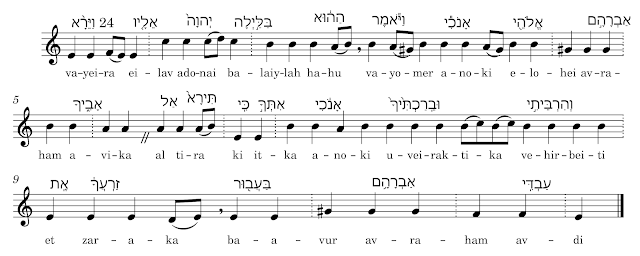
Genesis 26:24 -- I doubt that the poetic spacing is needed for all direct speech from the Most High
24 And Yahweh appeared to him in that night and he said,
I am the God of Abraham your father.
Do not fear for I am with you
and I bless you and increase your seed,
on behalf of Abraham my servant.
כד ויר֨א אל֤יו יהוה֙ בל֣ילה הה֔וא
 וי֕אמר אנכ֕י אלה֖י אברה֣ם אב֑יך
אל־תירא֙ כֽי־אתך֣ אנ֔כי
 ובֽרכת֙יך֙ והרבית֣י אֽת־זרעך֔
 בעב֖ור אברה֥ם עבדֽי
12
15
=27
9
14
7
=30
cd viira aliv ihvh blilh hhua
viamr anoci alohi abrhm abiç
al-tira ci-aitç anoci
ubirctiç vhrbiti at-zryç
bybur abrhm ybdi         

Tuesday, 1 October 2024

Poetry in Genesis - 2

 Continuing from the previous post, here is Noah with curse and blessing

Genesis 9:25-27

It is certainly possible to take the 16 syllables of bars 19 to 23 and split them into two phrases of  8 and 8. Then they fit the typical poetic line length.
25 And he said, Cursed be Canaan,
a servant of servants he will be to his brothers.
כה וי֖אמר אר֣ור כנ֑ען
ע֥בד עבד֖ים יֽהי֥ה לאחֽיו
8
10
ch viamr arur cnyn
ybd ybdim ihih lakiv
26 And he said, Blessed is Yahweh the God of Shem,
and Canaan will be their servant.
כו וי֕אמר בר֥וך יהו֖ה אל֣הי ש֑ם
ויה֥י כנ֖ען ע֥בד לֽמו
12
9
cv viamr bruç ihvh alohi wm
vihi cnyn ybd lmo
27 ♪C God will seduce Japhet and he will dwell in the tents of Shem,
and Canaan will be their servant.
כז י֤פת אלהים֙ לי֔פת וישכ֖ן באֽהלי־ש֑ם
ויה֥י כנ֖ען ע֥בד לֽמו
16
9
cz ipt alohim lipt viwcon baohli-wm
vihi cnyn ybd lmo

Besides the short passages that Loder notes, 14:19-20, 25:23, 27:27-29, there are a number of isolated verses that my Jerusalem Bible considers poetic: 8:22, 9:6, 12:3, 15:18, 16:11-12, 21:7, 24:60.

Genesis 8:22, The music does not support a poetic scansion
22 ♪g For all the days of the earth,
seed and harvest, and cold and warmth, and summer and autumn, and day and night will not cease.
כב ע֖ד כל־ימ֣י הא֑רץ
ז֡רע ו֠קציר וק֨ר וח֜ם וק֧יץ וח֛רף וי֥ום ול֖ילה ל֥א ישבֽתו
7
23
cb yod cl-imi harx
zry vqxir vqor vkom vqix vkorf viom vlilh la iwbotu
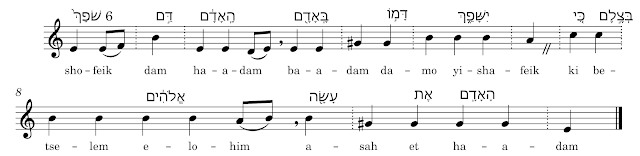
Genesis 9:6, the zaqef-qaton is in the right place to consider this as 4 short poetic lines
6 One shedding the blood of the human, by the human its blood will be shed,
for in the image of God, he made the human.
ו שפך֙ ד֣ם הֽאד֔ם בֽאד֖ם דמ֣ו ישפ֑ך
כ֚י בצ֣לם אלה֔ים עש֖ה את־האדֽם
14
13
v wopç dm hadm badm dmo iiwpç
ci bxlm alohim ywh at-hadm
Genesis 12:3: again the z-q's are placed where one could pause (but not in the middle of a word).
A formatting change does not convince me that this qualifies as poetry. Nor am I convinced that Genesis 15:18 is poetry.
Genesis 15:18
 -- when I see the sequence coming up from c or d to the Atnah, or a similar sequence returning to the tonic this strikes me as story telling and reporting, not poetics.

Part way through Genesis - more in a later post.


Monday, 30 September 2024

Poetry without poetic te'amim in the Torah

 Based on this list from @charles_loder, I thought I should look at the text and music per the deciphering key of Suzanne Haïk-Vantoura. 

So here is the first one - I admit I hadn't seen this particular one in a list before as an example of poetry.

Genesis 2:23 -- Adam re Eve

The verse certainly fits some of the characteristics of poetry if we allow the zaqef-qatan to represent a line feed. The syllables can be counted from the lyrics omitting bar 1 which has 5 syllables: 10, 6 // 7, 7. In the poetry of the psalms, the lines are measured by the verses. Here, we must break the verses down using other accents for separation.

23 And the human said, This pulse is bone of my bones and flesh of my flesh.
This one will be called woman. For from man this one was taken.
כג ויאמר֮ הֽאדם֒
ז֣את הפ֗עם ע֚צם מֽעצמ֔י
ובש֖ר מבשר֑י
לזאת֙ יקר֣א אש֔ה
כ֥י מא֖יש לֽקחה־זֽאת
22
14
cg viamr hadm
zat hpym yxm myxmii
ubwr mbwri
lzat iiqra aiwh
ci maiw luqkh-zat

I do not use the usual terms (disjunctive and conjunctive) because most accents when you look at many instances do not always fall into a single category. They may or may not have a pausal value. In all 24 books we can rely on the atnah to be a separator of the verse into two (not necessarily equal) parts.

Zaqef-qatan in the 21 books also usually implies pausal value -- my software now inserts a breath mark under some conditions.

In the 3 books, we can rely on the ole-veyored (if it is used) to separate the first part of or even a whole verse. If both these these cadence accents are used in a verse, then they reliably separate the verse into 3 parts (again not necessarily equal). The zaqef-qatan is not used in the 3 books. Sometimes, a singer might breathe at a revia in the poetry. Look at psalm 1 here for instance. On how many of the revia's would you take a breath? Perhaps the one in bar 21. The others don't invite a pause at all.

Example 2: Lamech to his wives:
Genesis 4:23-24
In the following, the revia invites a pause - but only after you have read the whole verse and observed the parallelism. With verse 23, you have to work the lines down to poetic lengths. The pause is more obvious from the rise to the C in bar 2. This is better than a long look-ahead requirement. A breath is needed at the revia. With verse 24, the work is done by the atnah.
23 and Lamech said to his wives
Adah and Zillah, Hear my voice,
wives of Lamech, give ear to what I say,
for I have slain someone for inflicting wounds on me,
a juvenile for my stripes.
כג וי֨אמר ל֜מך לנש֗יו
עד֤ה וצלה֙ שמ֣ען קול֔י
נש֣י ל֔מך האז֖נה אמרת֑י
כ֣י א֤יש הר֙גתי֙ לפצע֔י
וי֖לד לחברתֽי
(8)
10
10
=28
8
8
=16
cg viamr lmç lnwiv
ydh vxilh wmyn qoli
nwi lmç haznh amrti
ci aiw hrgti lpxyi
vild lkburti
24 ♪f For seven times vengeance for Cain,
and Lamech seventy and seven.
כד כ֥י שבעת֖ים יקם־ק֑ין
ול֖מך שבע֥ים ושבעֽה
8
8
cd ci wbytiim iuqm-qin
vlmç wbyim vwbyh

Enough for the first post in response to Charles' tweet.