Showing posts with label Delitzsch. Show all posts

Saturday, 12 March 2022

Psalms 1 again

A few minutes out of my spring break to look at how Forbes translation compares to the English translation of Delitzsch from the original German. I have left in a few notes, my syllable counts and on the left, the Hebrew and SimHebrew - On the right, Delitzsch are the odd lines and Forbes the even.
Psalms 1 Biblischer Commentar über die Psalmen von Franz Delitzsch

אַ֥שְֽׁרֵי הָאִ֗ישׁ‬ אֲשֶׁ֤ר ׀ לֹ֥א הָלַךְ֮ בַּעֲצַ֪ת רְשָׁ֫עִ֥ים
וּבְדֶ֣רֶךְ חַ֭טָּאִים לֹ֥א עָמָ֑ד
וּבְמוֹשַׁ֥ב לֵ֝צִ֗ים לֹ֣א יָשָֽׁב
1 ♪f BLESSED is the man who walketh not in the counsel of the ungodly,
And standeth not in the way of sinners,
And sitteth not in the company of scorners,
a awri haiw awr la hlç byxt rwyim
ubdrç k'taim la ymd
ubmowb lxim la iwb
15
9
8
Blessed is the man
That hath not walked in the counsel of the wicked,
Nor stood in the way of sinners,
Nor sat in the seat of the scorners:
  • Note the continuing present tense (walks, stands, sits) in D and the past tense (walked, stood, sat) in F.
  • Both translators use the traditional blessed and archaic English to be expected from the 19th century. awri - Dr.D's selig is more connected to happy - more like a shout of joy.
  • D has a tri-colon observing the ole-veyored and atnach, F observes the separator, a sign the music ignores. To have a four colon verse requires the promotion of some accents, most often revia. But this mordent is not always pausal.
  • D prefers ungodly (Gottlosen) to the Scots wicked. There is some advantage to the explicit plural.
  • Neither translator reflects the Hebrew word order in the second and third colon. The changes in word order are unnecessary in this case and disturb the thought process. D in the German keeps the Hebrew word order - bravo. This is poetry - not explanation!
My rendering is:
Happy the person who does not walk in the advice of the wicked,
and in the way of sinners does not stand,
and in the seat of the scornful does not sit. (Psalm is here. Performance here.)
כִּ֤י אִ֥ם בְּתוֹרַ֥ת יְהוָ֗ה חֶ֫פְצ֥וֹ
וּֽבְתוֹרָת֥וֹ יֶהְגֶּ֗ה יוֹמָ֥ם וָלָֽיְלָה
2 ♪C But his delight is in the Law of Jahve
And in His Law doth he meditate day and night —
b ci am btort ihvh kpxo
ubtorto ihgh iomm vlilh
9
11
But in the law of Jehovah is his delight;
And in His law doth he meditate day and night.
  • D.'s English translator has done badly. D. retains Hebrew word order and the translator muffles it with piety. The psalms are not pious. Sondern an Jahve's Gesetze hat er seine Lust (Google gets it wrong for poetic translation also).
  • ci am is a strong adversative. Used only here in the Psalms - though otherwise common.

וְֽהָיָ֗ה כְּעֵץ֮ שָׁת֪וּל עַֽל־פַּלְגֵ֫י־מָ֥יִם
אֲשֶׁ֤ר פִּרְי֨וֹ ׀ יִתֵּ֬ן בְּעִתּ֗וֹ וְעָלֵ֥הוּ לֹֽא־יִבּ֑וֹל
וְכֹ֖ל אֲשֶׁר־יַעֲשֶׂ֣ה יַצְלִֽיחַ
3 And he is like a tree planted by the water-courses,
Which bringeth forth its fruit in its season,
And its leaf withereth not,
And whatsoever he doeth, he carrieth through.
g vhih cyx wtul yl-plgi-mim
awr priio iitn byito vylhu la-iibol
vcol awr-iywh ixlik
11
15
10
And he shall be like a tree planted by the streams of water,
That bringeth forth its fruit in its season:
Whose leaf also shall not wither;
And in all that he doeth he shall prosper.
  • Again note the difference in tense in English. D allows the present. F. mixes them. I'm not good with tenses, but I think poetry is free to use what fits the present as much as possible since the present is all 'David' had and all we his readers have. His present is present to us through his words.
  • Both make verse 3 a 4-colon verse.

לֹא־כֵ֥ן הָרְשָׁעִ֑ים
כִּ֥י אִם־כַּ֝מֹּ֗ץ אֲ‍ֽשֶׁר־תִּדְּפֶ֥נּוּ רֽוּחַ
4 Not thus are the ungodly,
But they are like the chaff which the wind driveth away.
d la-cn hrwyim
ci am-cmox awr-tidpnu ruk
5
11
Not so are the wicked:
But they are like the chaff which the wind driveth away.


עַל־כֵּ֤ן ׀ לֹא־יָקֻ֣מוּ רְ֭שָׁעִים בַּמִּשְׁפָּ֑ט
וְ֝חַטָּאִ֗ים בַּעֲדַ֥ת צַדִּיקִֽים
5 Therefore the ungodly cannot stand in the judgment,
Nor sinners in the congregation of the righteous,
h yl-cn la-iqumu rwyim bmwp't
vk'taim bydt xdiqim
11
10
Therefore the wicked shall not stand in the judgment,
Nor sinners in the congregation of the righteous.
  • Both translators are overly free with la-iqumu and repeat the English stand ymd
  • D has a different word for verses 1 and 5 - see above. His translator has failed him again, probably using a standard English rendering of the time.

כִּֽי־יוֹדֵ֣עַ יְ֭הוָה דֶּ֣רֶךְ צַדִּיקִ֑ים
וְדֶ֖רֶךְ רְשָׁעִ֣ים תֹּאבֵֽד
6 For Jahve knoweth the way of the righteous,
But the way of the ungodly perisheth.
v ci-iody ihvh drç xdiqim
vdrç rwyim tabd
10
8
For Jehovah knoweth the way of the righteous:
But the way of the wicked shall perish.
  • Each uses a different rendering of the name ihvh.
  • D again prefers the present. I prefer that though I have not always rendered it so.

Sunday, 6 March 2022

Psalms 8:2-3 - comparing Delitzsch with Eusebius

 I am thinking that my conversation with Dr. D is nearing a pause. I found my initial impression of Ps. 1 in his commentary would require a lot of work to decode his thought pattern. I think I have found several attempts to make the book more accessible to the general public, so I expect my attempts would not add much at the moment. So maybe it is time to make this the 'end of the current semester' in my studies. I think I will go back to music for a while.

Given that Dr. D is sparing in his praise and excessively critical of Eusebius: "for the interpretation is superficial, and capriciously allegorical and forced", perhaps I can find a little to compare, to see what we think.

Eusebius begins his commentary (available here) with this on Psalm 8

He uses the title “for the end” here in reference to things prophesied about the consummation of the ages, and “concerning the winepresses” on account of the Churches that are existing in the whole earth, which are being referred to as “winepresses” by the law of allegory.

We see immediately that a. he is reading the Greek (lmnxk for the leader is rendered εἰς τὸ τέλος) and b. Delitzsch's accusation may be true: Eusebius of Caesarea speaks of a 'law' of allegory.

And immediately, again reading the LXX, he runs to literary figures around wine-presses and altars:

At that time there was one people, and this was Israel, to whom belonged the temple that they referred to as “tower,” and the “winepress” as the altar before the temple, according to the expression of Isaiah (Isa 5.2). The plural here of “winepresses” indicates the many altars which are divided together according to the portion of the churches. Wherefore also in the 83rd Psalm [84] which bears the same superscription, many “altars,” “dwellings” and “courts” are predicted...

So what does Eusebius do with these verses?

2. O Lord, our Lord, how marvelous is your name in all the earth! For Your magnificence is exalted high above the heavens. 3. From the mouth of infants and nurslings you have prepared praise for the sake of your enemies, to put down the enemy and avenger. (vv. 2-3)

The marvel in all the earth did not happen of old, but rather after the appearing of the Savior, when indeed “a congregation of peoples” [συναγωγὴ λαῶν] surrounded him (Ps 7.8), which is in harmony with what was said here, From the mouth of babes, etc. For he teaches that after his ascension on high the fresh and new congregation is made to consist of souls that are babes because of the regeneration, which [congregation] in Christ consists of the whole inhabited world after his ascension.  

 I love the allusion to Psalms 7:8 - but yes - he is allowing himself free association. And every time I work with the psalms, I get more from them.

To say that Delitzsch goes to the other extreme would be an understatement. His explanations are only for the few scholars of his time that understood fluently Arabic, Hebrew, Latin, Greek, and more. I frankly don't believe everything he says for a number of reasons:

  • There are lots of writers who have argued over the translation and sense of verse 2 and 3. 
  • I can't follow his arguments and I am not sure why they seem so important to him.
  • The arguments interrupt my reading.
  • Dr. D is a magnificent grammarian who is also a human, and therefore prone to error and misleading information, even though in preponderance, my sense is to trust his opinion.
  • But his approach loses me. It may even be disorganized as far as presentation is concerned.
  • The copy I am working from is seriously decrepit, missing even English words. I have seen others, but I prefer to work from an original. It forces me to read. It is clear that there is better OCR, at least one search mechanism for PDF and for Google able to interpret Greek, Hebrew, and Arabic. 
  • Some day if I ever can read it, I may take note with benefit.

I have to assume he is giving us his own translation (translated from the German) - but his comments indicate a stronger sense for wbt than indicated in the translation.

2. JAHVE, our Lord,
How excellent is Thy name in all the earth,
Who hast covered the heavens with Thy glory!
3. Out of the mouth of children and sucklings hast Thou founded a power,
Because of Thine adversaries,
To still the enemy and the revengeful.

 Opening paragraph is important and focuses on this psalm directing its thought to verse 5.

The omission of any reference to the sun in ver. 4 shews that Ps. viii. is a hymn of this kind composed in the night, or at least one in which the writer transfers himself in thought to the night season. The poet has the starry heavens before him, he begins with the glorious revelation of Jahve's power on earth and in the heavens, and then pauses at man, comparatively puny man, to whom Jahve condescends in love and whom He has made lord over His creation.

No wine-press here:

According to which it is a Philistine cithern, just as there was (according to Athenaeus and Pollux) a peculiar Phoenician and Carian flute played at the festivals of Adonis, called γίγγρας, and also an Egyptian flute and a Doric lyre. All the Psalms bearing the inscription אַל־הַגִּתִּית (viii. lxxxi. lxxxiv.) are of a laudatory character. The gittith was, therefore, an instrument giving forth a joyous sound, or (what better accords with its occurring exclusively in the inscriptions of the Psalms), a joyous melody, perhaps a march of the Gittite guard, 2 Sam xv 18 (Hitzig).

But Delitzsch does agree with Eusebius that "the subject speaking in the Psalm is not one individual, but a number of persons; and who should they be but the church of Jahve ..."

So what did I do with these verses?

I was inconsistent on the inscription - taking yl-hgitit as musing (hgh) = muttering, meditating, in both this psalm and 81. But in 84, I used at the gittith settlement. I must reconsider this.

Verses 2-3:

2. Yahweh our Lord how majestic your name in all the earth,
whose splendour is chanted above the heavens.
3. From the mouths of babies and nurslings, you have founded strength,
for the sake of your adversaries,
that you might cease enemy and vengeance.

I agree on the sense of put down / still / cease for לְהַשְׁבִּ֥ית Dr. D. writes: to restrain (lhwbit to cause any one to sit or lie down, rest, to put him to silence). My glosses for this word seek its variations without appealing to cognate languages, but simply to see the force of the verb wbt. I would rather accept Sabbath without force. It is strange that this word takes the sense of both rest and destroy in its semantic range.

Music of the accents in the Hebrew Text
Performance here.

Perhaps I will continue with this psalm...

Saturday, 5 March 2022

The first musical example in Delitzsch Physiology and Music

This is a very disappointing section. There is great detail on pronunciation and so on in this book, but next to zero in the music section about the music itself. And precious little about accents. The images were clearly included as an afterthought without serious reflection as to how to present or process them.

In accordance with our topic, we were only concerned with the singing lecture that follows the accent signs of the Old Testament text. Excluded were the two recitative-like performances of the Psalms, the ordinary and the antiphonal one of Ps. 119, divided between the prayer leader and the congregation; excluding the peculiar melody of the 5th chapter of the Jeremiah Lamentations. These three sages are the same for each verse and are not tied to the accents. The musical element of Hebrew grammar is the accentuological one. The purpose of the three supplements is to give an idea of ​​this, for example. The beginning of Genesis was deliberately not chosen as a sample of the Pentateuchic cantillation: it is relatively monotonous because many accents are not used there. As a sample of the prophetic cantillation, Isaiah Cap. 1, but this is the prophetic pericope for the mourning Sabbath before the day of the destruction of Jerusalem, which is also exceptionally sung in the mourning tune of the Jeremiah lamentations. The above pieces of music give the three different intonations of the accents according to the usual ways. The teacher S. BAER was commissioned with the design with the assistance of Mainzer and Frankfurter Chazanim (presingers). Music Director Dr. LANGER encouraged me to publish these samples, which he considered to be national and full of character.

As usual, the musician and the grammarian communicate in their separate silos and cannot get the ideas across. In our day, music has often been criticized by the ordained preachers (though not always). During the pandemic, it was the musicians who could actually make the spiritual point through their virtual performance and from what we have seen, they have excelled in their work.

I could probably get more from the full text, but I think the reward is not worth the effort at the moment. I am not going to learn physiology in German after all. The copy I have been working on is very poor in its OCR in any case.

"The Intonation of the Accents in the Ashkenazi (German-Jewish) way"
(Page 1 Ex 13:17-18a.)

Page 2 of Exod. 13:17-22

Here is a limited 'zarqa-table' for two verses of this passage from Exodus. The image (one of two) reveals that either the text fails to include the zarqa or the zarqa is equivalent to revia in this example.  The zarqa is definitely in the text of the Aleppo Codex.  

The accents need analysis. Again following this transformation manually is slow and painstaking work. Usually I produce the music by automation, but here I am copying by hand and following the application of the accents to the text. This Torah portion is not as consistent as the haftarah in the prior post in the series.
Two verses 17 and 18 of the above showing the accents and their motifs.

Besides the apparent equivalence of the shape of zarqa darga and revia (bars 1, 3, 23), the mahpakh (bar 7) like the pazer in verse 21 (see above, Page 2 - middle second line) rises to a high g. This was obviously written for a tenor. The tessitura in the Haïk-Vantoura keys rarely rises that high. The mahpak (on derek below) simply changes the reciting note to the c. The pazer at the beginning of verse 21 is not such a reach: 
Exof.17:21 pazer and telisha qetana

The variation in interpretation of the munah, red circles in the above example, is a bit perplexing. One can see also how in the absence of the concept of current reciting note, that the underlay for the words would be highly subject to variation. There is no clear rhythmic concept in the bars of the traditional music, because the accents of the text do not correspond with the down beat.

Nonetheless, the potential for beauty is available for a well instructed singer of recitative in both the traditional trope and the trope with the variable reciting note concept. I have compared these in a previous post. There is more tonal variety in the Ashkenazi above than in Jacobson and there are several similarities and differences. I can see that comparing zarqa tables could be a suitable way of developing a thesis about the changes in these tropes over time and over geography.
The same two verses 17 and 18 using the Haïk-Vantoura deciphering key.

Thursday, 3 March 2022

Theology and the Psalms - preliminaries

 Dr. D in his first statements on preliminaries asks first what is our standpoint — and he underlines three possibilities:

  • the standpoint of the poet, 
  • or the standpoint of the Old Testament church, 
  • or the standpoint of the church of the present dispensation
This will take some digging since these are not how I see my standpoint today. Dispensation is a term I leave to one side. The assemblies of the emerging faith of Torah and Psalms I do not characterize as 'church'. There must be a standpoint of the poet. That is where I began. I don't expect it encompasses the totality of either Torah or Psalms.

But I must also stand in my own time, past the era of the imposition of salvation (as if that were even possible!) and into the cacophony of bullying such as is seen in China's century of humiliation —following the opium wars, Russia's pride and fear —following the second world war, Ukraine's terror today, the inability of Canada (temporarily we hope) to manage false claims of freedom and the American right's inability to count, to trust, to be civil, and the overall failure to manage "whatsoever things are true, whatsoever things are honest, whatsoever things are just, whatsoever things are pure, whatsoever things are lovely, whatsoever things are of good report;". 

The notion of what is 'Christian' is so torn from its roots that it is almost completely dead for lack of suitable nutrients and water. The problem has been from the beginning of course, but I cannot put to one side the Shoah, nor the facts of climate change and the human capacity for self-destruction through nuclear annihilation. We have become so good through our sin at destroying each other. There is not one that doeth good, as the poet says.

A few 'facts' that trouble me and 'theories' that encourage me:

'Facts' - the blockaders in Canada did not and do not speak for most of us in this country. A blockade that exposes its own stupidity and makes itself obnoxious is not speaking to any notion of freedom that can be acceptable. If indeed they die for their sins, well let that be an end of them. Sin has no resurrection. Vindication requires angels beholding the face of God, and the childishness of these mockers does not qualify. Those who support them are equally obnoxious. I am sure they include many who think that the US election was stolen. The end of this lie has yet to be seen. The Canadian government's response was overly reasonable. These people could not see the will of God for our freedom but they should be able to see the will of the people they have damaged. Let them live then and pay their dues for the consequences of their actions. Ignorance masking itself as faith, and bluster masking itself as hope, stand against love, the greatest of these three gifts. The obnoxious do not will the good of others.

Encouraging 'theories' - we live in a time of immensely productive science. There are some doing good for the environment, some for the fauna and flora of the world, and some for the knowledge of the beginnings and endings of the cosmos, the dark matter that helped the visible form into stars and galaxies, that shapes the gravity of our situation cosmically and caused light to shine in the universe. If we as a species want to continue, we must incorporate a full science into our faith. 

I am also encouraged by faithful scholarship applied to the source of our ability to read, write, and think across the centuries. It is not a bad thing to pay attention to this emergence of knowledge, physical and spiritual. We still know 'in part'. We are all still bound by our assumptions. 

I wrote the above before the current war. What consequences are there for power and lies, evil and wickedness in this world? These will be determined, but putting aside the mad actions of a deranged and self-deluded man attempting to mislead everyone with his lies, if we all survive another 10 years, I hope we will see the international criminal court bring Putin to justice for war crimes. Anyone who praised him is as sick as he is. 

The psalms end in praise because Yahweh relieves the afflicted. He humbles the wicked to earth. And the job is given to those who know mercy: to bind this sovereign in chains, and this self-glorifying one with iron fetters. 

The oppressed of the earth know this is true and are showing their support for the one who has been attacked. We don't need correct theology to figure this out. 

It turns out that when I read the preliminaries, as Delitzsch calls this section, they raise so many questions about his thinking that I feel I am in an episode of Vienna Blood. So I will leave any further immediate comment. Dr D's theological summary is as would be expected, thorough, well-informed, and coherent for him. [He only uses the punish word twice in the theological preliminaries]. 

He does have a section that justifies wrath in the face of such injustice as we see today not only from Putin and his cronies, but from all the rich whose wealth is extracted from the people to their detriment and to the detriment of their earthly homes, "vine and fig tree" as given to them.

But as to the so-called imprecatory psalms, in the position occupied by the Christian and by the church towards the enemies of Christ, the desire for their removal is certainly outweighed by the desire for their conversion: but assuming, that they will not be converted and will not anticipate their punishment by penitence, the transition from a feeling of love to that of wrath is warranted in the New Testament (e. g. Gal. v. 12), and assuming their absolute Satanic hardness of heart the Christian even may not shrink from praying for their final overthrow. For the kingdom of God comes not only by the way of mercy but also of judgment; and the coming of the kingdom of God is the goal of the Old as well as of the New Testament saint (vid. ix. 21, lix. 14 and other passages), and every wish that judgment may descend upon those who oppose the coming of the kingdom of God is cherished even in the Psalms on the assumption of their lasting impenitence (vid. vii. 13 sq. cix. 17).

[I doubt that the Gal. 5:12 proof text is apt, Dr. D. It is a fit of pique from Paul. We don't need proof texts for this kind of judgment at this stage of human learning - though it remains to be seen if we have maturing within our current international consensus against the aggression of Russia - Gog or no Gog.]

As for what the OT and NT distinguish - here Dr. D and I are going to diverge. While I see the fullness of the Firstborn, I do not doubt that 'life after death' in an everlasting linearity is a misunderstanding of the eternal. We are still exploring the extremes of our knowledge of the heavens and the earth and there is no final theory that could have been expressed pre-science any more than the Patristic authors who had no Hebrew could effectively do grammar with Dr. D. As I quoted him in an earlier post, there is still more to come.

I will leave you dear reader to chose for yourself whether to read the whole epub section for this beginning. I want now to see more into what Delitzsch writes for a psalm. I may start with Psalms 1 - but may or may not proceed in sequence. In any case this is a long process, up to two years if I do the whole Psalter. And I have to intersperse it with other things, like music and grandchildren, and so on.

Wednesday, 2 March 2022

A scientific approach - grammatico-historico critical under-structure

 O what a pile of loaded words. Approach - science - grammar - history - critical - under-structure. (The phrase is in Keil and Delitzsch, Commentary on the Psalms p 48.)

What framework (under-structure - infra-structure) do we possess - to get into the life, heart, and mind of another whose work we know through their writing, our view of their culture and history, our understanding of their language and our critical faculties applied to the hints of their experience?

Is the created order capable of self-understanding? Will anyone see clearly? Does grammar help?
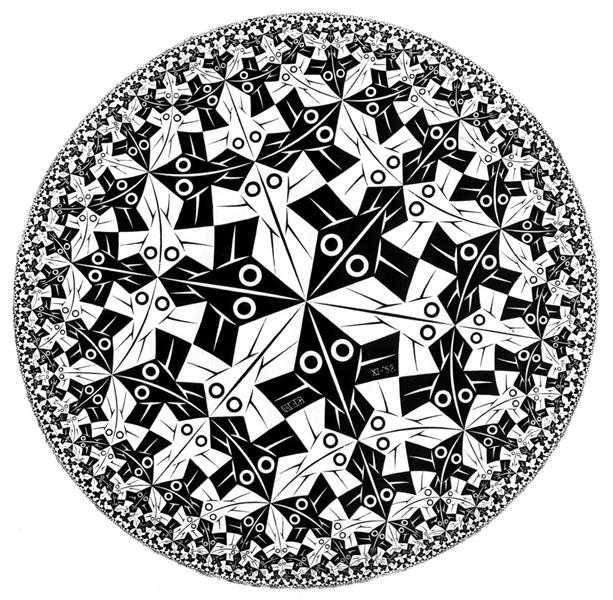
Escher - reducing infinity to a circle
Enough of the rhetorical questions. Another book I am delighting in is The End of Everything, Astrophysically Speaking. Our brains have driven us to the precision of mathematics for the description of physical theory. But we struggle to escape our fundamental assumptions. When they are violated by observation, the theories change. We strive for completeness and discover uncertainty and probability at every stage.

As I reread @Astrokatie I am struck by the limits we have to place on ourselves from the cosmological principle to labeling things as dark (matter / energy) to our having to reduce our visualizations to 2 dimensions - with some very clever results. With the speed of light being constant, I feel very alone in my observational universe where everything I see is already past by at least a few nanoseconds. Why should I have confidence in grammar?

Because it's fun to try things. And if we are to love as we are loved - in the presence - then we must try to understand with precision. And also with imprecision, the imprecise tools we have to hand: natural language, music, and the immeasurables of our lives.

Let's hope that we have a modicum of success in our fun and are not destroyed by criticism that calls our interpretation "superficial, and capriciously allegorical and forced" as Dr. D names Eusebius in his ignorance. But he has kinder words for Athanasius: His book: πρὸς Μαρκελλῖνον εἰς τὴν ἑρμηνείαν τῶν ψαλμῶν ([to Marcellinus on the interpretation of the Psalms] in the same vol. of the Benedictine edition) is a very beautiful essay. He has good words for several others, notably

Hilarius Pictaviensis, in the Western church, wrote his allegorizing (after Origen's example) Tractatus in librum Psalmorum with an extensive prologue, which strongly reminds one of Hippolytus. We still have his exposition of Ps. i. ii. ix. xiii. xiv. li. lii. liii-lxix. xci. cxviii-cl (according to the numbering of the LXX); according to Jerome (Ep. ad Augustin. cxii) it is transferred from Origen and Eusebius. It is throughout ingenious and pithy, but more useful to the dogmatic theologian than to the exegete.

 His knowledge of the ancients is clearly extensive - 

He [Hilary] and Ambrose have pronounced the highest eulogiums on the Psalter. The latter says: Psalmus enim benedictio populi est, Dei laus, plebis laudatio, plausus omnium, sermo universorum, vox Ecclesice, fidei canora confessio, auctoritatis plena devotio, libertatis Icetitia, clamor jucunditatis, Icetitia? resultatio. Ab iracundia mitigat, a sollicitudine abdicat, a moerore allevat. Nocturna arma, diurna magisterial scutum in timore, festum in sanctitate, imago tranquilliiatis, pignus pads atque concordice, citharce modo ex diversis et disparibus vocibus unam exprimens cantilenam. Diei ortus psalmum resultat, psalmum resonat occasus. 

Via Google here is a translation:

For the psalm is the blessing of the people, the praise of God, the praise of the people, the applause of all, the speech of all, the voice of the Church, a melodious confession of faith, full of authority, devotion, freedom, craving, crying of joy, craving! a result. He calms them from anger, disowns them from anxiety, lifts them up from grief. Nocturnal weapons, a newspaper magisterial shield against fear, a feast in sanctity, an image of tranquility, a pledge of pads and a harmonious harp that expresses one song from different and different voices. The rising of the day echoes the psalm, the setting echoes the psalm. 

We can go on with Delitzsch and read his brief views of Chrysostom, Theodore, Augustine, and many others - this chapter is now corrected (in haste) and available for reading including his sweeping criticism.

The defects to be found in the ancient exposition of the Psalms are in general the same in the Greek and in the Western expositors. To their want of acquaintance with the text of the original  was  added their unmethodical, irregular mode of procedure, their arbitrary straining of the prophetic character of the Psalms (as e. g. Tertullian, De spectaculis, takes the whole of Ps. i as a prophecy concerning Joseph of Arimathea), their unhistorical perception, before which all differences between the two Testaments vanish, and their misleading predilection for the allegorical method. In all this, the meaning of the Psalms, as understood by the apostles, remains unused; they appropriate it without rightly apprehending it, and do not place the Psalms in the light of the New Testament fulfilment of them, but at once turn them into New Testament language and thoughts.

 But there must be a contrast:

Wherever you turn, writes Jerome to the widow of Marcellus from the Holy Land, the plowman holding the corn plow sings Hallelujah, the sweaty reaper calls himself psalms, and, pruning down the curve with a coarse scythe, the vinedresser sings something of David. These are the songs in this province, these (as it is commonly said) amorous songs, here the whistle of the shepherds, these the weapons of culture. The delights of country life he commends to Marcella in the following among other words: In truth the field is painted with flowers, and among the plain birds the Psalms will be sung sweeter. In Sidonius Apollinaris we find even psalm-singing in the mouth of the men who tow the boats, and the poet takes from this a beautiful admonition for Christians in their voyage and journey through this life:

The winding dance of the helciarum
Hallelujah to the banks
He raises his friend to Christ with a shout.
Sing thus, thus, sailor, traveler!

He has little good to say of the Middle Ages - 

The mediaeval church exposition did not make any essential advance upon the patristic... If you know one of these expositors, you know them all. The most that they have to offer us is an echo of the earlier writers. By their dependence on the letter of the Vulgate, and consequently indirectly of the LXX, they only too frequently light upon a false track and miss the meaning. The literalis sensus is completely buried in mysticae intelligentiae. Without observing the distinction between the two economies, the conversion of the Psalms into New Testament language and thought, regardless of the intermediate steps of development, is here continued. 

but this makes me think that in the 19th century, if you were a real scholar with good access to libraries and both Christian and Jewish tradition, you might have been able still to read almost everything that had been written about the Psalms. I get the impression from Dr. D that he has. 

He moves from this survey of Christian tradition to the Hebrew tradition: 

The interpretations of passages from the Psalms scattered up in the Talmud are mostly unsound, arbitrary, and strange. And the Midrash on the Ps., ...contain far more that is limitlessly digressive than what is to the point and usable.

He is much more positive about developments after 900 beginning with Saadia Gaon. He mentions the Karaites - a group I must find out more about - and then he notes the work of

Rashi (d. 1105)... he has not only treasured up with pithy brevity the traditional interpretations scattered about in the Talmud and Midrash, but also (especially in the Psalms) made use of every existing grammatico-lexical help. 

Aben-Ezra of Toledo (d. 1167) and David Kimchi of Narbonne (d. about 1250) are less dependent upon tradition, which for the most part expended itself upon strange interpretations. The former is the more independent and genial, but seldom happy in his characteristic fancies; the latter is less original, but gifted with a keener appreciation of that which is simple and natural, and of all the Jewish expositors he is the preeminently grammatico-historical interpreter. 

Of these and others in the Jewish traditions, he notes that 

Their knowledge of the Hebrew gives all these expositors a marked advantage over their Christian cotemporaries, but the veil of Moses over their eyes is thicker in proportion to their conscious opposition to Christianity.

He moves his survey to the reformation

Now, however, when a new light dawned upon the church through the Reformation — the Light of a grammatical and deeply spiritual understanding of Scripture, represented in Germany by Reuchlin and in  France by Vatablus — then the rose-garden of the Psalter began to breathe forth its perfumes as with the renewed freshness of day;  and born again from the Psalter, German resounded from the shores of the Baltic to the foot of the Alps with all the fervour of a newly quickened first-love. "It is marvellous"—says the Spanish Carmelite Thomas a Jesu,— "how greatly the hymns of Luther helped forward the Lutheran cause. Not only the churches and schools echo with them, but even the private houses, the workshops, the markets, streets, and fields." 

Calvin introduced the Psalms in Marot's version as early as 1542 into the service of the Geneva church, and the Psalms have since continued to be the favorite hymns of the Reformed church. Goudimel, the martyr of St. Bartholemew's night and teacher of Palestrina, composed the melodies and chorales. The English Established church adopted the Psalms direct as they are, as a portion of its liturgy, the Congregational church followed the example of the sister-churches of the Continent. 

The survey goes on to the post-reformation through Romish expositors (1550-1650), its decline into scholasticism, the protestant decline c 1745, becoming "torpid", and even losing "revealed religion", degenerating into a "merely literary, or at most poetical, interest." Then he is right up to his colleagues that were published in his present day. 

It has been the honour of Herder that he has freed psalm-exposition from this want of taste, and the merit of Hengstenberg (first of all in his Lectures), that he has brought it back out of this want of spirituality to the believing consciousness of the church.... De Wette's commentary on the Psalms (first published in 1811, 5th edition by Gustav Baur, 1856) was far more independent and forms an epoch in exegesis. 

He has both praise and criticism for his peers

We stand neither on the side of this scepticism, which everywhere negatives tradition, nor on the side of that self confidence, which mostly negatives it and places in opposition to it its own positive counter-assumptions; but we do not on this account fail to recognise the great merit which Olshausen, Hupfeld and Hitzig have acquired by their expositions of the Psalms. In Olshausen we prize his prominent talent for critical conjectures; in Hupfeld grammatical thoroughness, and solid study so far as it is carried; in Hitzig the stimulating originality everywhere manifest, his happy perspicacity in tracing out the connection of the thoughts, and the marvellous amount of reading which is displayed in support of the usage of language and of that which is admissible according to syntax. ...None of these expositors are in truly spiritual with the spirit of the psalmists.

He longs for some rivalry with the Romish and the Greek church.

Would that the zealous industry of Bade and Reinke, the noble endeavours of Schegg and König, might set an example to many in the Romish church! Would that also the Greek church on the basis of the criticism of the LXX defended by Pharmakides against Oikonomos, far surpassing the works on the Ps. of Nicodimos and Anthimos, which are drawn from the Fathers, might continue in that rival connection with German scholarship...

Non plus ultra is the watchword of the church with regard to the word of God, and plus ultra is its watchword with regard to the understanding of that word. Common work upon the Scriptures is the finest union of the severed churches and the surest harbinger of their future unity. The exposition of Scripture will rear the Church of the Future.

 Dr. D has laid out an extensive framework: Approach - science - grammar - history - critical - under-structure. Those are his words. I will continue with the last section of his introduction on a preliminary theology. I should have studied this teacher years ago - but we all have our own paths to tread. [And I know I am going to take his strict conservative approach to the text with a grain of salt.]

Tuesday, 1 March 2022

Surprise - another whole introductory section

Back to the main task - the commentary on the psalms. The music is interesting and the zarqa table helpful - but I am not convinced by the traditional tropes because they use too little of the information embedded in the accents. Still - I had to pay attention. And I may go back to fixing and translating the German of his music book - learning German at this stage of my life would be a challenge. I read it because I have sung lots of it, but I don't have much fluency. 

But there is a section on the history of the exposition of the psalms to do first. And I did not cover all the detail in the section on early translations. There will be more in this new section. To read the whole thing, the epub is gradually taking shape. 

Hopefully I have time to let Delitzsch be my teacher for a while yet. I am cautious. He is clearly a Christian with these sentiments: 

The Old Testament according to its very nature tends towards and centres in Christ. Therefore the innermost truth of the Old Testament has been revealed in the revelation of Jesus Christ.

And I am myself Christian - but I am more aware than he of the way in which New Testament assumptions have been dismantled over the past 150 years. When he says 

He revealed to His disciples the meaning τοῦ συνιέναι τάς γραφάς Luke xxiv. 44 sq. Jesus Christ's exposition of the Psalms is the beginning and the goal of Christian Psalm-interpretation. 

Am I to assume that my tradition has correctly interpreted the psalms according to this revelation of Jesus Christ? Whom should I ask? This is a serious question. Indeed the Scriptures speak of Christ - but when he speaks to me through them, he does not glorify himself. But he shows the character of Yahweh-God who is praised in these psalms. And this has been true of Christendom in part - but also in part, Christendom has done things that are completely outside the character of Yahweh. I find that when we really read what is in the psalms, it is not our theology - i.e. right or wrong beliefs, that is in question, but our actions in imitation of the kindness we see. As church whether institution or individual, we should not be in the position of the bully, or in a conflict of interest because we are beholden to some social situation.

Here is what Dr. D is doing in his work as a grammarian: 

But we must not seek in the New Testament Scriptures what they are not designed to furnish, viz., an answer to questions belonging to the lower grades of knowledge, to grammar, to cotemporary history and to criticism. The highest and final questions of the spiritual meaning of Scripture find their answer here; the grammatico-historico critical under-structure, — as it were, the candlestick of the new light, — it was left for succeeding ages to produce.

Now there's a thought - and close to what he reveals about his love of language in the foreword of the Music book (Physiologie Und Musik in Ihrer Bedeutung Für Die Grammatik: Besonders Die Hebräische); 

When I was called back to the local university after twenty-one years of work in Rostock and Erlangen, where I had now completed the professorship a full 25 years ago; I heard from several quarters that I was to be primarily concerned with preserving and cultivating the solid grammatical tradition established by my predecessor in the exegesis of the Old Testament. 

... And this expectation also agrees with my personal inclination, because theology and linguistics have always fought for supremacy in me, and in the course of my studies I have become more and more convinced that theology, as an essentially historical science that is based on documented facts and has to be built on the foundations of grammatical interpretation.

I am really looking forward to carrying on this unexpected journey into the past. 

Delitzsch - Music he was familiar with - 2

Isaiah 42:5-10, music from 1868 in Delitzsch, Physiologie und Musik in ihrer Bedeutung für die Grammatik

Isaiah 42:5-10 traditional German mid 19th c
The above reads as G major but cadences in D major and never uses the leading tone except for the cadences. If we look at the accents, we find these: (see the chart in the prior post). I will with some work see a consistent definition of the accents in this section above. I suspect the zarqa table will be oriented around various melismatic idioms and that different accents below the text are all harmonically similar. Nonetheless a melody is more evident than I expected. Given that the effective key is D major, the notes all revolve around the subdominant g. There is some movement to recitation on both f# and A. 

כֹּֽה־אָמַ֞ר הָאֵ֣ל ׀ יְהוָ֗ה בּוֹרֵ֤א הַשָּׁמַ֙יִם֙ וְנ֣וֹטֵיהֶ֔ם רֹקַ֥ע הָאָ֖רֶץ וְצֶאֱצָאֶ֑יהָ

נֹתֵ֤ן נְשָׁמָה֙ לָעָ֣ם עָלֶ֔יהָ וְר֖וּחַ לַהֹלְכִ֥ים בָּֽהּ

The music for verse 5 is as follows: 

reciting note e (silluq default) ornament tarsin, reciting note B munah, ornament revia, reciting note C mahpakh, ornament qad, qad, reciting note B, ornament z-q, recitation on f then g# then the mid-point rest (atnach) ^A 

following the rest, reciting note C qadma, reciting note B munah, ornament zaqen-qatan, then return to the tonic via g# (tifha) f (merkha) e (silluk).

The raw material below is readable by a human singer and also by automation using deciphering key by Suzanne Haïk-Vantoura. There is no variation in the interpretation of the hand-signals below the text. 

There is no pause after Adonai because the description that follows is part of the identification of this speaker. The only cadences marked are at the subdominant marked // (atnah) and the rest on the tonic between verses (silluq).

For all 6 verses this is the sequence of notes and ornaments. 

e tar,B rev,C qad,qad,B z-q,f g# ^A C qad,B z-q,g# f e 
e c d f e g# B ^A rev,d f g# f e 
e g# B ^A C qad,z-q,f g# f e 
e f g# B ^A qad,B e z-q,g# e 
e g# ^A e qad,B z-q,f g# f e 
C e qad,B z-q,g# B ^A C qad,z-q,g# e 

Isaiah 42:5-10 - interpreted according to the deciphering key of Suzanne Haïk-Vantoura

You have to work at this - the management of all the pieces is very difficult. Here's verse 6 very much simpler. No ornaments except revia.
אֲנִ֧י יְהוָ֛ה קְרָאתִ֥יךָֽ בְצֶ֖דֶק וְאַחְזֵ֣ק בְּיָדֶ֑ךָ
וְאֶצָּרְךָ֗ וְאֶתֶּנְךָ֛ לִבְרִ֥ית עָ֖ם לְא֥וֹר גּוֹיִֽם
e c d f e g# B ^A rev, d f g# f e
(silluq) darga galgal merkha (metheg/gaia - not music - Unicode design error) tifha munah atnach //
revia galgal merkha tifha merkha silluq

And here's an image of the first 2 verses showing the (relative) consistency of the mapping of phrase and melisma to the accents. Of the various ornaments zaqen-qatan is a mordent in both mappings, tarsin and revia are ornaments, though different in each system, some of the phrasings look similar to Burns phrasings, but the lack of recognition of the underlying scale as applied by Haïk-Vantoura diminishes any possible comparisons.
Almost a zarqa table


Monday, 28 February 2022

Delitzsch - music he was familiar with

I have the tools in my toolshed, now I must continue to pick them up and use them. This music in Delitzsch's Physiology and music in its meaning for grammar, especially the Hebrew, has little similarity to that of Haïk-Vantoura's deciphering key, but I must compare a few notes.

I don't intend to read the whole of this thesis, here's my guesses at some of the German with the help of some Biblical Scholars on FB and Google  - if I were to read through the whole thing I might even become more fluent in German!

It is true that those newly discovered means of physical observation are of greater importance to music than to grammar. But music engages with the grammar of Hebrew as it does with the grammar of no other language. (Aber in die hebräische Grammatik greift auch die Musik ein wie in die Grammatik keiner andern Sprache.)

The Hebrew grammar has the Old Testament scripture as its next challenge, (Vorwurf) and the text of this is verse by verse provided with musical signs which indicate the note value of the individual words for the singing performance; every verse of the OT.

The text forms a musical period regulated by these tones and consisting of antecedents and consequents with their cadenzas.

These tones are called accents. They are at the same time punctuation marks in that, breaking down into separators and connectors, bisect the verse, its two halves, and this sound and meaning ful sign-writing consists of about 30 different small figures and configurations (according to one count); that the accentuation of the 3 books, which are distinguished by their particularly melodic manner of delivery: Psalms, Job and Proverbs, follows a system which differs from that of the other books and that the sequence of accents in both systems is determined down to the last detail by fixed laws and is entirely arbitrary: so it is clear that it is no easy task to familiarize oneself with the subtleties of this character writing...

I allow myself, to cite but two examples, to doubt that even one of the greatest living grammarians, sitting here before me, could give an immediate answer to the question under what conditions a metheg in a connecting accent and especially in a Meajla [No idea what this word means] is transformed, or to the question according to which rules in the 21 and especially the 3 books Gaia is added to the Sheba at the beginning of the word i.e. the shortest vowel sound, with which the first part of the word is to be spoken, is given a tone length that enables it to carry the melody of the word.

Here we learn something of Hupfeld who "possessed the musical ability and inclination and knowledge to spend most of his time at the piano in the afternoon with spiritual music to refresh."

But who would have given an answer to questions such as why Mercha Patchta takes the place where Mehupnck Pashta should stand, and why Mercha Tebir should stand where Darga Tebir should stand, and why no Zakef should follow Pazer or Telisha — these are questions , to which the most shrewd mind, by logical standards, cannot answer; here such insight into the theory of composition as that Westphal was so fortunate to bring to classical metrics is the indispensable prerequisite

These are interesting questions for those who attempt to describe music in words without knowing the music! Perhaps they have to do with musical line, instrumental possibilities, and conventional cadences in the first and second temple periods. But how to decode the signs? Here an example comparative image of the music he knows based on these common but circular questions without end. Whether I attempt to solve the OCR German problems or not remains to be seen. But I have a good solution to the musical issue.

Lam 1:1-3 from Franz. Delitzsch ; Physiologie Und Musik in Ihrer Bedeutung Für Die GrammatikBesonders Die Hebräische

Compare with the version using the Haïk-Vantoura deciphering key. (I could not have developed the above music into a choral piece as I have done here with the music below.)

My starting point was this raw material:
Lam 1:1-3 Raw material derived from the Hebrew text


Delitzsch on Translations of the Psalms

If I had read this overview of ancient translations, (even if I could have at the time), I would perhaps never have started my own project. Fortunately reading it now, I can begin to appreciate some more of the complexity I took on and take on, but I am no longer starting from scratch.

Delitzsch displays immense learning here as one might expect. This is not a narrow study of 'the word' but an appreciation of history, and reception, and conflict, and a continuing hope that this middle wall of partition that he knows, will not stand.

He begins with the LXX translation of the Psalms, noting that

The story of the LXX (LXXII) translators, in its original form, refers only to the Thôra; the translations of the other books are later and by different authors. All these translators used a text consisting only of consonants, and these moreover were here and there more or less indistinct; this text had numerous glosses, and was certainly not yet as later, settled on the Masoretic basis. in ignorance of the higher exegetical and artistic functions of the translator in ignorance of the higher exegetical and artistic functions of the translator and frequently the translation itself is obscure". 

Warning noted.  He cites a host of texts I am not aware of - perhaps I should look them all up. (See note 1 in this section in his book.) They reveal more of the substance of the Psalter as received over the centuries. Had he read them all?

Nonetheless he gives first place to the LXX:

This version, at the outset, created for Christianity the language which it was to use; for the New Testament Scriptures are written in the popular Greek dialect (κοινή,) with an Alexandrine colouring. And in a general way we may say that Alexandrinism moulded the forms beforehand, which Christianity was afterwards to fill up with the substance of the gospel. As the way of Jesus Christ lay by Egypt (Matth. ii. 15), so the way of Christianity also lay by Egypt, and Alexandria in particular.

Then  he makes the claim: "Next to the Book of Isaiah, no book is so frequently cited in the New Testament as the Psalter."

It looks more like a tossup to me between these two and probably depends on how you measure it. And I would suggest that for translation of the psalms, one should be cautious in translating according to the New Testament's usage. I would not want to fall into the black hole of NT theology on its way to the destruction of the Jews in the middle of the 20th century. Delitzsch would not want to either, but he is surrounded by those who were and are not aware of this tendency to superiority and the abuse of such thoughts. But this anticipates his preliminaries on theology.

He spends some time on the targum of the Psalms, in convoluted prose

But as there was a written Targum to the Book of Job even during the time of the Temple, there was also a Targum of the Psalms, though bearing in itself traces of manifold revisions, which probably had its origin during the duration of the Temple. In distinction from the Targums of Onkelos to the Pentateuch and of Jonathan to the minor Prophets the Targum of the Psalms belongs to the so-called Jerusalem group, for the Aramaic idiom in which is written, — while, as the Jerusalem Talmud shows, it is always distinguished in no small degree from the Palestinian popular dialect as being the language of the literature — abounds in the same manner as the former in Greek words (as אנגלין άγγελοι, אכסדרין εξέδραι, קירים κύρίος), and like it also closely approximates, in sound and formation, to the Syriac.

What do I make of his words? All the Hebrew look like Greek transcribed.

Then he moves to the Peshito:

The third most important translation of the Psalms is the Peshito, the old version of the Syrian church, which was made not later than in the second century. Its author translated from the original text, which he had without the vowel points, and perhaps also in a rather incorrect form: as is seen from such errors as 

  • xvii. 15 (amuntç [your faithfulness - used 7 times in the Psalter] instead of tmuntç [your similitude - unique in the Psalter] ), 
  • lxxxiii. 12 [13] (wdmo vabdmi, dele eos et perde eos instead of witmo ndibmo), 
  • cxxxix. 16 (gmli retributionem meam [my payback] instead of golmi [my embryo]). 
  • In other errors he is influenced by the LXX, as lvi. 9 (bngdk [near you] LXX ἐνώπιόν σου instead of bnadç [in your bottle]),
  • he follows this version in such departures from the better text sometimes not without additional reason, as xc. 5 [4 - I don't see any reason other than a typo for the verse #] (generationes eorum annus erunt, i. e. LXX τὰ ἐξουδενώματα αὐτῶν ἔτη ἔσονται [or like a watch in the night]), 
  • cx. 3 (populus tuus gloriosus, i. e. ymç ndbvt in the sense of ndibh), Job xxx. 15, nobility, rank, LXX μετὰ σοῦ ἡ ἀρχὴ. 
The thought process as you can see is wide ranging, multi-lingual and occasionally lacks sufficient explanation. He was not writing for the common reader of the Bible, nor as a teacher. I suppose he was writing for a few friends who were also scholars.

Speaking of the translator of the Peshito, he notes (unfortunately without substantiation):

It is evident that he was a Christian from passages like xix. 5, cx. 3, also from lxviii. 19 comp. with Ephes. iv. 8, Jer. xxxi. 31 comp. with Hebr. viii. 8; and his knowledge of the Hebrew language, with which, as was then generally the case, the knowledge of Greek was united, shews that he was a Jewish Christian.

Moreover the translation has its peculiar Targum characteristics: tropical expressions are rendered literally, and by a remarkable process of reasoning interrogative clauses are turned into express declarations: lxxxviii. 11 -13 is an instance of this with a bold inversion of the true meaning to its opposite. In general the author shuns no violence in order to give a pleasing sense to a difficult passage e. g. xii. 6b, lx. 6. The musical and historical inscriptions, and consequently also the slh (including hgion slh ix. 17) he leaves untranslated, and the division of verses he adopts is not the later Masoretic.

I cannot find any reason to believe or disbelieve what he has written above. But I would need the Greek to see his point. At the moment I can only find an English translation and there is no interrogative in 89:11-13 to turn into a declarative. Similarly 12:6b, 60:6, - perhaps these comments will be more informative when I get (if I get there) to the detailed part of the commentary. 

He goes next to the translation by Aquila of Pontus ("a proselyte from heathenism to Judaism") - heathenism - now there's a 19th century bias!

Not to lose any of the weighty words he translates the first sentence of the Thôra thus: Ἐν κεφαλαίῳ ἔκτισεν ὁ Θεὸς σὺν (את) τὸν οὐρανὸν καὶ σὺν (את) τὴν γῆν.

I think this is supposed to be funny. I have a bit of a hard time with the associations of glosses. I don't have enough Greek to enjoy this. But Delitzsch praises him as a translator in any case. He follows with a mention of Theodotion, building on Aquila, then Symmachus "more decidedly and independently than Theodotion, and distinguishes himself from Aquila by endeavouring to unite literalness with clearness and verbal accuracy: his translation of the Psalms has even a poetic inspiration about it."

Finally he has a section on the Latin Psalters - praising Jerome:

Jerome's translation of the Psalter, juxta Hebraicam veritatem, is the first scientific work of translation, and, like the whole of his independent translation of Old Testament from the original text, a bold act by which he has rendered an invaluable service to the church, without allowing himself to be deterred by the cry raised against such innovations.

Sunday, 27 February 2022

Delitzsch - presentation on music in the church

 Came across this by accident: 

while looking for a copy of Delitzsch Physiologie und Musik in Ihrer Bedeutung für die Grammatik, Besonders die Hebräische hopefully in an OCR or editable format. Anyone know of such?

MUSIC IN THE CHURCH.

Theses given by Dr. Franz Delitzsch to his English Exegetioal Society.

1. Music in the church is allowed, for music belongs not to the shadow of the Old Testament worship, which is abolished by the substance of salvation which has appeared in the person of our Savior and by the work of our Savior.

2. If singing is allowed, consequently also playing instruments is allowed ; for, singing, we make music with the instruments of our speech and, playing instruments, we make the wood and metal and strings sing. The vocal music makes the nature of our body serviceable to God's honor and the instrumental music makes eternal nature serviceable to God's honor.

3. Whatever is allowed to be done internally, is also allowed to be done externally. The Apostle summons us to sing and to make melody (music) in our hearts (Eph. v. 19), therefore it is also laudable to make music to the Lord with our mouth and with our hands.

4. Whatever takes place in the upper (celestial) or tri- umphant church, cannot be forbidden in the church here below. Now the Seer hears in the heavens a voice as the voice of many waters, and the voice which he heard was like the voice [hos) of harpers harping with their harps. (Revelation xiv. 2.) The particle hos, which is expressed neither in the received nor in the revised version, is signi- ficant. The harps and the harping were antitypically cor- responding to the terrestrial.

5. Saul was refreshed and the evil spirit departed from him when David took his harp and played with his hands, 1 Sam. XVI. 23, and music was employed in the prophets' school to awaken the prophetic charisma, as the example of Elisha shows upon whom came the hand of the Lord when the minstrel played, 2 Kings iii. 15. This energy of music continues and is still practicable.

Friday, 25 February 2022

Delitzsch on the te-amim

His opening salvo:

The accents are only musical, and indirectly interpunctional, signs for the chanting pronunciation of the synagogue. And moreover we no longer possess the key to the accents of the three metrical (i. e. consisting of symmetrical stichs and strophes) books as musical signs. For the so-called Sarka-tables (which give the value of the accents as notes, beginning with Zarka, zrqa), e. g. at the end of the second edition of Nagelsbach's Gramm., relate only to the reading of the pentateuchal and prophetic pericope, — consequently to the system of prose accents.

 Before we get to his notes, here are the accents and the names I use. How many zarqa-tables would have different names - I cannot answer this. The lack of a consistent transcription of square text to Latin text impedes understanding of this basic question. 

Haïk-Vantoura clearly manages both the prose and the poetic accents with her two related deciphering keys. Delitzsch is clear in his rejection of punctuation. The shape of the phrase comes from the music. 

The Accents of the Hebrew Bible relating to the Music. Updated table here.
Below the text Above the text
Recitation Accent name OrnamentFull name
c

 ֧

darga

֝֗ 

ger-rev revia-mugrash
d

 ֢ ֛

galgal (prose), tevir (poetry)

֨ 

pas pashta
e

 ֽ

silluq

֜ 

ger geresh
f

֥ 

merkha

֞ 

tar tarsin
g

 ֭

tifha, (d’khi)

֡ 

paz pazer
A

 ֑

atnah

 ֔

z-q zaqef-qatan
B

֣ 

munah

 ֕

z-g zaqef-gadol
C

 ֚

mahpakh, (yetiv)

 ֙

qad qadma
dm

 ֦

double merkha, kefulah

֒ 

seg segol

֘ 

zar zarqa, tsinnor

 ֩

t-q telisha qetana

 ֠

t-g telisha gedolah

 ֟

qar qarne farah

 ֓

shl shalshalet

 ֬

ill illuy

 ֫

ole ole

 ֗

rev revia
So Delitzsch writes:
Pazer and Shalsheleth have a like intonation, which rises with a trill; though Shalsheleth is more prolonged, about a third than that of the prose books.

 Well, they are both ornaments and so do not move the reciting note. The problem with ornaments is that they can all be similar to a trill - SHV has pazer as moving up a third then returning by step to the current reciting note, shalshelet as moving down a minor third and returning to the reciting note by semi-tone. Shalshelet is rare in any case - 7 uses in the 21 books, 39 in the poetry.

Legarme (in form Mahpach or Azla followed by Psik) has a clear high pitch, before Zinnor, however, a deeper and more broken tone; soft tone tending to repose.

Legarmeh is an adjective applied to other accents. It has no pitch in the SHV schema. Here is what the translator of SHV noted: "The attentive reader, familiar with synagogue chant or the grammatical rules used by Hebraists, will notice that the list of names given by Haik-Vantoura for the signs (cf. pp. 97-100) lacks several names found in every modern list of names given by Hebraists or cantors: azla , legarmeh, yetiv, debir, gaya or metheg, and so on. This includes the list given by Mayer Lambert in his treatise (cited by Haik-Vantoura as her source). Those graphical signs which have more than one name in the modern lists are precisely those which are found in more than one grammatical placement relative to the verbal text. In effect, modern specialists have chosen certain names (among the 80 or so found in the ancient treatises) which are found in all the early sources; their lists assign one of these names to each "grammatical accent" used in the text. Haik-Vantoura’s key assigns (from the same group of names) one name for each graphical form used; the names she rejects can be accounted for as later, secondary names added to distinguish between the different grammatical placements of certain signs. Since (as is acknowledged) the grammatical rules of the Masoretes are an arbitrary imposition upon the syntax of the verbal text, only a decipherment of the te‘amim independent of the names given to various signs could clearly demonstrate which names are ancestral and which were added by the Masoretes and later scribes." For the full book see here.

By Silluk the tone then diminishes.

 Silluk is the tonic, assumed if not specified and returned to at the end. So yes, the tone (volume) will likely diminish.

The tone of Mercha is according to its name, andante and sinking into the depths; the tone of Tarcha corresponds to adagio.

 Tone and tempo should not be confused with each other.

Further hints cannot be traced: though we may infer with respect to Ole we-jored (Mercha mahpachatum) and Athnach, that their intonation ought to form a cadence, as that Rebia parvum and Zinnor (Zarqa) had an intonation hurrying on to the following distinctive accent.

 Yes these are the two major cadences, the Atnah in all books, and the ole-veyored only in the poetry books.

Further, if we place Dechi (Tiphcha initiale) and Rebia gereshatum beside the remaining six servi among the notes, we may indeed produce a sarka-table of the metrical accentuation, although we cannot guarantee its exact agreement with the original manner of singing.

 There is no guarantee associated with any zarka-table.

Following Gerbert (De musica sacra) and Martini (Storia della musica), the view is at present very general that in the eight Gregorian tones together with the extra tone (tonus peregrinus)* used only for Ps. cxiii (= cxiv-cxv in the Hebrew numeration), we have a remnant of the ancient Temple song; and this in itself is by no means improbable in connection with the Jewish nationality of the primitive church and its gradual severance at the first from the Temple and synagogue. 

That Dr. D mentions tonus peregrinus is significant. This is the only 'modern' mode with a variable reciting note. Why would the variation in reciting note have been dropped?  It is very expressive of tone of voice. The 'tune' for Psalms 114 as derived from the deciphering key of Haïk-Vantoura is variations on tonus peregrinus. She herself did not notice this. Her key provides a crucial test case for any other deciphering of the music of the accents. (For more on modes see these posts.)

Here is the score for the psalm 114 showing its similarity to tonus peregrinus.


Thursday, 24 February 2022

Temple Music and Psalmody

 Delitzsch begins this section with a note:

The Thôra contains no directions respecting the use of song and music in divine worship except the commands concerning the ritualistic use of silver trumpets to be blown by the priests (Numb. ch. x). David is really the creator of liturgical music, and to his arrangements, as we see from the Chronicles, every thing was afterwards referred, and in times when it had fallen into disuse, restored.

There are a few claims for the instruments that he states. 

In a Psalm where slh is appended (vid. on Ps. iii), the stringed instruments (which hgion slh ix. 17 definitely expresses), and the instruments generally, are to join in* in such a way as to give intensity to that which is being sung.

The footnote he gives, I think, he considers as a contrasting theory: 

Comp. Mattheson's "Erläulerties Selah" 1745: Selah is a word marking a prelude, interlude, or after-piece with instruments, a sign indicating the places where the instruments play alone, in short a so-called ritornello.

But if Torah gives little instruction on this, later books are not lacking. He specifically suggests these verses in this sequence as having information from which we can infer things about the performance of the music in temple:

  • 1 Chron 25:2 "So long as David lived, the superintendence of the liturgical music was in his hands"; 
  • 1 Chron 15:17-21 "the harps (nblim) represented the soprano, and the bass (the male voice in opposition to the female) was represented by the citherns an octave lower, which, to infer from the word lnxk used there, were used at the practice of the pieces by the mnxk appointed", [I don't follow this inference]
  • 2 Sam 6:5, instruments with harps and with lutes and with timbrels and with sistrums and with cymbals,
  • Ps 150, for the instruments, shofar, lute, harp, drum, harp-strings, pipes, cymbals,
  • Ps 5:1, not to omit the flute which  "formed the peculiar musical accompaniment of the hallel ... and of the nightly torch-light festival on the semi-festival days of the Feast of Tabernacles", 
  • "The trumpets (kxxrot) were blown exclusively by the priests to whom no part was assigned in the singing (as probably also the horn)" Ps 81:4, Ps 98:6,
  • 2 Chron 5:12 "where the number of the two Mosaic trumpets appears to be raised to 120", 
  • 2 Chron 7:6 "At the dedication of Solomon's Temple the Levites sing and play and the priests sound trumpets", 
  • 2 Chron 29:26-30 "and at the inauguration of the purified Temple under Hezekiah the music of the Levites and priests sound in concert ... In the second Temple it was otherwise: the sounding of the trumpets by the priests and the Levitical song with its accompanying music alternated, they were not simultaneous. The congregation did not usually sing with the choir, but only uttered their Amen; nevertheless they joined in the Hallel and in some psalms after the first clause with its repetition, after the second with hallelujah (Maimonides, Hilchoth Megilla, 3)."
  • 1 Chron 16:36 the amen of the people and a whole chapter of music, "points to a similar arrangement in the time of the first Temple" i.e. more congregational antiphonal singing - 
  • "Just so does " Jer 33:11 the promise of restoration with singing, 
  • "Antiphonal singing on the part of the congregation is also to be inferred from" Ezra 3:10 trumpets and cymbals under the hand of David (conducting and chironomy); 
  • The Psalter itself is moreover acquainted with an allotment of the ylmot, comp. mwrrot" Ezra 2:65 (whose treble was represented by the Levite boys in the second Temple, vid. on " Ps. 46:1 "in choral worship and speaks of a praising of God in full choirs." Ps. 26:12, Ps. 68:27,
  • "And responsive singing is of ancient date in Israel: even Miriam with the women answered the men (lhm " Ex. 15:21 ") in alternating song, and " Nehemiah 12:27 " at the dedication of the city walls placed the Levites in two great companies which are there called todot, in the midst of the procession moving towards the Temple."
  • "In the time of the second Temple each day of the week had its psalm." Sunday 24, Monday 48, Tuesday 82, Wednesday 94, Thursday 81, Friday 93, the Sabbath 92.

This arrangement is at least as old as the time of the Ptolemies and the Seleucidae, for the statements of the Talmud are supported by the inscriptions of Ps. xxiv, xlviii, xciv, xciii in the LXX, and as respects the connection of the daily psalms with the drink-offering, by Sir. 1. 14-16.

(Sirach 50:14) Finishing the service at the altars,
and arranging the offering to the Most High, the Almighty,
15 he held out his hand for the cup
and poured a drink offering of the blood of the grape;
he poured it out at the foot of the altar,
a pleasing odor to the Most High, the king of all.
16 Then the sons of Aaron shouted;
they blew their trumpets of hammered metal;
they sounded a mighty fanfare
as a reminder before the Most High.

"The psalms for the days of the week were sung, to wit, at the time of the drink-offering (nsç) which was joined with the morning Tamid: two priests, who stood on the right and left of the player upon the cymhal (Zelazal) by whom the signal was given, sounded the trumpets at the nine pauses (prqim), into which it was divided when sung by the Levites, and the people bowed down and worshipped. The Levites standing upon the suggestus (ducn) — i. e. upon a broad staircase consisting of a few steps, which led up from the court of the laity to that of the priests, — who were both singers and musicians, and consequently played only on stringed instruments and instruments of percussion, not windinstruments, were at least twelve in number, with 9 citherns, 2 harps, and one cymbal: on certain days the flute was added to this number."

One complaint I have of the older writers. They do not sufficiently separate paragraphs. We have almost reached the end of the first paragraph with this last note. I may add some paragraphs in the epub - but I haven't to date.

I should comment on the nasal singing technique, but I don't approve! [Sounds like the cantors were having fun.] You can read the emerging epub and all its sections here.

Words related to music are collected in the glossary page of the concordance here.

Some parts of what might be precursors of current design for naves are suggested by the word suggestus in his text (ducn ? Aramaic - not Hebrew in any case). 

(per Google:) suggestus m (genitive suggestūs); fourth declension. elevated place made of materials poured out; raised place, height, elevation. platform, dais, stage, tribune, pulpit. hint, intimation, suggestion. higher part of the stage.

I suggest that my translation of Hebrew ymd preceded by yl (on by a standing-place, pillar etc) could stand some suggestions towards clarity, interpreting yl as 'on' rather than 'by' and using dais, stage, platform, pulpit(?) or some such - perhaps some day.

Note also that spelling of sections of Rabbinic material is different, e.g. Erechin is Arakhin. But I haven't find my way around these implications on Sefaria yet. One thing about Delitzsch that sets him above other commentators is his knowledge of Hebrew tradition.

In the next section, he defines all the accents and modes, mostly compatible names but not entirely as I would expect and also not with anything that is out of place with what I have seen through the deciphering key of Suzanne Haïk-Vantoura. I will look at these in a separate post.