Showing posts with label Vantoura. Show all posts

Tuesday, 18 June 2024

Cantillation creep over a thousand years of copying

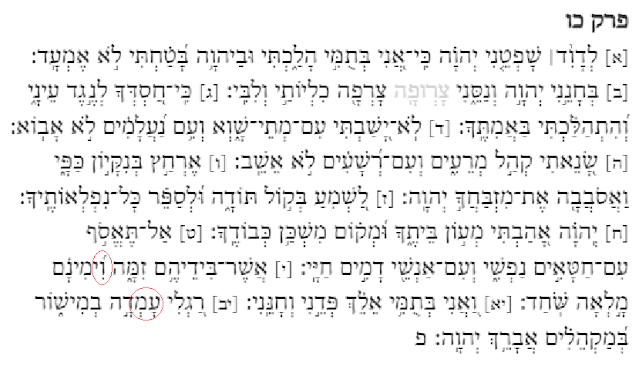
 Comparing Psalm 26 as a whole in the Aleppo codex and the Leningrad codex reveals a couple of differences in the cantillation signs, among them two spurious methegs in the WLC that are not in the Aleppo. My program eliminated only one of these. 

Here is an image of the Aleppo transcription with the two differences that I noted circled in red. Two differences in 100 years?

Psalm 26 -- sight sing this bit of the Aleppo codex

Comparing the psalm with Haïk-Vantoura's rendition of the Letteris edition, shows a larger set of differences. 
Letteris edition of Psalm 26 -- showing about 15 differences with the Aleppo codex

The images show the differences in the accents. For instance, in line 1, שָׁפְטֵ֤נִי in the Aleppo and WLC has a clear mapakh below the text and no short vertical bar (metheg) below the last syllable of this word. Nonetheless, Haïk-Vantoura's version reads as if there were a munah under the second syllable and a silluq under the third, or as if there were an illuy over the second syllable. A glance at the Letteris edition of the psalms (available here) shows an illuy. I.e., over time, an ornament above the text has replaced the reciting note below the text.

Her music is below. If you compare this with the music created from the WLC here, it is easier to see the differences. It's an accumulation of copying errors and inventions. Though it doesn't eliminate the use of the deciphering key, it certainly changes the music, sometimes for the worse. A thousand years of copying have produced several spurious returns to the tonic, a confusion of ornaments, and a proliferation of additional zarqas. There is no performance of this psalm. I wonder if Haïk-Vantoura had noted the spurious methegs and decided not to chose to have this psalm performed. 

Monday, 17 June 2024

Manuscript differences in accentuation

Even a cursory look at one psalm reveals differences in the te'amim written in the text over the centuries. I have been verifying the presence of the metheg in a few verses. So far my program's fuzzy logic (to avoid the premature return to the tonic that it causes in the music) is performing very well. Most methegs I have seen are on the first syllable of a word -- generally unaccented. And my program correctly ignores them.

Psalm 26:12 is an example. The first image is the Aleppo codex as reconstructed on the mgketer.org site. Here is the clear text for Psalm 26:12 -- the first two words. It is clear from the text that it begins on the third degree of the scale (g = tifha = median) and moves to the fifth degree (B = munah = dominant) on the last syllable. Do you see how easy this is to sight read?

The first two words of Psalm 26:12 -- no metheg

The music as derived by Suzanne Haïk-Vantoura from the Letteris Edition (19th century) is in the image below. 

Suzanne Haïk-Vantoura handwritten Psalm 26:12.

In the image above, the little stroke under the a (ayin is carrying the a) is a metheg -- not a musical instruction. It should be ignored. It is not a silluq -- signifying a return to the tonic. It is not an accent. It gives a false emphasis to an 'upbeat' in the music. The metheg is an aid to pronunciation of the vowel. This particular error is of little significance since it is immediately followed by a change of reciting note.

The first two words of Psalm 26:12 Westminster Leningrad Codex

The output of my program correctly ignores the metheg in the WLC (seen in the Hebrew above). It produces the music as for the Aleppo Codex text above.

An observation of the Letteris shows other differences in accentuation from the Aleppo Codex and the WLC. Maybe one day some official site will write the programming to do the music from their textual versions. You can compare the text at the links. And report your observations in a comment -- love to hear from you :).

Saturday, 18 May 2024

Suzanne Haïk-Vantoura - a little history

Forty-three years ago, 1981, the English translation of The Music of the Bible Revealed by Suzanne Haïk-Vantoura was published. What sort of impact has it had? The book is available to read online from the link.

I recall in the Oxford conference on the Psalms (2010) where I was introduced to this work, that there was considerable dialogue over the control to be exercised by Fondation Roi David over the use of the deciphering key. 

The website of Fondation Roi David, via https://shirhashirim.org.il/, has been partially restored. The link brings up a single image with some links superimposed. Try them out. This is new information for me. The first is a conversation with SHV largely about the prose reconstruction. It's very clear. Those of you who are on Facebook can join the group https://www.facebook.com/biblerevealed

Note below the first publication in 1976. The recordings happened over a 12 year period, 1976-87, not quite as long as I have spent familiarizing myself with the musical framework, 2010-24. A curious word from her introduction to her book is this: A tradition is not established in just a few generations. She continued her work at least until 1995-6. I don't have any further information at this time.

History of the various performances published under the banner of Fondation Roi David

Friday, 10 May 2024

Sample chapter of a book?

This book may not be written by me. But it's there for anyone to do it if you have the impulse. I may be in a place to write it, but I'm in no hurry and I may not last long enough. The book I'm thinking of is on the impact of the idea of a deciphering key for the te'amim. Think the Mind of the Maker and communicating with ancient designers of musical notation. Creator to creator -- Performance to performance -- Energy to energy -- i.e. trinity and incarnation. You could even provide probabilities. Why did those engineers put a golden CD in the Voyager?

Oh well, this is a blog -- not a book. But there is a lot of data in it. My tags are fair but limited, but the search blog is comprehensive -- if a little too much at times.

Suzanne Haïk-Vantoura and I are not entirely in agreement about the interpretation and resolution of ornaments. She, for instance, allows her musical judgment to let an ornament just be a dip or a rise on a single note. Maybe. She also (sometimes) allows for placement of the accent to make a difference. Also maybe. Some aspects of design are more highly prone to copying error than others.

Here's her appendix note on Lamentations 1:1.

From The Music of the Bible Revealed

She and I disagree here. Her musical intuitions on a note by note basis are not programmable, at least by me.

I programmed my interpretation of the Unicode so my e-brain is not always fully attuned to the nuances of placement in a sign or identity of shape in the 2 cases where signs are the same above and below the text. This may be an error in my thinking and programming. Unicode, (see the coding here) even though deficient in managing little short strokes like silluq, has been more careful in distinguishing Geresh from Geresh Muqdam and Pashta from Qadma than I have been in my programming.

The above is slightly unreadable and somewhat out of its context - i.e. lacking in explanation. But this brief chapter is totally comprehensible - please let me know if you disagree. Especially if you would like to collaborate on a book. Anyway, at the time of pushing the publish button, I am still quite alive -- if more silent than usual. Onedrive embed is however quite unreliable. This chapter has been rewritten as a blog post. Please see the October 2024 replacement.

Sunday, 19 February 2023

Proverbs as an example of the music for poetry

It's a long story to talk about prose and poetry in Hebrew. The first thing to note is that the te'amim, the accents above and below the text that are cantilation signs, are divided into two sets: those for the three books, Psalms, Proverbs, and the speeches of Job, and those for the other 21 books of the Hebrew Bible and the prose sections of Job, chapters 1, 2, and 42 from verse 7 to the end, and as well, each of the single phrase introductions to the speeches by the narrator. These three books are called poetic. This post is about the observable differences in the music of the three books.

Only in the three books do we find the combination accents ole veyored and revia mugrash. The lowest reciting note c (darga) of the 21 books does not occur in the poetry of the three books. And there are six ornaments that occur only in the 21 books, the double geresh (or tarsin ב֞), zaqef qatan (upright small ב֔), zaqef gadol (upright big ב֕), segol (bunch of grapes ב֒), and the two horns, qarne farah (both horns together), telisha (detached ב֩) qetanah/gedolah (ב֠).

Putting aside these preliminaries, I have here a thought or two about the musical lines in the poetry. I will skip the process of underlay here. This post has a different purpose from refining my translation for lyrics (as if that were even possible!).

I need you to hear. I had dictated this into my phone with singing, but I destroyed the recording while editing. It does need to be sung and heard so that you can distinguish the fourth note of the scale from the fifth or the octave (that interval does not exist in the three books!). And so you can hear the tone of the message.

One of the chief characteristics of Suzanne Haïk-Vantoura's deciphering key for the te'amim is the mid-verse cadence on the atnah -- this is a mid-verse recitation note on the sub-dominant. It would be highly unusual for a 20th century musician to consider this as suitable for the mid point of a musical form. The music of the last 4 centuries has been an exploration of the move from tonic to dominant, modulating to create tension in the middle of a piece that sets up a longing for the return to the tonic at the end of the piece. The recitation to the sub-dominant doesn't set up such a tension. It is a cadence that allows a sense of rest. Recitation on the sub-dominant after the atnah often carries the sense of rest further. Here is the first such note in Proverbs 1:1a:

Proverbs - the opening notes.

The tonic is e. -- Not as if it were fixed but it is generally convenient for the human voice. Raise or lower the tonic for the individual singer as necessary. Notice that the book of Proverbs starts on a g (tifha is the accent name - it is always the third note of the scale). This connects the book of Proverbs as a continuation of the Psalms which is itself a commentary on Torah and Prophets. Psalms, Proverbs, and Job all start on a note other than the tonic. They with Deuteronomy and The Song are the only sections of Scripture that do not have e as the opening reciting note.

Sing those three notes -- imagine e as your home base, but go up the third to g (natural in this mode) then to the fifth (the dominant - signified by the accent munah), then to the mid point cadence on the syllable vid. We of course use the dominant as a note in a phrase, but we don't come to a cadence in it as modern music might. The idea of cadence in another 'key' is foreign to the Biblical recitation. The movement to the subdominant (atnah) is not a modulation. (Though if I am arranging such melodies, I do allow such a treatment occasionally.)

The second part of this verse returns to the tonic. As is common in the poetry, the pair of accents revia-mugrash above the text occurs as part of the return. It occurs 2,839 times in the 4,442 verses of the three books that use the poetic te'amim. It is always in the last part of the verse. The verse structures will be repetitive, but there is much variation in tone, in emotion, in ornaments, and so on throughout the forms that will be encountered as the study continues.

The first two verses of Proverbs

Notice the similarity and the difference between the shapes of the two verses. In all three of the poetry books, this pattern and variations will be evident. [The g in melek is an accident - a bug in an old program that I have never noticed till now - when the melisma is over 4 notes, the usual sharpening is ignored.]

Several verses in the three books are tri-cola, having two mid-verse cadences. There are arguments for tri-cola in the 21 books as well, but no verse in any of those books hase a second significant cadence on the supertonic. If a verse in the poetry has two cadences, the one on the second step of the scale always precedes the one on the 4th step of the scale. A cadence on the second step is always preceded by the ole, an ornament to which Haïk-Vantoura assigns a leap of the fourth. E.g. in Proverbs 1, these three verses from 21-23.

Three verses in a row that use the ole-veyored coming to a cadence on the supertonic.

Bars 99 to 103 express a verse that is a bi-colon, having one cadence only on the supertonic. Bars 103 to 109 illustrate a tri-colon with cadences on the supertonic and the subdominant. Similarly bars 110 to 116.

Similarity of accent sequences (= melodic line shape) is very easy to see and hear with Haïk-Vantoura's deciphering key. It is also easy to learn to sight-read this notation.

A claim was made to me that the poetry books differ from each other. I doubt this, but it is a question that statistics would confirm or deny with some degree of confidence.

Getting to the atnah (A) - the Psalms have greater variety of phrase as seen in the table below. These are phrases getting to the atnah with a frequency of use greater than 10 times in the book. 

Read it this way as you sing the note sequence: The first line of the table: Munah atnah in accents occurs 13 times in the Psalms and not at all in the other two books. The second line: B-g-B-A Munah-tifha-munah-atnah occur in all three books, 42 times in psalms, 72 in Proverbs, and 16 in Job. The seventh line: Silluq munah atnah occurs 329 times in psalms and 92 times in Proverbs and 181 times in Job. And so on. Given the length of the books, it seems to me that all the accent combinations are used in each book, and there is no significant difference in the composers' use of the differing phrases.

In volume 10, The Progression of the Music of my series, the Hebrew Bible and its music, you will find every phrase and can examine this data at your leisure.

Psa

Pro

Job

Accents

13


B-mun A

42

72

16

B-mun g-tif B-mun A

19

21


B-mun g-tif A

33

13

20

C-mph B-mun A

22


14

C-mph B-mun g-tif B-mun A

12


C-mph B-mun g-tif A

329

92

181

e-sil B-mun A

211

162

91

e-sil B-mun g-tif B-mun A

185

64

71

e-sil B-mun g-tif A

21


e-sil B-mun g-tif e-sil A

34


11

e-sil C-mph B-mun A

28


e-sil C-mph B-mun g-tif B-mun A

20


e-sil C-mph B-mun g-tif A

13


e-sil C-mph e-sil f-mer A

20


e-sil C-mph f-mer A

23


e-sil C-mph g-tif B-mun A

11


e-sil d-gal f-mer g-tif B-mun A

290

79

110

e-sil f-mer A

37

14

15

e-sil f-mer e-sil A

16


e-sil f-mer g-tif B-mun A

139

105

112

e-sil g-tif B-mun A

20


13

e-sil g-tif A

13


e-sil g-tif f-mer A

320

118

156

g-tif B-mun A

13


g-tif e-sil B-mun A


Sunday, 13 November 2022

Crowther on two systems of te'amim

 I have come across a new downloadable book on the Masoretic texts. I jumped immediately to Crowther: Why are there Two Systems of Tiberian Ṭeʿamim?

(Daniel J. Crowther (PhD, University of Bristol, 2015) is an Assistant Director for Langham Scholars’ Ministry and a Research Associate of the Centre for Muslim and Christian Studies, Oxford. )

He, like Wickes, (and he appears to understand Wickes - a feat in itself) describes the music using rules about the te'amim (marks of taste). After a clear but incomplete description, he comes to no conclusion other than this:

"It seems to me intuitively sensible to take the testimony of the Masoretes more seriously when they claim to be attempting to capture an established tradition of recitation with their ṭeʿamim, not creating one through the application of an established grammar of the ṭeʿamim."

I certainly agree with him. My own posts on Wickes are not as polite or knowledgeable but I repeat a statement by Wickes who (1881 :35) complains that "these poets are not using the dichotomy consistently". And so they aren’t. They likely had not heard of it. Not one of the corrections that Wickes proposes is required for the music. The idea of continuous dichotomy should be removed from discussion. Music is subject to more nuanced shape than a hierarchy, a concept that is overused in most professions. Crowther (following Wickes) uses the word "law" as if the accents were a law unto themselves. 

But he did point out to me that in the 21 books, tifha (g or g#) always precedes the atnah (A) and the silluk (e). In contrast, in the 3 books, this restriction is not used. I admit that I hadn't noticed, though the observation is evident in the appendix to my own book, The Song in the Night. To explain it musically, the leading tone, g#, is always present in the phrase leading to the rest, and in the phrase returning to the silluq. This is not a law, but a convention. The leading tone gives the character to the phrases of the 21 books. It is a traditional augmented second in the default tone that Haïk-Vantoura uses. She is right in her mapping of the accents below the text to a modal scale. 

Scholars of the Masoretic text should start to listen to her treatise.

Scholars do not have a better explanation.

See also this later post

Thursday, 8 April 2021

List of available music performances

Here is a list of available performances of the Music derived from the Hebrew Bible according to the deciphering key of Suzanne Haik-Vantoura. 

Please use this link for the directories and explore the DVD. A list is available from this pdf.


Saturday, 31 October 2020

Finding the psalms in the Aleppo codex

Here are a couple of images that illustrate the psalms and their music. It is difficult to search the codex because you really have to read it. I find my place using a technique of two consecutive words. If I can read those words and note their stems I can do a search for these two stems in sequence and that narrows the field considerably. Then I can look at a readable Hebrew text and verify that I am in the right place. My skills may improve, but right now at age about 14 that's where my reading is.

By the way, my search now uses SimHebrew - It really works as a left to right abbreviation of the square text. It works on more levels than I could have seen when I began 8 or so months ago.

So Psalm 96 and 1 Chronicles 16 were found by deciphering mlpni ihvh - but it narrowed down more easily with az irnnv. The next one was harder to find since I wasn't even sure that 145 was in the manuscript, but the Psalms are spaced in a way that makes them recognizable with a brief scan of the images so I was able to see that they preceded Chronicles and narrow them down accordingly. I am grateful to Ardon Bar-Hama for providing a link to the images of the Aleppo Codex that he has taken.

Psalm 96 in 1 Chronicles 16:33

The second image is the music we are currently working on. The manuscript is actually missing the verse for n. Verse 8 is for the eighth letter chet (k). You can read the letters vertically ה ט י כ ל מ [נ] ס ע

In the music I have illustrated the letters with a little polyphony. The text itself is chanted without elaboration. The 'illustrations' are of course in the text if one can read the accents. Haïk-Vantoura's key makes for very straightforward sight reading once you get used to it. I also restored the n verse from the DSS and from the Greek and applied accents to it so it had some music. (All the raw music is available on this site.)

Psalm 145 8-15


Tuesday, 8 September 2020

Research - what's useful and what isn't?

 I cannot tell you the answer to this question: Research - what's useful and what isn't?

For me one thing might be useful, for someone else, something else. So I am exposing all the pdf's that I have available related to the work of Suzanne Haïk-Vantoura. They have been available on shared directories for a while. But here they are in a more easily browsable form where one doesn't have to dig through so much rubble. (If individual links do not work - general access to the whole DVD should be available here.)

The MP3 performances are here. Below are the pdfs with links.

What could be useful to you if you are developing music is the way that SHV approached this massive and brilliant effort that she accomplished in the face of so much real confusion.

Postersharp_recital2004.pdf
javier_poster01.pdf
mana_museo_poster01.pdf
mana_museo_poster02.pdf
mana_museo_poster03.pdf
TSG_Symposia.pdf
tsg_symposium2009.pdf
Web CapturesThe Hands of David.pdf
leningrad_backnotes.pdf
estherlamandier_com.pdf
PapersTemple Studies Group 2009-05-30.pdf
The Hebrew Musical Accents.pdf
A Tale of Two Paradigms - Paper.pdf
Psalmodiashv_pr031_1999ed.pdf
shv_ps007-001.pdf
shv_ps016_001b.pdf
shv_ps016_1999ed.pdf
shv_ps022-001.pdf
shv_ps034-001.pdf
shv_ps037-001.pdf
shv_ps040-001.pdf
shv_ps042-001.pdf
shv_ps043-001.pdf
shv_ps052-001.pdf
shv_ps070-001.pdf
shv_ps117-001.pdf
shv_ps138-001.pdf
shv_pss100_01.pdf
shv_pss100_02.pdf
Prosodiashv_de016-002.PDF
shv_ex014_015-031.pdf
shv_ex015_001-021.pdf
shv_ex015_022-026.PDF
shv_ex024-004a.pdf
shv_ex024-004b.PDF
shv_ge001_001-003.pdf
shv_ge001-001.pdf
shv_is006-001.pdf
shv_is040-006.PDF
shv_is061-001.pdf
shv_jo001-001.pdf
shv_jo002-001.pdf
shv_jo003-001.pdf
shv_jo004-001.pdf
shv_ne001_1999ed.pdf
shv_ru001-001.pdf
shv_ze001-001.pdf
Miscellaneouscartel_maná_mail.pdf
errata.pdf
flyer_2004-11.pdf
harp_recital2004.pdf
javier_poster01.pdf
masoretic_text_bhs.pdf
old_ads.pdf
order_form_2005-07.pdf
psalm_singing.pdf
read_me.pdf
recording_info.pdf
shofar_2004-08_poster.pdf
shofar_2004-08.pdf
shofar_2006.pdf
welcome_mbr_cd.pdf
Lyricsvol3_lyrics.pdf
mga_booklet.pdf
Liner Notesvolume01.pdf
cantique02.pdf
Letteris Psalmsbook01.pdf
book02.pdf
book03.pdf
book04.pdf
book05.pdf
Journalsetudes_juives3.log
etudes_juives2.pdf
Denise Jourdan 1.pdf
Denise Jourdan 2.pdf
Israel Adler.pdf
Werner.pdf
SHV review.pdf
SHV review 2.pdf
SHV review-Werner.pdf
Jeffery TSB review.pdf
McKinnon - Instruments in Synagogue.pdf
J.A. Smith TSB review.pdf
ams_vol33_no3_1980_437-467.pdf
arane12009.pdf
iconea2008.pdf
manuel_du_lecteur.pdf
etudes_juives.pdf
SHV - Quatre Meghilot00_quatre_meghilot.pdf
01_obverse.pdf
02_intro.pdf
03_esther001.pdf
03_esther002.pdf
03_esther003.pdf
03_esther004.pdf
03_esther005.pdf
03_esther006.pdf
03_esther007.pdf
03_esther008.pdf
03_esther009.pdf
03_esther010.pdf
04_ecclesiastes001.pdf
04_ecclesiastes002.pdf
04_ecclesiastes003.pdf
04_ecclesiastes004.pdf
04_ecclesiastes005.pdf
04_ecclesiastes006.pdf
04_ecclesiastes007.pdf
04_ecclesiastes008.pdf
04_ecclesiastes009.pdf
04_ecclesiastes010.pdf
04_ecclesiastes011.pdf
04_ecclesiastes012.pdf
05_lamentations001.pdf
05_lamentations002.pdf
05_lamentations003.pdf
05_lamentations004.pdf
05_lamentations005.pdf
06_ruth001.pdf
06_ruth002.pdf
06_ruth003.pdf
06_ruth004.pdf
07_key.pdf
SHV - Message Biblique Integral00_message_biblique.pdf
01_obverse.pdf
02_analysis.pdf
03-01_gen001_001.pdf
03-02_gen028_010.pdf
03-03_gen033_001.pdf
03-04_gen042_001.pdf
03-05_gen043_001.pdf
03-06_gen044_001.pdf
03-07_gen045_001.pdf
03-08_exo014_015.pdf
03-09_exo015_001.pdf
03-10_exo034_001.pdf
03-11_num015_037.pdf
03-12_num024_003.pdf
03-13_deu011_013.pdf
03-14_1sa007_001.pdf
03-15_2sa022_001.pdf
03-16_1ki010_001.pdf
03-17_2ki019_015.pdf
03-18_1ch015_014.pdf
03-19_1ch016_001.pdf
03-20_1ch016_008.pdf
03-21_1ch017_001.pdf
03-22_1ch009_001.pdf
03-23_pro031_001.pdf
03-24_pro031_010.pdf
03-25_eze037_001.pdf
03-26_ezr003_001.pdf
03-27_joe001_001.pdf
03-28_jon001_001.pdf
03-29_jon002_001.pdf
03-30_jon003_001.pdf
03-31_jon004_001.pdf
03-32_isa002_001.pdf
03-33_isa006_001.pdf
03-34_isa012_001.pdf
03-35_isa035_001.pdf
03-36_isa037_015.pdf
03-37_isa053_001.pdf
03-38_isa060_001.pdf
03-39_isa061_001.pdf
03-40_mic001_001.pdf
03-41_mic004_001.pdf
03-42_neh001_001.pdf
03-43_neh012_027.pdf
03-44_publications.pdf
04_reverse.pdf
SHV - Les 150 Psaumes Tome 1150psalms_vol1.pdf
condensed_analysis.pdf
psalm001.pdf
psalm002.pdf
psalm003.pdf
psalm004.pdf
psalm005.pdf
psalm006.pdf
psalm007.pdf
psalm008.pdf
psalm009.pdf
psalm010.pdf
psalm011.pdf
psalm012.pdf
psalm013.pdf
psalm014.pdf
psalm015.pdf
psalm016.pdf
psalm017.pdf
psalm018.pdf
psalm019.pdf
psalm020.pdf
psalm021.pdf
psalm022.pdf
psalm023.pdf
psalm024.pdf
psalm025.pdf
psalm026.pdf
psalm027.pdf
psalm028.pdf
psalm029.pdf
psalm030.pdf
psalm031.pdf
psalm032.pdf
psalm033.pdf
psalm034.pdf
psalm035.pdf
psalm036.pdf
psalm037.pdf
psalm038.pdf
psalm039.pdf
psalm040.pdf
psalm041.pdf
psalm042.pdf
psalm043.pdf
psalm044.pdf
psalm045.pdf
psalm046.pdf
psalm047.pdf
psalm048.pdf
psalm049.pdf
psalm051.pdf
psalm052.pdf
psalm053.pdf
psalm054.pdf
psalm055.pdf
psalm056.pdf
psalm057.pdf
psalm058.pdf
psalm059.pdf
psalm060.pdf
psalm061.pdf
psalm062.pdf
psalm063.pdf
psalm064.pdf
psalm065.pdf
psalm066.pdf
psalm067.pdf
psalm068.pdf
psalm069.pdf
psalm070.pdf
SHV - Les 150 Psaumes Tome 2150psalms_vol2.pdf
psalm071.pdf
psalm072.pdf
psalm073.pdf
psalm074.pdf
psalm075.pdf
psalm076.pdf
psalm077.pdf
psalm078.pdf
psalm079.pdf
psalm080.pdf
psalm081.pdf
psalm082.pdf
psalm083.pdf
psalm084.pdf
psalm085.pdf
psalm086.pdf
psalm087.pdf
psalm088.pdf
psalm089.pdf
psalm090.pdf
psalm091.pdf
psalm092.pdf
psalm093.pdf
psalm094.pdf
psalm095.pdf
psalm096.pdf
psalm097.pdf
psalm098.pdf
psalm099.pdf
psalm100.pdf
psalm101.pdf
psalm102.pdf
psalm103.pdf
psalm104.pdf
psalm105.pdf
psalm106.pdf
psalm107.pdf
psalm108.pdf
psalm109.pdf
psalm110.pdf
psalm111.pdf
psalm112.pdf
psalm113.pdf
psalm114.pdf
psalm115.pdf
psalm116.pdf
psalm117.pdf
psalm118.pdf
psalm119.pdf
psalm120.pdf
psalm121.pdf
psalm122.pdf
psalm123.pdf
psalm124.pdf
psalm125.pdf
psalm126.pdf
psalm127.pdf
psalm128.pdf
psalm129.pdf
psalm130.pdf
psalm131.pdf
psalm132.pdf
psalm133.pdf
psalm134.pdf
psalm135.pdf
psalm136.pdf
psalm137.pdf
psalm138.pdf
psalm139.pdf
psalm140.pdf
psalm141.pdf
psalm142.pdf
psalm143.pdf
psalm144.pdf
psalm145.pdf
psalm146.pdf
psalm147.pdf
psalm148.pdf
psalm149.pdf
psalm150.pdf
Editions Choudens01 - Volume 1 Score.pdf
01 - Volume 1 Supplement (Full).pdf
01 - Volume 1 Supplement (Vocals).pdf
02 - Volume 2 Score.pdf
02 - Volume 2 Supplement (Full).pdf
02 - Volume 2 Supplement (Vocals).pdf
03 - Volume 3 Score.pdf
03 - Volume 3 Supplement (Full).pdf
04 - Song of Songs Score.pdf
Chartsheb_ex024-004.pdf
heb_ps024-001.pdf
shv_application_chart.pdf
shv_verification_ruler.pdf
teamim_sephardic.pdf
teamim_wycliffe.pdf
BooksMBR French Book.pdf
Backgroundchironomy_biblical.pdf
chironomy_egyptian.pdf
curt_sachs_counterpoint.pdf
curt_sachs_tuning01.pdf
curt_sachs_tuning02.pdf
dm_weil_masoretic_chant.pdf
etudes_juives.pdf
full_music_sect.pdf
jh_wheeler_ps001.pdf
jr_jacobson_chanting.pdf
ka_kitchen_orot.pdf
komitas_code.pdf
reply_price.pdf
sharakan.pdf
Bookletsmga_booklet.pdf
vol01_lyrics.pdf
vol03_lyrics.pdf
vol04_lyrics.pdf
vol3_lyrics.pdf
Samuele Bacchiochieti_33.pdf
eti_39.pdf
eti_40.pdf
rockmusic3.pdf
Suzanne Haïk-Vantourareal_meaning.pdf
resume_key_english.pdf
John Wheelerabr01.pdf
abr02.pdf
abr03.pdf
jjml01.pdf
short_articles.pdf
the_hymn01.pdf
Johanna Spectorkdh_mj_jspector1981-1982b.pdf
Analysisshv_analysis-000.pdf
shv_analysis-001.pdf
shv_analysis-002.pdf
shv_analysis-003.pdf