Showing posts with label genealogy. Show all posts

Sunday, 7 July 2024

Successions recapitulation

Here's a recapitulation of the first sections of the Genesis successions up to the kings of Edom. The music for the kings is not identical. The pauses in the lists of names bring many things from the earlier stories to mind.


I have been thinking of doing other books, including Isaiah and Lamentations 3 but I just happened across the Chronicles text and so decided to have a look through it. Here's a comparison of the section on the kings in Genesis and Chronicles.
Gen 36:31e qad,qad,z-q,f g# B ^A f g# f e וְאֵ֙לֶּה֙ הַמְּלָכִ֔ים
Gen 36:32e B z-q,g# ^A f g# e בֶּ֖לַע בֶּן־בְּע֑וֹר
Gen 36:33e g# ^A B z-q,f g# e יוֹבָ֥ב בֶּן־זֶ֖רַח
Gen 36:34e g# ^A B z-q,g# f e חֻשָׁ֖ם מֵאֶ֥רֶץ הַתֵּימָנִֽי
Gen 36:35e g# ^A pas,ger,B rev,C qad,B z-q,f g# e הֲדַ֣ד בֶּן־בְּדַ֗ד
Gen 36:36e g# ^A B z-q,g# e שַׂמְלָ֖ה מִמַּשְׂרֵקָֽה
Gen 36:37e g# ^A B z-q,g# f e שָׁא֖וּל מֵרְחֹב֥וֹת הַנָּהָֽר
Gen 36:38e g# ^A B z-q,f g# e  בַּ֥עַל חָנָ֖ן בֶּן־עַכְבּֽוֹר
Gen 36:39e zar,B B seg,C qad,z-q,f g# ^A pas,C e qad,z-q,g# f e הֲדַ֔ר
Gen 36:40t-g,tar,C qad,z-q,g# ^A f d f e g# f e וְ֠אֵלֶּה שְׁמ֞וֹת אַלּוּפֵ֤י עֵשָׂו֙
Gen 36:41e c d f g# f e אַלּ֧וּף אָהֳלִיבָמָ֛ה אַלּ֥וּף אֵלָ֖ה אַלּ֥וּף פִּינֹֽן
Gen 36:42e f d f g# f e אַלּ֥וּף קְנַ֛ז אַלּ֥וּף תֵּימָ֖ן אַלּ֥וּף מִבְצָֽר
Gen 36:43e f g# B ^A B B rev,e qad,B z-q,f g# f e אַלּ֥וּף מַגְדִּיאֵ֖ל אַלּ֣וּף עִירָ֑ם אֵ֣לֶּה ׀ אַלּוּפֵ֣י אֱד֗וֹם לְמֹֽשְׁבֹתָם֙ בְּאֶ֣רֶץ אֲחֻזָּתָ֔ם ה֥וּא עֵשָׂ֖ו אֲבִ֥י אֱדֽוֹם פ
1Ch 1:43e B rev,C qad,B z-q,f g# B ^A C z-q,f g# e vv 31-32 combined וְאֵ֣לֶּה הַמְּלָכִ֗ים... בֶּ֚לַע בֶּן־בְּע֔וֹר
1Ch 1:44e g# ^A B z-q,f g# e vs 33 above יוֹבָ֥ב בֶּן־זֶ֖רַח
1Ch 1:45e g# ^A B z-q,g# f e חוּשָׁ֖ם מֵאֶ֥רֶץ הַתֵּימָנִֽי
1Ch 1:46e g# ^A pas,ger,B rev,C qad,B z-q,f g# e הֲדַ֣ד בֶּן־בְּדַ֗ד
1Ch 1:47e g# ^A B z-q,g# e שַׂמְלָ֖ה מִמַּשְׂרֵקָֽה
1Ch 1:48e g# ^A B z-q,g# f e שָׁא֖וּל מֵרְחֹב֥וֹת הַנָּהָֽר
1Ch 1:49e g# ^A B z-q,f g# e בַּ֥עַל חָנָ֖ן בֶּן־עַכְבּֽוֹר
1Ch 1:50e qad,qad,B z-q,C qad,z-q,f g# ^A pas,C qad,z-q,g# f e הֲדַ֔ד
1Ch 1:51e g# ^A qad,B z-q,f d f e g# f e וַיָּ֖מָת הֲדָ֑ד... וַיִּהְיוּ֙ אַלּוּפֵ֣י אֱד֔וֹם
1Ch 1:52e c d f g# f e אַלּ֧וּף אָהֳלִיבָמָ֛ה אַלּ֥וּף אֵלָ֖ה אַלּ֥וּף פִּינֹֽן
1Ch 1:53e f d f g# B e אַלּ֥וּף קְנַ֛ז אַלּ֥וּף תֵּימָ֖ן אַלּ֣וּף מִבְצָֽר
1Ch 1:54e f g# B ^A g# f e אַלּ֥וּף מַגְדִּיאֵ֖ל אַלּ֣וּף עִירָ֑ם אֵ֖לֶּה אַלּוּפֵ֥י אֱדֽוֹם פ

Friday, 5 July 2024

Joseph's end - Genesis 50:22-26

Genesis begins with the successions of the heavens and the earth and ends with the last of the lists of successions, in this case Joseph and his grandchildren. The section begins and ends with Joseph's age at his death. Most of the recitation in verses 22 to 24 is on the submedian, C, mahpakh, the sixth note of the scale. I find a tone of promise and appeal in this section. It is a subjective judgment. When the tone drops to recitation on the dominant, B, munah, I hear a proclamation - a this-is-what-happened tone.

Genesis 50:22-26
These are not stories that I am particularly fond of, but the accents translated into this particular form of music according to the deciphering key of Suzanne Haïk-Vantoura certainly makes the story clear in its telling and reveals a shapely music. I think if the deciphering key were wrong, it could not possibly create such reasonable music.

Over the next months, I hope to look at a selection of texts, some of which we have seen before, and some new, but in their raw forms, so that I can learn more what the music says about the text. If you have a favorite, let me know and I will undertake to look at it in a post.

Monday, 1 July 2024

Genesis 49 - Jacob's Song

This is not exactly a genealogy -- but surely worth looking at to hear what the song is. I was going to do the whole chapter, but decided in the end to omit the descriptive parts and confine myself to the uncensored poem. It is a poem though it is not the te'amim of the poetic books. The bolded words indicate alliterative effects that you should listen for.

רְאוּבֵן֙ בְּכֹ֣רִי אַ֔תָּה כֹּחִ֖י וְרֵאשִׁ֣ית אוֹנִ֑י
יֶ֥תֶר שְׂאֵ֖ת וְיֶ֥תֶר עָֽז
3 Reuben, my firstborn you are, my power, and the first of my virility,
the surplus of what is lifted up and the surplus of strength.
g raubn bcori ath coki vrawit aoni
itr wat vitr yz
15
8
ravbn bcr\i ath ck\i v/raw\it avn\i
itr wa\t v/itr yz
פַּ֤חַז כַּמַּ֙יִם֙ אַל־תּוֹתַ֔ר כִּ֥י עָלִ֖יתָ מִשְׁכְּבֵ֣י אָבִ֑יךָ
אָ֥ז חִלַּ֖לְתָּ יְצוּעִ֥י עָלָֽה פ
4 ♪C Reckless like water, you will not have surplus, for you went up to where your father lies down,
then you profaned my bunk in going up.
d pkz cmim al-totr ci ylit mwcbi abiç
az killt ixuyi ylh p
17
10
pkz c/mim al tv/tr ci yl\it m/wcb\i ab\ic
az kll\t ixvy\i ylh
שִׁמְע֥וֹן וְלֵוִ֖י אַחִ֑ים
כְּלֵ֥י חָמָ֖ס מְכֵרֹתֵיהֶֽם
5 Simeon and Levi, kin,
instruments of violence are in your forges.
h wmyon vlvi akim
cli kms mcrotihm
7
9
wmyvn v/lvi ak\im
cli kms m/cr\tihm
בְּסֹדָם֙ אַל־תָּבֹ֣א נַפְשִׁ֔י בִּקְהָלָ֖ם אַל־תֵּחַ֣ד כְּבֹדִ֑י
כִּ֤י בְאַפָּם֙ הָ֣רְגוּ אִ֔ישׁ וּבִרְצֹנָ֖ם עִקְּרוּ־שֽׁוֹר
6 In their council may my being not comply. Into their congregation may my glory not be united,
for in their anger, they slew someone. In their acceptance, they rooted out a barrier.
v bsodm al-tboa npwi bqhlm al-tikd cbodi
ci bapm hrgu aiw ubrxonm yiqru-wor
17
14
b/sd\m al t/ba npw\i b/qhl\m al t/kd cbd\i
ci b/ap\m hrg\v aiw vb/rx\nm yqr\v wvr
אָר֤וּר אַפָּם֙ כִּ֣י עָ֔ז וְעֶבְרָתָ֖ם כִּ֣י קָשָׁ֑תָה
אֲחַלְּקֵ֣ם בְּיַעֲקֹ֔ב וַאֲפִיצֵ֖ם בְּיִשְׂרָאֵֽל פ
7 Cursed be their anger for strength and their fury for intransigence.
I will divide them in Jacob and fracture them in Israel.
z arur apm ci yz vybrtm ci qwth
aklqm biyqob vapixm biwral p
14
16
arr ap\m ci yz v/ybr\tm ci qw\th
a/klq\m b/iyqb va/pxm b/iwral
יְהוּדָ֗ה אַתָּה֙ יוֹד֣וּךָ אַחֶ֔יךָ יָדְךָ֖ בְּעֹ֣רֶף אֹיְבֶ֑יךָ
יִשְׁתַּחֲוּ֥וּ לְךָ֖ בְּנֵ֥י אָבִֽיךָ
8 Judah you are the one for whom your brothers will give thanks. Your hand will be in the nape of your enemies.
The children of your father will worship you.
k ihudh ath ioduç akiç idç byorf aoibiç
iwtkvu lç bni abiç
19
11
ihvdh ath iv/d\vc ak\ic id\c b/yrp aib\ic
i/wk\vv l\c bn\i ab\ic
גּ֤וּר אַרְיֵה֙ יְהוּדָ֔ה מִטֶּ֖רֶף בְּנִ֣י עָלִ֑יתָ
כָּרַ֨ע רָבַ֧ץ כְּאַרְיֵ֛ה וּכְלָבִ֖יא מִ֥י יְקִימֶֽנּוּ
9 ♪C Judah is a lion's whelp. From prey, my son, you have ascended.
He is bowed down. He reclines like a lion, and as an old lion, who will make him arise?
T gur arih ihudh mTrf bni ylit
cry rbx carih uclbia mi iqimnu
14
15
gvr ari\h ihvdh m/Trp bn\i yl\it
cry rbx c/ari\h vc/lbia mi i/qim\nv
לֹֽא־יָס֥וּר שֵׁ֙בֶט֙ מִֽיהוּדָ֔ה וּמְחֹקֵ֖ק מִבֵּ֣ין רַגְלָ֑יו
עַ֚ד כִּֽי־יָבֹ֣א שִׁיל֔וֹ וְל֖וֹ יִקְּהַ֥ת עַמִּֽים
10 Sceptre will not turn aside from Judah, nor a lawgiver from between his feet,
till Shiloh come and to him will be the obedience of the peoples.
i la-isur wbT mihudh umkoqq mbin rgliv
yd ci-iboa wilh vlo iiqht ymim
14
11
la i/svr wbT m/ihvdh vm/kqq m/bin rgl\iv
yd ci i/ba wil\v v/l\v iqh\t ym\im
אֹסְרִ֤י לַגֶּ֙פֶן֙ עִיר֔וֹ וְלַשֹּׂרֵקָ֖ה בְּנִ֣י אֲתֹנ֑וֹ
כִּבֵּ֤ס בַּיַּ֙יִן֙ לְבֻשׁ֔וֹ וּבְדַם־עֲנָבִ֖ים סוּתֽוֹ
11 Binding to the vine his foal, to the noble vine, the child of his she-donkey,
he scoured in wine his clothing and in the blood of grapes his vesture,
ia aosri lgpn yiro vlworqh bni atono
cibs biin lbuwo ubdm-ynbim suto
17
14
asr\i l/gpn yir\v vl/wrq\h bn\i atn\v
cbs b/iin lbw\v vb/dm ynb\im svt\v
חַכְלִילִ֥י עֵינַ֖יִם מִיָּ֑יִן
וּלְבֶן־שִׁנַּ֖יִם מֵחָלָֽב פ
12 flushed eyes from wine,
and white teeth from milk.
ib kclili yiniim miin
ulbn-winiim mklb p
8
8
kclil\i yin\im m/iin
v/lbn wn\im m/klb
זְבוּלֻ֕ן לְח֥וֹף יַמִּ֖ים יִשְׁכֹּ֑ן
וְהוּא֙ לְח֣וֹף אֳנִיּ֔וֹת וְיַרְכָת֖וֹ עַל־צִידֹֽן פ
13 Zebulun at the seaport will dwell,
and he will be a port for ships, his flanks at Tsidon.
ig zbulun lkof imim iwcon
vhua lkof aoniiot vircto yl-xidon p
9
15
zbvln l/kvp im\im i/wcn
v/hva l/kvp ani\vt v/irc\tv yl xidn
יִשָּׂשכָ֖ר חֲמֹ֣ר גָּ֑רֶם
רֹבֵ֖ץ בֵּ֥ין הַֽמִּשְׁפְּתָֽיִם
14 Issachar is a strong-boned ass,
reclining between two hearth-stones.
id iwwcr kmor grm
robx bin hmwptiim
7
8
iwwcr kmr grm
rbx bin hm/wpt\im
וַיַּ֤רְא מְנֻחָה֙ כִּ֣י ט֔וֹב וְאֶת־הָאָ֖רֶץ כִּ֣י נָעֵ֑מָה
וַיֵּ֤ט שִׁכְמוֹ֙ לִסְבֹּ֔ל וַיְהִ֖י לְמַס־עֹבֵֽד ס
15 And he saw rest as good and the land as pleasant,
and he bent his backside for burden and became a servant in forced service.
Tv vira mnukh ci Tob vat-harx ci nymh
viT wcmo lsbol vihi lms-yobd s
16
13
vi/ra m/nk\h ci Tvb v/at h/arx ci nym\h
vi/T wcm\v l/sbl vi/hi l/ms ybd
דָּ֖ן יָדִ֣ין עַמּ֑וֹ
כְּאַחַ֖ד שִׁבְטֵ֥י יִשְׂרָאֵֽל
16 ♪g Dan makes the case for his people,
as one of the sceptres of Israel.
Tz dn idin ymo
cakd wbTi iwral
5
8
dn i/din ym\v
c/akd wbT\i iwral
יְהִי־דָן֙ נָחָ֣שׁ עֲלֵי־דֶ֔רֶךְ שְׁפִיפֹ֖ן עֲלֵי־אֹ֑רַח
הַנֹּשֵׁךְ֙ עִקְּבֵי־ס֔וּס וַיִּפֹּ֥ל רֹכְב֖וֹ אָחֽוֹר
17 Dan will be a snake by the way, a horned adder by a path,
biting the heels of the horse so its rider will fall backwards.
iz ihi-dn nkw yli-drç wpipon yli-aork
hnowç yiqbi-sus viipol rocbo akor
14
13
i/hi dn nkw yl\i drc wpipn yl\i ark
h/nwc yqb\i svs vi/pl rcb\v akr
לִֽישׁוּעָתְךָ֖ קִוִּ֥יתִי יְהוָֽה ס 18 For your salvation I await, Yahweh.
ik liwuytç qivviti ihvh s 10
l/iwvy\tc qv\iti ihvh
גָּ֖ד גְּד֣וּד יְגוּדֶ֑נּוּ
וְה֖וּא יָגֻ֥ד עָקֵֽב ס
19 ♪g Gad, a raiding party will invade him,
and himself, he will invade the hindmost.
iT gd gdud igudnu
vhua igud yqb s
7
7
gd gdd i/gvd\nv
v/hva i/gd yqb
מֵאָשֵׁ֖ר שְׁמֵנָ֣ה לַחְמ֑וֹ
וְה֥וּא יִתֵּ֖ן מַֽעֲדַנֵּי־מֶֽלֶךְ ס
20 From Asher, his bread will be stout,
and himself will make royal specialty foods.
c mawr wmnh lkmo
vhua iitn mydni-mlç s
8
10
m/awr wmn\h lkm\v
v/hva i/tn m/ydn\i mlc
נַפְתָּלִ֖י אַיָּלָ֣ה שְׁלֻחָ֑ה
הַנֹּתֵ֖ן אִמְרֵי־שָֽׁפֶר ס
21 Naphtali is potency set loose,
the one who gives glistening promises.
ca nptli aiilh wlukh
hnotn amri-wpr s
9
7
nptli ail\h wlk\h
h/ntn amr\i wpr
בֵּ֤ן פֹּרָת֙ יוֹסֵ֔ף בֵּ֥ן פֹּרָ֖ת עֲלֵי־עָ֑יִן
בָּנ֕וֹת צָעֲדָ֖ה עֲלֵי־שֽׁוּר
22 ♪C A fruitful child is Joseph, a fruitful child by a spring,
whose daughters march over a barrier.
cb bn port iosf bn port yli-yin
bnot xydh yli-wur
11
8
bn pr\t iv/sp bn pr\t yl\i yin
bn\vt xyd\h yl\i wvr
וַֽיְמָרֲרֻ֖הוּ וָרֹ֑בּוּ
וַֽיִּשְׂטְמֻ֖הוּ בַּעֲלֵ֥י חִצִּֽים
23 And have embittered him and assailed him,
and opposed him, the owners of the arrows.
cg vimrruhu vrobu
viwTmuhu byli kixim
8
10
vi/mrr\hv v/rb\v
vi/wTm\hv byl\i kx\im
וַתֵּ֤שֶׁב בְּאֵיתָן֙ קַשְׁתּ֔וֹ וַיָּפֹ֖זּוּ זְרֹעֵ֣י יָדָ֑יו
מִידֵי֙ אֲבִ֣יר יַעֲקֹ֔ב מִשָּׁ֥ם רֹעֶ֖ה אֶ֥בֶן יִשְׂרָאֵֽל
24 But his bow persists perennially and the arms of his hands are made nimble,
by the hands of the Mighty One of Jacob. From there is the shepherd, the Stone of Israel.
cd vtwb baitn qwto vipozu zroyi idiv
midi abir iyqob mwm royh abn iwral
17
16
vt/wb b/aitn qw\tv vi/pz\v zry\i id\iv
m/id\i abir iyqb m/wm ryh abn iwral
מֵאֵ֨ל אָבִ֜יךָ וְיַעְזְרֶ֗ךָּ וְאֵ֤ת שַׁדַּי֙ וִיבָ֣רְכֶ֔ךָּ בִּרְכֹ֤ת שָׁמַ֙יִם֙ מֵעָ֔ל בִּרְכֹ֥ת תְּה֖וֹם רֹבֶ֣צֶת תָּ֑חַת
בִּרְכֹ֥ת שָׁדַ֖יִם וָרָֽחַם
25 From the God of your father and your helper and the Sufficient, and he will bless you: the blessings of heaven above, the blessings of the abyss reclining under,
the blessings of the breasts and the womb.
ch mal abiç viyzrç vat wdii vibrcç brcot wmiim myl brcot thom robxt tkt
brcot wdiim vrkm
33
7
m/al ab\ic vi/yzr\c v/at wdi vi/brc\c brc\t wmim m/yl brc\t thvm rbx\t tkt
brc\t wd\im v/rkm
בִּרְכֹ֣ת אָבִ֗יךָ גָּֽבְרוּ֙ עַל־בִּרְכֹ֣ת הוֹרַ֔י עַֽד־תַּאֲוַ֖ת גִּבְעֹ֣ת עוֹלָ֑ם
תִּֽהְיֶ֙ין֙ לְרֹ֣אשׁ יוֹסֵ֔ף וּלְקָדְקֹ֖ד נְזִ֥יר אֶחָֽיו פ
26 The blessings of your father have prevailed over the blessings of my progenitors to the desire of the everlasting hillocks.
They will be as the beginning of Joseph, and on the scalp of the Nazirite of his brothers.
cv brcot abiç gbru yl-brcot horii yd-tavvt gbyot yolm
thiinh lraw iosf ulqodqod nzir akiv p
20
14
brc\t ab\ic gbr\v yl brc\t hv/r\i yd t/av\t gby\t yvlm
th/i\in l/raw iv/sp vl/qdqd nzr ak\iv
בִּנְיָמִין֙ זְאֵ֣ב יִטְרָ֔ף בַּבֹּ֖קֶר יֹ֣אכַל עַ֑ד
וְלָעֶ֖רֶב יְחַלֵּ֥ק שָׁלָֽל
27 Benjamin, a wolf, will tear: in the morning he will devour endlessly,
and in the evening he will divide spoil.
cz bnimin zab iTrf bboqr iacl yd
vlyrb iklq wll
13
9
bni\min zab i/Trp b/bqr i/acl yd
vl/yrb i/klq wll

Verses 3 and 4 are clearly a unit, with verse 4 beginning on the C. There is wordplay here which I have preserved in the English, but it is not possible to convey the turn from surplus to advantage, both of which are senses of the Hebrew root word, itr.

Verses 5 to 7 note the violence of Simeon and Levi. Jacob's blessing is not at all sentimental. Sex, violence, and anger in the opening salvo. Judah however, is different. The promise is that Judah will be worshipped. Or if you prefer, his kin will bow down to him.

Judah almost dominates the poem with verse 8 to 12.

Zebulun gets one verse, Issachar two. Verse 16 alliterates the name Dan with a word for a lawyer making a case. Why does it begin on the third degree of the scale, g, tifha?

The whole of verse 9 is alliterative on the name Gad. Gad, Asher, and Naphtali get a verse each.

Jospeh dominates the second part of the poem with 5 verses as Judah dominated the first. Joseph beginning on the 6th note of the scale, C, mahpakh, looks back to the last several chapters of Genesis. Benjamin ends the 12 with another violent verse.

I decided to introduce a breath mark in the music for a zaqef-qatan. It works well for the most part, but not in the case of two-syllable words where the z-q is on the first syllable. E.g. the word ath is stressed on the first syllable where the ornament is. רְאוּבֵן֙ בְּכֹ֣רִי אַ֔תָּה Gen 49? But its pausal effect is delayed by a note. This is the first time that I have seen the need for look-ahead logic in the phrasing -- but its only a syllable or two.

So it appears that the scope of a ta'am is the syllable when it comes to stress, but when it comes to pause, its scope is the word. There are at least two examples in this passage. And certainly some te-amim do represent pauses, cadences, and therefore musical phrase endings. When zaqen-qatan is a one syllable word, it works well. In Gen 49, it turns the lines into poetry-like lengths. The following has been shrunk to a narrow width for you to see the music differently.

Thursday, 27 June 2024

Names - Genesis 46

This short passage from verses 8 to 27 again illustrates what I nicknamed the backward colon, i.e. any note that starts a verse other than the tonic. The thesis is that any verse that does not start on the tonic is referring back to some earlier part of the canon. In this case each subsection of the song closes with a verse that begins with a note other than the tonic -- verse 15 [dominant, 5th note of the scale, B, munah] and verses 18, 22, 25 [sub-median, 6th note of the scale, C, mahpakh]. I have not yet found any verse that stands as a counter example to this thesis. It is this kind of result of my research that convinces me that Suzanne Haïk-Vantoura is on the right track in her deciphering of the te'amim, the cantillation symbols or accents in the Hebrew Bible. What is in the music is so much easier to hear than to see when reading.

  • Besides these sectional backward references which illustrate forms such as this section of Genesis 46, and the strophic structure of Psalms like psalm 96,
  • there are very short backward references - e.g. the attacca note beginning Psalm 115 indicating that the In exitu Israel, Psalm 114 is to be immediately followed by Psalm 115 -- Non nobis Domine. For obvious reasons -- deliverance is by grace.
  • And there are distanced backward references, like the paired narrator parts (using the prose accents) in the poetic sections of Job.
  • And there are extra long distanced references, like the books that begin with a note that is not the tonic. There are five -- Deuteronomy, commenting on the first four books of Torah, Each of the books of truth, The Psalms, David's Torah, Proverbs, and Job, mimicking Genesis, and The Song of Songs, another key to Torah.
In short, for the study of Scripture, the music is a significant aid to understanding.

Bk-Ch-Vs Getting to the Subdominant Returning to the Tonic
Gen 46:8 e pas,c e d f g# B ^A f g# e
Gen 46:9 e g# ^A f g# f e
Gen 46:10 e B rev,c d g# B ^A g# e
Gen 46:11 e g# ^A z-g,g# e
Gen 46:12 e B rev,c d g# B ^A pas,C qad,B z-q,f g# f e
Gen 46:13 e g# ^A f g# f e
Gen 46:14 e g# ^A f g# e
Gen 46:15 B B rev,pas,e C qad,B z-q,g# B ^A c d g# f e
Gen 46:16 e B z-q,f g# B ^A f e g# e
Gen 46:17 e B rev,c d f g# B ^A B z-q,g# e
Gen 46:18 C B z-q,f g# B ^A C qad,qad,z-q,f g# e
Gen 46:19 e C qad,B e z-q,g# e (no rest)
Gen 46:20 e B zar,B seg,C e qad,e z-q,f g# B ^A g# e
Gen 46:21 e B rev,C qad,qad,z-q,f g# B ^A f g# e
Gen 46:22 C B z-q,f g# ^A g# f e
Gen 46:23 e g# e (no rest)
Gen 46:24 e g# ^A f g# f e
Gen 46:25 C B z-q,f g# B ^A c d g# f e
Gen 46:26 e t-g,pas,C qad,qad,B z-q,g# B ^A g# f e
Gen 46:27 e f d f g# B ^A c e d f g# e

Wednesday, 26 June 2024

Successions - Genesis 36

Genesis 36 is the next set of births. What does the music tell me? It appears that Esau found rest in Adah, the daughter of Elon the Hittite. I find it curious that the recitation stays so long on the subdominant. Ahalivamah is more low key, as is Basmat. The first five verses show little in the way of pattern.

Verse 6 is not genealogy but story. Here the music is more ornamented - the recitation is very long -- 40 syllables on the dominant. The story ends with verse 8 where the music repeats the short phrase from verse 1: he is Edom.

Verse 9 begins a repeat of the successions. Esau's children are all recited on the rest note of the subdominant. The grandchildren do not get this treatment. If there is a rest, it is very briefly sung and Amalek in particular is relegated to a recitation on the tonic.

Verse 15 refers back to the list, noting the grandchildren with the title of אַלּ֣וּף which I have rendered as captain. It's quite a celebratory read of the names.

Verse 19, again beginning on the low c rather than the tonic refers back to the lists and concludes with the same short phrase from verse 1: he is Edom.

Then there is a section on the children of the Chorites - or Horites or kori in SimHebrew for הַחֹרִ֔י, the k being used for the strong aspirate chet, ח. Which to be fair to the simulation should be spelled ket. (Aside: Changing a paradigm is no small task. aleph, bet, gimel, dalet, he, vav, zayin, ket, Tet, iod, caf, lamed, mem, nun, samec, ayin, peh, xade, qof, rew, win, taf -- no one spells the letters this way. It might solve my problem with translating / transliterating names if I used SimHebrew there also.)

אֵ֤לֶּה בְנֵֽי־שֵׂעִיר֙ הַחֹרִ֔י יֹשְׁבֵ֖י הָאָ֑רֶץ
לוֹטָ֥ן וְשׁוֹבָ֖ל וְצִבְע֥וֹן וַעֲנָֽה
20 ♪C These are the children of Seir, the Chorite who inhabited the land:
Lotan and Shoval and Tsivon and Anah,
c alh bni-wyir hkori iowbi harx
loTn vwobl vxbyon vynh
13
11
alh bn\i wyir h/kri iwb\i h/arx
lvTn v/wvbl v/xbyvn v/ynh

The music of this section is an addendum to the successions of Esau since he moved to Seir. This connection to the prior verses is signified by its beginning on the sub-median, the sixth note of the scale.

After Seir, the list of kings begins. Each of these is of the form, And when X had died, Y child of Z reigned in his stead. But the music varies, even forming a chiasm -- the middle (vs 35-36) recalls an incident.

Bk-Ch-Vs Getting to the Subdominant Returning to the Tonic
Gen 36:33 e g# ^A B z-q,f g# e
Gen 36:34 e g# ^A B z-q,g# f e
Gen 36:35 e g# ^A pas,ger,B rev,C qad,B z-q,f g# e
Gen 36:36 e g# ^A B z-q,g# e
Gen 36:37 e g# ^A B z-q,g# f e
Gen 36:38 e g# ^A B z-q,f g# e


Verse 39 is even more complex. Verses 40 to the end celebrate the final set of captains. The last phrase returning to the tonic repeats an elaboration of the short phrase - he is Edom: It is Esau the father of Edom -- so we won't forget.

Here is the whole chapter -- over 380 bars of music.

Wednesday, 19 June 2024

Successions - Genesis 25

 Getting back to the genealogies. The music of Genesis 25 is different from the lists that have gone before.


This is a large chunk of music to work through. Most of the chapter is about births:
  • Qeturah - a host of children and grandchildren but Isaac is isolated.
  • Ishmael - a dozen tribes.
  • Isaac - Esau and Jacob
A few observations. 
  • Verses 1 (21 similar verses with this shape) and 5 (4 similar verses) have no rest point. 
  • The descent to the tonic on הַפִּֽילַגְשִׁים֙ is in the Aleppo codex. The music here is elaborate - a story telling moment.
  • There are no refrains in the chapter. The description of death for Abraham (verse 8 bar 60) and Ishmael (verse 17 bar 141) is threefold: expired, died, and was gathered to his people. But there is no significant musical imitation apart from the last 5 notes.
  • The somewhat rare ornament tarsin (109 in Genesis) is used 5 times in the chapter verse 6, 9, 16, 26, 34 -- These are all significant turns in the story:
    • sending away the children of the courtesans, 
    • the entombment of Abraham, 
    • celebrating the children of Ishmael, 
    • Jacob grasping Esau by the heel, 
    • and Jacob feeding Esau the lentil stew. 

Friday, 14 June 2024

Successions of Shem continued -- Genesis 11

 It's curious that we have a second recital of the children of Shem. And this part of the song has a pattern like the one in chapter 5, but a little different. The genealogy of Shem begins at verse 10. The genealogy of Terah begins at verse 27 and continues to the end of the chapter.

Verse 10, as we noted in a prior post links to something that has gone before--in this case to the genealogy in chapter 10. The dependency on the prior pattern in chapter 5 is to be heard in the phrase, 'and he had sons and daughters', 'viold bnim ubnot' a phrase of music that repeats exactly as in chapter 5, here in chapter 11, verses 11, 13, 15, 17, 19, 21, 23, and 25.

The refrain every two verses from 11 to 25 in chapter 11 of Genesis reflecting the same words and music from chapter 5.

It's not that the same words would necessarily have the same music -- this can be widely illustrated. Music is not like punctuation and the accents are not punctuation. Accents are music and music phrases the words, forwards and backwards, and provides refrains and other structural forms, but primarily, melodies expressing story and emotion and highlights. In this case, the setting of the number of years of each of the patriarchs is a varied musical phrase. Not too varied, as can be seen from the shapes. Verses 15 and 17 have the same shape. The first four, 11, 15, 17, 19, lack a B immediately preceding the subdominant ^A (atnah).

Verse Approach to the rest
on the 4th degree of the scale
11 e rev,e qad,B z-q,f g# ^A
13 e B rev,e qad,B z-q,B z-q,f g# ^A
15 e rev,qad,B z-q,B z-q,f g# ^A
17 e rev,qad,B z-q,B z-q,f g# ^A
19 e rev,qad,B z-q,f g# B ^A
21 e B rev,qad,B z-q,f g# B ^A
23 e B rev,d f g# B ^A
25 e B rev,qad,B z-q,e f g# B ^A

Yet this piecemeal approach to the music will limit the potential aural impact of the minstrel. The four sections with the lower timbre will be sung perhaps with a different emphasis -- more mysterious than proclamation. One of the even verses (18 Peleg) hase the same shape as the opening of Genesis 1:1 -- perhaps this indicates a new beginning for the families described. This true for Terah also (verse 26).

Verse 27 focusses on Lot. Then we hear that his father died before his grandfather. This prepares us for the complex relationship of Abram and his nephew Lot.

The music of verse 29 strikingly highlights the word wife, each time on a high C with an immediate descent of a sixth to the tonic. I have noted the accents above the text highlighting similar words and concepts in a passage. I had not seen an accent under the text highlighting paired words until this example. In fact the return to the tonic is an error in the text. The Aleppo codex does not have it in either name (wm / vwm). This kind of decision must be reviewed for all the spurious methegs that have entered the text through copying over the years. As even an introductory text like Lambdin will tell you, the use of metheg (same Unicode as silluq) is a problem. Metheg is an aid to some pronunciation issues (and not a very useful one), but it is not a silluq. My program makes a guess as to whether the silluq should be observed. In this case, it makes the wrong guess. I will now change the database to the Aleppo marking. So the tone of the verse is joyful rather than subdued.
Genesis 11:29 with the text of awt corrected to remove the spurious methegs.


Wednesday, 12 June 2024

Successions -- Genesis 10

We have something to see from Genesis 10 that will confirm the thesis of the role of the opening note of a verse.

Genesis is about births -- and here are a host of them to populate the storied earth. What sort of music does it make. It's odd to be describing music. These are not my favorite sections of the Bible. I don't know the stories or the names or what memories they might have carried for the people who wrote them. But if I was around a fire, listening to the minstrel, and hearing the recitation, I expect I might have been enthralled.

We have already heard some of this music. We began with toldot, which I have rendered as 'successions', now we are seeing a synonym, mwpkot, [in SimHebrew, w is sh, k is a strong h] which I have rendered as 'families'. But neither is 'generations', the word used in the KJV -- these are dorot, the plural of dor, as in the phrase ldor vdor - from generation to generation. 

This song is at times, a concatenation of names. So verses 2-4. Then verse 5 beginning with the qarne ornament explains what the prior list accomplished. verses 6-7 and a slight variation on Nimrod verse 8-10. Verses 5 and 10 each close a section and each one rises to a recitation on the 6th degree of the scale. Perhaps 11-12 would also be included by the minstrel in that section, a temporary culmination of the impact of Nimrod.

Let Nimrod, the mighty hunter,
Bind a leopard to the altar
And consecrate his spear to the Lord. (Christopher Smart liked this passage).

The list of tribes and children continues through verses 13-18 on low reciting notes c, d, e. In verse 19 we again hear the high C, bringing to an end the list of Ham's children. Verse 20 concludes the section with its backward looking colon (a role that can be played by any ta'am saying to us: remember what we have sung about). Opening on a proclamation on the dominant, it announces that you have heard the catalogue of the children of Ham. JB uses a past tense verb here "These were the generation of ..." -- reasonable but definitely biased to a reading sequence rather than a wholistic memory of the sound of the song. And the past tense in this translation is applicable to the act of reading, not the issue of the history or the form of the verb which remains present even though it refers to past times.

The text deals with the list of the three sons of Noah in reverse order. Shem is the last beginning in verse 21 and continuing to the end of the chapter. The high C on verse 25 highlights the children of Eber, Peleg and Joktan.

וּלְעֵ֥בֶר יֻלַּ֖ד שְׁנֵ֣י בָנִ֑ים
שֵׁ֣ם הָֽאֶחָ֞ד פֶּ֗לֶג כִּ֤י בְיָמָיו֙ נִפְלְגָ֣ה הָאָ֔רֶץ וְשֵׁ֥ם אָחִ֖יו יָקְטָֽן
25 And to Eiver were born two sons,
the name of the first Peleg, because in his days the earth was entangled, and the name of his brother, Joktan.
ch ulybr iuld wni bnim
wm hakd plg ci bimiv nplgh harx vwm akiv ioqTn
9
22
vl/ybr ild wn\i bn\im
wm h/akd plg ci b/im\iv n/plg\h h/arx v/wm ak\iv iqTn

The closing explanation of this section is a matter-of-fact low verse 30. Where the musical phrase sequence e f g# B ^A B e tar,rev,C qad,B z-q,f g# e is unique for verse 25, the phrase, e f g# ^A f g# f e, in verse 30 occurs 42 times in the Scripture. I doubt that there is a real significance to this count apart from the use of a lower timbre of the tone of voice. Verses 31 and 32 both begin on the dominant B, thus connecting themselves to the prior verses. Check out the comments on verse 32 in the earlier post of this series on the song of the genealogies in Genesis.

Monday, 10 June 2024

Successions - Genesis chapter 5

 This chapter has a patterned form -- does the music imitate the pattern? Probably but to what extent?

The first 2 verses recapitulate creation. See the post on Noah for the first verse. Verse 3 then begins the pattern. 3-5 Adam, 6-8 Seth, 9-11 Enosh, 12-14 Cainan, 15-17 Mahalaleel, 18-20 Jared, 21-24 Enoch -- the exception,  25-27 Methuselah, 28-31 Lamech, another exception, -- and we have caught up to where we started.

If I presented this all at once, it would be hard to see for the non-musician and hard to hear for the musician. I know this because, even as a musician, I have to work to hear the text and its music, and it's a work of the ear, like poetry -- and demands something I don't easily give, a kind of energy that takes the music off the page and makes something of it.

And what is to be made of a history of births? Here is the first. 

Genesis 5:3-5

This first section has several phrases that are unique. It's preamble is longer. It is the only one that sings of image and likeness. The later groups truncate the opening statement. Several patterns recur. The first section to the atnah, the rest point, of each group of 3 (or 4) verses, always begins on the tonic and has varying reciting notes. Each of the these verses beginning with verse 6 and following the rest point is brief and identical throughout in its quick return to the tonic - saying, 'and he had xxx', on the notes A g# e, the name of the son. The second verse movement to the rest point is again variable for each section, but the return to the tonic, A f g# e is identical to the phrase above, bars 13-16. The third verse of each group exhibits additional variation for each story, but every group except that of Enoch, ends with the same three notes as in bar 21-22 above. 

So in effect, the ear of the listener would easily identify the variable verse parts, and also the repetitive ones. The result will be as if each group of verses had three refrains. Perhaps the listeners would join in by the end. -- and sometimes with a smile. Enoch and Noah stand out as different. Whole chapter is here.


Friday, 7 June 2024

Successions - Genesis chapter 4

The opening poem of Genesis reveals the successions of the heavens and the earth. This the terraforming of the gods. It is the first full succession passage. We have heard the music of Genesis 1 - beautifully sung by the French soprano, Esther Lamandier.

I now need to examine the music for each of these genealogies. I was going to start with chapter 5 but it threw me back to chapter 4.

Genesis 5 begins with a phrase starting on the dominant. So if you are translating, the opening is not something new that indicates what comes afterwards, as if the verse is to be followed by a colon. There needs to be a colon pointing both forward and backward - not a practice in a literary culture, but certainly one in an aural culture. The phrase completes something in the prior chapter. The clear break is between verses 24 and 25 of chapter 4.

Look aside for a moment at the end of the song about Cain's descendants.

Verses 23 and 24 complete the list of the descendants of Cain. These verses are sometimes formatted as if they were a poem. Does the music support this? It is certainly 3 couplets with an intro.

Genesis 4:23-24 Lamech's vengeance snippet

There's an argument for a poetic understanding of the phrases -- even if only from the parallelism, with the inner phrases divided by the zaqef-qatan and a revia. -- but only some of these. Verse 24 has similar syllable counts to a psalm verse. 

וַיֹּ֨אמֶר לֶ֜מֶךְ לְנָשָׁ֗יו עָדָ֤ה וְצִלָּה֙
שְׁמַ֣עַן קוֹלִ֔י נְשֵׁ֣י לֶ֔מֶךְ
הַאְזֵ֖נָּה אִמְרָתִ֑י
כִּ֣י אִ֤ישׁ הָרַ֙גְתִּי֙ לְפִצְעִ֔י
וְיֶ֖לֶד לְחַבֻּרָתִֽי
23 and said Lamech to his wives Adah and Zillah,
Hear my voice, wives of Lamech,
give ear to what I say,
for I have slain someone for inflicting wounds on me,
a juvenile for my stripes.
cg viamr lmç lnwiv ydh vxilh
wmyn qoli nwi lmç
haznh amrti
ci aiw hrgti lpxyi
vild lkburti
13
9
6
8
8
vi/amr lmc ln/w\iv ydh v/xlh
wmy\n qvl\i n/w\i lmc
h/azn\h amr\ti
ci aiw hrg\ti l/pxy\i
v/ild l/kbr\ti
כִּ֥י שִׁבְעָתַ֖יִם יֻקַּם־קָ֑יִן
וְלֶ֖מֶךְ שִׁבְעִ֥ים וְשִׁבְעָֽה
24 ♪f For seven times vengeance for Cain,
and Lamech seventy and seven.
cd ci wbytiim iuqm-qin
vlmç wbyim vwbyh
8
8
ci wby\tim i/qm qin
v/lmc wby\im v/wby\h

I had wondered if my program to create the music should interpret some of these accents as breaths. The difficulty is that not all of them behave this way.

Verse 25 then begins a new line from Adam via Seth, It is this line that Genesis 5:1 connects with by beginning on the dominant. We should also consider the verses from verse 4:17 - 22, the bulk of the genealogy.
The births of the children of Cain from Enoch to the children of Lamech.
The first two verses begin with high recitation, a note I have sometimes associated with pleading or grief. Each is followed by a long recitation on the subdominant, the note that is called 'resting'. So contrary to whatever we might think of this line of humanity, there appear to be periods of rest in their lives, though how building a city is rest escapes me! I can barely build an extension, let alone deal with the bureaucracy of a whole city. Verse 18 also includes a recitation on the dominant after the recitation on the subdominant. I think of the dominant as proclamation, perhaps telling us to pay attention to what follows: the first instance of multiple wives. So chapter 5 led me to chapter 4 and I didn't look at these in the first pass since they didn't include the word toldot.


Wednesday, 5 June 2024

Patterns in the music? The genealogy of Esau and Jacob

I note that we are considering these phrases related to genealogy in isolation from their immediate context. What type of recitation is the section that these verses are a part of? What characterizes these parts of Genesis as song? I hope to come back to this question.

So following up with my selection of verses for the genealogies, is there any additional information in the remaining verses: Gen 36:1, 9, and 37:2?

וְאֵ֛לֶּה תֹּלְד֥וֹת עֵשָׂ֖ו ה֥וּא אֱדֽוֹם And these are the successions of Esau. He is Edom.
a valh toldot ywiv hua adom 10
v/alh t/ld\vt ywv hva advm

Genesis 36:1 valh toldot ywiv

Within these verses that I have extracted from the genealogies, this is the first verse that has no internal rest point. There are times when such verses are significant. I have noted two extended passages, the impatience of the lovers in the Song of Songs, chapter 1,10-17 and the absence of rest in Lamentations chapter 3 with the exception of verse 56.

וְאֵ֛לֶּה תֹּלְד֥וֹת עֵשָׂ֖ו אֲבִ֣י אֱד֑וֹם
בְּהַ֖ר שֵׂעִֽיר
And these are the successions of Esau, the father of Edom,
in mount Seir.
T valh toldot ywiv abi adom
bhr wyir
11
4
v/alh t/ld\vt ywv ab\i advm
b/hr wyir
Genesis 36:9

Another matter of fact phrase. Nine verses share this shape.

אֵ֣לֶּה ׀ תֹּלְד֣וֹת יַעֲקֹ֗ב יוֹסֵ֞ף בֶּן־שְׁבַֽע־עֶשְׂרֵ֤ה שָׁנָה֙ הָיָ֨ה רֹעֶ֤ה אֶת־אֶחָיו֙ בַּצֹּ֔אן וְה֣וּא נַ֗עַר אֶת־בְּנֵ֥י בִלְהָ֛ה וְאֶת־בְּנֵ֥י זִלְפָּ֖ה נְשֵׁ֣י אָבִ֑יו
וַיָּבֵ֥א יוֹסֵ֛ף אֶת־דִּבָּתָ֥ם רָעָ֖ה אֶל־אֲבִיהֶֽם
2 ♪B These are the successions of Jacob. Joseph, a child of seventeen years, was shepherding with his brothers among the sheep, and he, a youth, was with the children of Bilhah and the children of Zilpah, wives of his father.
And Joseph brought their evil defamation to their father.
b alh toldot iyqob iosf bn-wby-ywrh wnh hih royh at-akiv bxan vhua nyr at-bni blhh vat-bni zlph nwi abiv
viba iosf at-dibtm ryh al-abihm
44
15
alh t/ld\vt iyqb iv/sp bn wby ywr\h wnh hih ryh at ak\iv b/xan v/hva nyr at bn\i blhh v/at bn\i zlph n/w\i ab\iv
vi/ba iv/sp at db\tm ry\h al ab\ihm

Genesis 37:2 alh toldot iyqob

This is a remarkable segue. The 'succession' is interrupted by a focus on Joseph. It's a very long interruption. The Jerusalem Bible simply translates it as if it was spr iosf, story or record of Joseph. Jacob doesn't rate a mention. Rewriting the Hebrew certainly makes for smoother reading..

The remainder of the analysis of Genesis music will have to have a different approach. Maybe someone should perform the whole book - It would be quite a long performance I think -- around 8 hours+.

Tuesday, 4 June 2024

Patterns in the music? The genealogy of Terah, Ishmael, and Isaac

One might object that I have found nothing so far. After all, how many shapes of musical line are there and who would hear them if they were similar? 

It's a legitimate concern. But let me give you some examples: 

  1. I can imagine Job as a stage play and I can see and hear the narrator using the prose accentuation carefully introducing each pair of poetic speeches.
  2. I can clearly hear aurally a sound scape like that in Psalm 96 (performance here). There's no guessing as to what the strophic structure is.
  3. Genesis 1 - sung here has an obvious refrain whether said or sung.
But would Genesis be performed in its entirety? Perhaps it would in an aural culture. Would it be performed in its sections? I have taken the verses out of their context. Another question we need to ask is whether there are units that stand alone as a song? 

But first we are still looking for distant patterns. Several of the verses we have looked at so far this month have a unique musical phrase. But snippets of vocal lines are similar - there are, for instance, 8 verses that start with the notes B c d g#. And strangely, Isaiah 38:11 has identical music to Genesis 10:1. These are the only two incidences of this complete phrase in the whole of the Tanach. Perhaps it is coincidence. I suppose that in 23,197 verses, it would not be surprising that there were a few coincidences, and to be fair, we have only just begun to think about musical sequences as an organizing aural component of the Hebrew Scripture.

So following up with my selection of verses for the genealogies that contain the variations on toldot, in this post we look at the father and children of Abraham, Terah, Ishmael, and Isaac. In the next post, we will look at Esau and Jacob: Gen 36:1, 9, and 37:2.

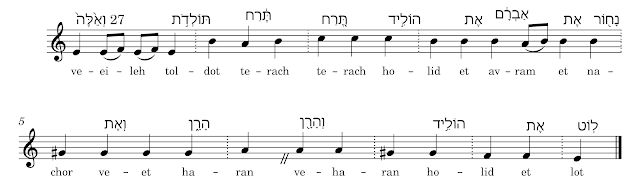
וְאֵ֙לֶּה֙ תּוֹלְדֹ֣ת תֶּ֔רַח תֶּ֚רַח הוֹלִ֣יד אֶת־אַבְרָ֔ם אֶת־נָח֖וֹר וְאֶת־הָרָ֑ן
וְהָרָ֖ן הוֹלִ֥יד אֶת־לֽוֹט
27 And these are the successions of Terah. Terah had Abram Nahor and Haran,
and Haran had Lot.
cz valh toldot trk trk holid at-abrm at-nkor vat-hrn
vhrn holid at-loT
21
7
v/alh tv/ld\t trk trk hv/ld at abrm at nkvr v/at hrn
v/hrn hv/ld at lvT

Genesis 11:27 valh toldot trk

The first two bars of this music are identical to the first two of Gen 10:1. So there is some relationship to the successions of the children of Noah. This beginning is not uncommon. It occurs 11 more times in other verses of Genesis. The final four note sequence is common in the prose books, occurring 972 times.

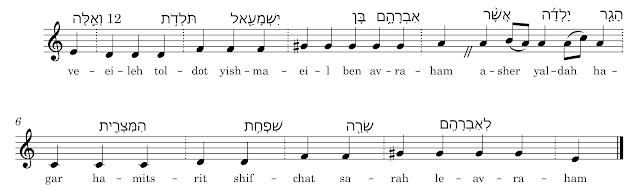
וְאֵ֛לֶּה תֹּלְדֹ֥ת יִשְׁמָעֵ֖אל בֶּן־אַבְרָהָ֑ם
אֲשֶׁ֨ר יָלְדָ֜ה הָגָ֧ר הַמִּצְרִ֛ית שִׁפְחַ֥ת שָׂרָ֖ה לְאַבְרָהָֽם
12 And these are the successions of Yishmaeil child of Abraham,
that Hagar gave birth to, the Egyptian handmaid of Sarah, for Abraham.
ib valh toldot iwmyal bn-abrhm
awr ildh hgr hmxrit wpkt wrh labrhm
13
17
v/alh t/ld\t iwmyal bn abrhm
awr ild\h hgr hm/xr\it wpk\t wrh l/abrhm
Genesis 25:12 valh toldot iwmyal

This is a new pattern in my selection of verses. The whole verse is unique. The phrase in the second part of the verse -- after the atnah -- is shared with Genesis 3:21. And the phrase leading to the atnah is shared with 190 other verses of Scripture. Perhaps the action is matter of fact, but the second half has to cover it.

וְאֵ֛לֶּה תּוֹלְדֹ֥ת יִצְחָ֖ק בֶּן־אַבְרָהָ֑ם
אַבְרָהָ֖ם הוֹלִ֥יד אֶת־יִצְחָֽק
19 And these are the successions of Yitschaq child of Abraham.
Abraham had Yitschaq.
iT valh toldot ixkq bn-abrhm
abrhm holid at-ixkq
11
8
v/alh tv/ld\t ixkq bn abrhm
abrhm hv/ld at ixkq
Genesis 25:19 valh toldot ixkq

You will recognize the first half -- the shape is identical to the verse for Ishmael. As you might expect, the return to the tonic is very common. It is shared by 8,094 other verses. The shape of this verse as a whole is shared by 7 additional verses. The 8 verses with equal shape do not seem to have anything particular in common.

Genesis is a book about birth (ild). Genesis uses the root for birth 218 times, at roughly 10 times the volume of any other book of the Bible apart from  the recap in 1 Chronicles (108).

Monday, 3 June 2024

Patterns in the music - the genealogy of Noah

In the previous post, I looked at Genesis 2:4, the first of ten times that the phrase 'These are the successions of" occurs in Genesis.

There are many patterns in the music for verses that define structure. In Genesis 1 the phrase 'and it was evening and it was morning', is clearly a musical refrain. Each one is of the form e f e g# f e. 

Genesis 1 verse 5 vihi-yrb vihi-boqr iom akd

But would there be musical motifs that operate over a book the size of Genesis? 

Here are the next 3 verses in the form alh toldot, Genesis 6:9, 10:1 and 11:10 -- Noah (nok) and his children.

אֵ֚לֶּה תּוֹלְדֹ֣ת נֹ֔חַ נֹ֗חַ אִ֥ישׁ צַדִּ֛יק תָּמִ֥ים הָיָ֖ה בְּדֹֽרֹתָ֑יו
אֶת־הָֽאֱלֹהִ֖ים הִֽתְהַלֶּךְ־נֹֽחַ
9 ♪C These are the successions of Noah. Noah, a righteous man, was complete in his generations.
With this God walked Noah.
T alh toldot nok nok aiw xdiq tmim hih bdorotiv
at-halohim hthlç-nok
19
10
alh tv/ld\t nk nk aiw xdiq tmm hih b/dr\tiv
at h/alh\im ht/hlc nk

Genesis 6:9 alh toldot nok

This experiment is a bit of a shot in the dark. At first glance, there is no obvious musical connection of these distant parts of Genesis. So perhaps the question needs refining or the net needs to be widened. 

According to my thesis, this verse is connected to what precedes it. In this case we could say it is connected to the prior verse where Noah is introduced. The music is, however, not similar to Genesis 2:4, nor is it similar to the next instance below, where the phrase begins a new section.

The reason is that my filter included the pair of words and chapter 5 has uniquely, the word spr preceding toldot. It doesn't quite follow the pattern I set up for the search. Chapter 5 states a genealogy and so chapter 6:9 is referring back, this sentence in chapter 6 being the completion of the genealogy begun there. 

זֶ֣ה סֵ֔פֶר תּוֹלְדֹ֖ת אָדָ֑ם
בְּי֗וֹם בְּרֹ֤א אֱלֹהִים֙ אָדָ֔ם בִּדְמ֥וּת אֱלֹהִ֖ים עָשָׂ֥ה אֹתֽוֹ
1 ♪B This is the record of the successions of Adam,
in the day of God's creating Adam in the likeness of God's constructing him.
a zh spr toldot adm
biom broa alohim adm bdmut alohim ywh aoto
7
18
zh spr tv/ld\t adm
b/ivm bra alh\im adm b/dm\vt alh\im ywh at\v
Genesis 5:1 zh spr toldot adm

So my net was too narrow to catch the book. The opening verse of chapter 5 also begins on a B showing it is connected to the prior chapter -- this is confirmed by the story -- the whole being the successions of Adam -- but ultimately leading to Noah. (I will examine these patterns in relation to others in a later post -- but think of the story and song for now and not the dryer statistics.)

וְאֵ֙לֶּה֙ תּוֹלְדֹ֣ת בְּנֵי־נֹ֔חַ שֵׁ֖ם חָ֣ם וָיָ֑פֶת
וַיִּוָּלְד֥וּ לָהֶ֛ם בָּנִ֖ים אַחַ֥ר הַמַּבּֽוּל
1 And these are the successions of the children of Noah, Shem, Ham, and Japhet.
And there were born to them children after the deluge.
a valh toldot bni-nok wm km vipt
viivvldu lhm bnim akr hmbul
13
13
v/alh tv/ld\t bn\i nk wm km v/ipt
viv/ld\v l/hm bn\im akr h/mbvl
Genesis 10:1 valh toldot bni-nok wm km vipt 

Genesis 11:10 ends the genealogies from Noah. Sandwiched between them, however, is the tower of Babel. So the opening note continues chapter 10:31-32. If you check out the full PDF of Genesis, you will find that chapter 10 ends with two verses beginning on the dominant. Was the musician aware of the sandwich structure? It is likely. The first half of verse 32 is identical in shape to Genesis 2:4 that we looked at in the previous post: B c d g# ^A.

אֵ֣לֶּה בְנֵי־שֵׁ֔ם לְמִשְׁפְּחֹתָ֖ם לִלְשֹׁנֹתָ֑ם
בְּאַרְצֹתָ֖ם לְגוֹיֵהֶֽם
31 ♪B These are the children of Shem in their families, in their tongues,
in their lands, in their nations.
la alh bni-wm lmwpkotm llwonotm
barxotm lgoiihm
14
8
alh bn\i wm l/mwpk\tm l/lwn\tm
b/arx\tm l/gvi\hm
אֵ֣לֶּה מִשְׁפְּחֹ֧ת בְּנֵי־נֹ֛חַ לְתוֹלְדֹתָ֖ם בְּגוֹיֵהֶ֑ם
וּמֵאֵ֜לֶּה נִפְרְד֧וּ הַגּוֹיִ֛ם בָּאָ֖רֶץ אַחַ֥ר הַמַּבּֽוּל פ
32 ♪B These are the families of the children of Noah in their successions, in their nations,
and from these the nations were separated in the earth after the deluge.
lb alh mwpkot bni-nok ltoldotm bgoiihm
umalh nprdu hgoiim barx akr hmbul p
16
19
alh mwpk\t bn\i nk ltv/ld\tm b/gvi\hm
vm/alh n/prd\v h/gvi\m b/arx akr h/mbvl

So we have here a recognizing in the music that there is more to the successions of Noah after the insertion of the Babel story in Genesis 11:1-9. And my shot in the dark with a little extension of the net seems to have hit a target.

אֵ֚לֶּה תּוֹלְדֹ֣ת שֵׁ֔ם שֵׁ֚ם בֶּן־מְאַ֣ת שָׁנָ֔ה וַיּ֖וֹלֶד אֶת־אַרְפַּכְשָׁ֑ד
שְׁנָתַ֖יִם אַחַ֥ר הַמַּבּֽוּל
10 ♪C These are the successions of Shem. Shem was a child of a hundred years and he had Arphaxad,
two years after the deluge.
i alh toldot wm wm bn-mat wnh viold at-arpcwd
wntiim akr hmbul
18
8
alh tv/ld\t wm wm bn ma\t wnh viv/ld at arpcwd
wn\tim akr h/mbvl
Genesis 11:10 alh toldot wm 

If you are unfamiliar with the accents and the music, please see the explanatory introductory chapter using Lamentations 1:1 here or the aural introduction here.