Wednesday, 6 September 2023

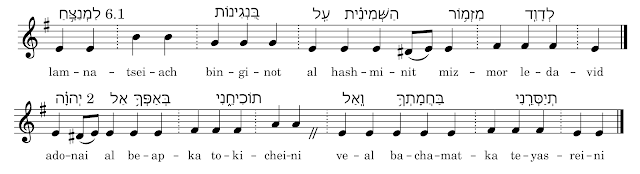
#Psalmtweet #Psalter 6:1-2

Psalms 6:1-2

 Every verse is sung, even the inscription. Note here the plea for protection. Verse 1 is the inscription, sung as a single phrase. Verse 2 has two cola. There is no ornamentation in the second colon. This is in contrast to many examples that we will see of the revia mugrash following the last cadence in the verse in the three poetry books (Psalms, Proverbs, and the speeches of Job -- excepting the narrator's bits).

לַמְנַצֵּ֣חַ בִּ֭נְגִינוֹת עַֽל־הַשְּׁמִינִ֗ית מִזְמ֥וֹר לְדָוִֽד 1 For the leader on strings over octaves. A psalm of David.
a lmnxk bnginot yl-hwminit mzmor ldvid 16
lm/nxk b/ngn\vt yl h/wmn\it m/zmr l/dvd
יְֽהוָ֗ה אַל־בְּאַפְּךָ֥ תוֹכִיחֵ֑נִי
וְֽאַל־בַּחֲמָתְךָ֥ תְיַסְּרֵֽנִי
2 Yahweh, do not in your anger correct me,
and do not in your heat chasten me.
b ihvh al-bapç tocikni
val-bkmtç tiisrni
10
10
ihvh al b/ap\c tv/c\ikni
v/al b/km\tc t/isr\ni

There are limited performances available. The list of what was on the master DVD which I was given by Jonathan Wheeler, Editor of Suzanne Haïk-Vantoura's English book, is here.

All the music is available for every chapter of the Hebrew Bible in single PDFs, e.g. the psalms are here or combined PDFs. The combined are more recent. Feel free to use them native or as input to arrangements.


Tuesday, 5 September 2023

#Psalmtweet #Psalter 5:7

Psalms 5:7

 The poet is very confident in this psalm. Overconfident? We are reading in sequence. And there is already intimation of a rebuke. The music above illustrates a verse with a cadence on the supertonic only. The tessitura never reaches the subdominant.

The four table elements below are: 1. the Westminster Leningrad Codex Hebrew, 2. my rendering in English, 3. the SimHebrew based on the 'full spelling' without vowel pointing, and 4. an automated representation of prefix/root\suffix of the consonants in the first element.

תְּאַבֵּד֮ דֹּבְרֵ֪י כָ֫זָ֥ב
אִישׁ־דָּמִ֥ים וּמִרְמָ֗ה יְתָ֘עֵ֥ב ׀ יְהוָֽה
7 You will make the speakers of a lie to perish.
A person of blood and deceit Yahweh will abhor.
z tabd dobri czb
aiw-dmim umrmh ityb ihvh
7
11
t/abd dbr\i czb
aiw dmm vm/rmh i/tyb ihvh


Monday, 4 September 2023

The latest project - 150 #psalmtweet from the #psalter in daily succession

You might have noticed that I am scheduling daily verses. Yes - software. I am about half-way through drafting the first 72 psalms. I hope to complete the draft in the next month, assuming I live so long. Last night I spent 6 hours in emergency with a sudden inexplicable explosive nosebleed. I am more fragile than I thought. Too much stress. But that's another story. Today I am swollen (an inflated balloon in half my soul) but still alive. 

My posts are unique. Words without music are dangerous. They create a false abstraction not to be believed. There is only one place in the world where the music can be generated from the Hebrew Unicode text verse by verse - that's on my computer. I line up the verse on my translation form and press the music button. Then I open the XML with Musescore - and presto a verse of music, isomorphic to the Scripture -- nothing added -- and more importantly, nothing taken away. So the computer has to last until the draft is completed.

Also there is only one place where the four quadrant Hebrew, English, SimHebrew, and automated parsing can be produced. The same computer - still going strong with a new solid-state drive (thanks to science). This table is produced ad hoc by an Oracle routine I wrote a year or two ago. It's not perfect, but it doesn't destroy information -- following the commandment in a few psalms: Do not destroy. I may make the odd comment too and point to the odd performance -- all on my blog already if you look for them.

It's not quite a religious thing with me to do daily study or daily verses. I have resisted this practice. 

But I have been meditating on science, culture, and faith for several weeks recently. I follow a number of things on Twitter, that app with the most lame rebranding I have ever noted. But it is still a source of confused, contradictory, and interesting tweets.

Religion is too often used to justify the status quo, to hearken back to a false narrative on the truth, and to support propaganda for war. The last is evident with the imperial Russian story and now also with the lunatic fringe of Pope Francis praising violence - how disappointing.  The middle -- hearkening back to earlier stages of ambiguity -- is a common refuge for a certain class of scholarship and also for the fearful, searching for certainty. And the first - justifying the status quo - is all too common in power structures. "It shall not be so with you." I think we have not learned this well.

The psalms tell the truth about the poet. Poetry -- admittedly with metaphor -- but how else do we speak of anything.

Science was to some also a search for certainty but in another direction. Certainty turned out to be a false narrative. Science, (fully supported by the honesty of the Scriptures and their invitation to question, is as uncertain as the religious framework). Faith is best termed faithfulness, i.e. rendering the adherent trustworthy. (Not 'faith' as if it were believing a lie.) With such exploratory faithfulness, science yields true delight in the intricacy of its patterns. The most religious experience I had as a teen was my fourth year class on special relativity. Learning time dilation was more revelatory to me of God's work than some of the learning of Scripture that I fell into fearfully shortly thereafter. Now I think that the uncertainty principle supports the doctrine of co-creation and theosis, but I don't want to give either the Anglicans or the Orthodox any reasons to boast. And I'm not about to explain my hunch.

Culture is yet another question. Science and religion both are part of it. The New Testament has the phrase - in the world but not of the world, and that phrase has had several busses drive through it and cause immeasurable damage. Damage is not what religion should be about. Doesn't God love the world, and the created order, and the cultures that develop as the people learn to govern and to care?

What if the Gospel, like a good sourdough, ate up the world, flour and milk cup by cup, and taught the world to care? It is like the yeast that works in the lump, leavening everything. And now that living and working culture, like its sourdough starter analogue, is trying to teach the churches what caring means because the churches in the rigid application of their own history, jurisprudence, and prejudice have forgotten what their purpose is. In the same way that the fifth book of Torah rewrites earlier laws and statutes for a later time, so the churches must research just how it has its tendencies to stray.

Lost sheep they are. Forgot their knowledge.

תָּעִ֗יתִי כְּשֶׂ֣ה אֹ֭בֵד בַּקֵּ֣שׁ עַבְדֶּ֑ךָ
כִּ֥י מִ֝צְוֺתֶ֗יךָ לֹ֣א שָׁכָֽחְתִּי
176 Time and again I wander like a newborn lamb that is perishing. Seek your servant,
for your commandments I do not forget.
qyv tyiti cwh aobd bqw ybdç
ci mxvotiç la wckti
12
9
ty\iti c/wh abd bqw ybd\c
ci m/xv\tic la wck\ti

All the music is available for every chapter of the Hebrew Bible in single PDFs, e.g. the psalms are here or combined PDFs. The combined are more recent. Feel free to use them native or as input to arrangements.

#Psalmtweet #Psalter 4:3


Psalms 4:6 A rebuke. Sung here
בְּנֵ֥י אִ֡ישׁ עַד־מֶ֬ה כְבוֹדִ֣י לִ֭כְלִמָּה תֶּאֱהָב֣וּן רִ֑יק
תְּבַקְשׁ֖וּ כָזָ֣ב סֶֽלָה
3 Children, each of you, how long will you humiliate my glory? your love empty?
your seeking a lie? Selah.
g bni aiw yd-mh cbodi lclimh tahbun riq
tbqwu czb slh
16
7
bn\i aiw yd mh cbvd\i l/clm\h t/ahb\vn riq
t/bqw\v czb slh

(The performer has chosen a differing mode and there are some accent differences due to the Letteris edition that she is singing).

Sunday, 3 September 2023

#Psalmtweet #Psalter 3:6

Psalms 3:6 - a performance of the psalm is available here.

 This verse is a tri-cola with cadences on the supertonic and the subdominant. It has a very short second colon, one word, four syllables. David has enemies -- as do we, but he can sleep, and awaken.

אֲנִ֥י שָׁכַ֗בְתִּי וָֽאִ֫ישָׁ֥נָה
הֱקִיצ֑וֹתִי
כִּ֖י יְהוָ֣ה יִסְמְכֵֽנִי
6 I lie down and I sleep.
I awake,
for Yahweh supports me.
v ani wcbti vaiwnh
hqixoti
ci ihvh ismcni
9
4
7
ani wcb\ti va/iwn\h
h/qix\vti
ci ihvh i/smc\ni


Saturday, 2 September 2023

#Psalmtweet #Psalter 2:6

The music of this verse begins on a note other than the tonic. My thesis is that this indicates a special connection with the prior verse.  (See this post.) You can see the music for the whole psalm here. The first 6 verses are all connected in this way. It is as if each verse is annotated with the instruction attacca.
וַ֭אֲנִי נָסַ֣כְתִּי מַלְכִּ֑י
עַל־צִ֝יּ֗וֹן הַר־קָדְשִֽׁי
6 ♪g I myself have offered as libation my own king,
on Zion, my holy hill.
v vani nscti mlci
yl-xion hr-qodwi
8
6
v/ani nsc\ti mlc\i
yl xivn hr qdw\i
Psalms 2:6

Friday, 1 September 2023

#Psalter 1:3

Psalms 1:3 You can hear Psalm 1 performed here.
וְֽהָיָ֗ה כְּעֵץ֮ שָׁת֪וּל עַֽל־פַּלְגֵ֫י־מָ֥יִם
אֲשֶׁ֤ר פִּרְי֨וֹ ׀ יִתֵּ֬ן בְּעִתּ֗וֹ וְעָלֵ֥הוּ לֹֽא־יִבּ֑וֹל
וְכֹ֖ל אֲשֶׁר־יַעֲשֶׂ֣ה יַצְלִֽיחַ
3 Such a one is like a tree transplanted by streams of water,
that gives its fruit in its time and its leaf does not wither.
And in all that it does, it thrives.
g vhih cyx wtul yl-plgi-mim
awr priio iitn byito vylhu la-iibol
vcol awr-iywh ixlik
11
15
10
v/hih c/yx wtl yl plg\i mim
awr pr\iv i/tn b/yt\v v/ylh\v la i/bl
v/cl awr i/ywh i/xlk

The first line, in a low tessitura, cadences in bar 4 (on the word mim) on the supertonic. This cadence, called ole veyored covers two accents, the first above the text and the second below. The combination is used only in the three poetry books, Psalms, Proverbs, and the speeches of Job. Only in these books do we see these tri-cola, the first cadence on the second note of the scale, and the second on the subdominant, the fourth note of the scale.

The second musical line, beginning in the last beat of bar 4, ascends to the sixth in joy at the unfading fruitfulness of the one who delights in the instruction of Yahweh. The cadence and pause on the subdominant is marked (bar 8).

The final musical line returns to the tonic. For an introduction to the music, please see here