Being — passage of time.
No time. No being.
Character of the source?
Loves large numbers.
Must create time. Aeveternal apparently.
Fundamental of pleasure.
Troubled by totalitarian impulse.
Necessity of breath.
For there is a language of flowers
for flowers are peculiarly, the poetry of Christ (Christopher Smart)
א ב ג ד ה ו ז ח ט י כ ל מ נ ס ע פ צ ק ר ש ת
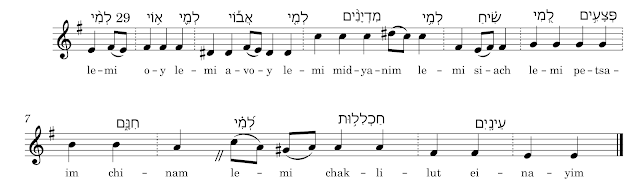
Here's the only verse in Scripture that uses lamed (l), that great camel of a letter, 6 times.
| לְמִ֨י א֥וֹי לְמִ֪י אֲב֡וֹי לְמִ֤י מִדְיָנִ֨ים ׀ לְמִ֥י שִׂ֗יחַ לְ֭מִי פְּצָעִ֣ים חִנָּ֑ם לְ֝מִ֗י חַכְלִל֥וּת עֵינָֽיִם |
29 Whose is woe? whose is appetite? whose is dissension? whose is blather? whose are inflicted wounds for nothing? whose are flushed eyes? | |
| c't lmi aoi lmi aboi lmi mdiinim lmi wik lmi pxyim kinm lmi kclilut yiniim |
25 8 |
| Proverbs 23:29 |
How is one to approach by example the more than 15,000 instances of the prefix b (beth)? I found a verse with 7 instances and at least two differing uses. (Can't learn everything at once.)
| Deuteronomy 6:7 (we've been near here before) |
וְשִׁנַּנְתָּ֣ם לְבָנֶ֔יךָ וְדִבַּרְתָּ֖ בָּ֑ם בְּשִׁבְתְּךָ֤ בְּבֵיתֶ֙ךָ֙ וּבְלֶכְתְּךָ֣ בַדֶּ֔רֶךְ וּֽבְשָׁכְבְּךָ֖ וּבְקוּמֶֽךָ |
7 And you will sharpen them for your children, and speak in them, when you sit in your house, and when you walk in the way, and when you lie down, and when you arise. | |
| z vwinntm lbniç vdibrt bm bwbtç bbitç ublctç bdrç ubwocbç ubqumç |
13 23 |
The preposition "בְּ" (beth) is primarily used to indicate various relationships of proximity and accompaniment, such as "in," "with," "by," "among," and "through." It is also used to denote various meanings, including location, presence, means, instrument, and price.
The text further divides the uses of "בְּ" into different categories, such as "in a place," "presence in a multitude," "within enclosing limits," "motion into a place," "state or condition," and "proximity."
It also discusses how "בְּ" is used in relation to God, indicating actions done by or with the aid of God, such as prophesying in the name of God or swearing by God.
The preposition "בְּ" is also used to express cost or price, where the price of something is considered the means by which an action is accomplished, as in "buying for a certain price" or "exchanging one thing for another."
Overall, the text presents a detailed analysis of the various nuances and uses of the preposition "בְּ" (beth) in Hebrew, providing valuable insights into its multifaceted functions in the language. However, understanding the specific linguistic and grammatical points would require a deeper understanding of Hebrew language and its syntax.
Eleven of the 22 letters in Hebrew are used in grammatical forms. These are א ב ה ו י כ ל מ נ ש ת in SimHebrew a b h v i c l m n w t. Tet, ט, 't sounds like t, is a minor player on the grammatical team, occasionally changing place in a word, (a feature called metastasis that occurs with the letter taf also).
Of the main 11, the following act as single letter prefixes: b, h, v, c, l, m, and w. This last seems a late development in Biblical Hebrew, but is more common in modern Hebrew. It occurs a little over 150 times in the Bible, roughly 2/3 of these in the Song and Qohelet. So if it is a late development, then perhaps these books too are late.
For example, wli, pronounced as shli, reads 'that is mine'. Here it seems to me like an abbreviation of awr li. This occurs exactly twice in the Song of Solomon only. It forms a frame, 1:6 and 8:12. Note how this is not abbreviated in the alliterative verse 1: wir hwirim awr lwlmh. The song of songs which is of Solomon.
![]() |
| Song 1:6 and 8:12, a frame for the song |
אַל־תִּרְא֙וּנִי֙ שֶׁאֲנִ֣י שְׁחַרְחֹ֔רֶת שֶׁשֱּׁזָפַ֖תְנִי הַשָּׁ֑מֶשׁ בְּנֵ֧י אִמִּ֣י נִֽחֲרוּ־בִ֗י שָׂמֻ֙נִי֙ נֹטֵרָ֣ה אֶת־הַכְּרָמִ֔ים כַּרְמִ֥י שֶׁלִּ֖י לֹ֥א נָטָֽרְתִּי | 6 You will not stare at me that I am swarthy, that the sun has glanced on me. My mother's children were scorched by me. They set me up to mind the vineyards. My vineyard that is mine I could not mind. | |
| v al-trauni wani wkrkort wwzptni hwmw bni aimi nikru-bi wmuni no'trh at-hcrmim crmi wli la n'trti | 19 26 |
כָּרְמִ֥י שֶׁלִּ֖י לְפָנָ֑י הָאֶ֤לֶף לְךָ֙ שְׁלֹמֹ֔ה וּמָאתַ֖יִם לְנֹטְרִ֥ים אֶת־פִּרְיֽוֹ | 12 My vineyard that is mine is before me. The thousand is for you Solomon, and two hundred for those who mind his fruit. | |
| ib crmi wli lpnii half lç wlmh umatiim lno'trim at-priio | 7 17 |
I found a verse (1 Chronicles 12:24) with prefixes c, m, and h just by scanning on a filter. A little more work on my part allowed me to see the count of the use of these common prefixes: c (caf) is used 3,168 times as a prefix, m (mem) 17,419, v (vav) 60,131, h (heh) 34,070, b (beth) 15,386, and l (lamed) 17,689.
So prefixes are very commonly used. We need to get a handle on them and the variability of their usage. I was surprised, having not looked at my programming, how I had not included 'h' in my single character prefixes. The reason is perhaps -- I don't remember -- that h has a number of different uses as a prefix in both verbs and nouns.
If you look at a lexicon like BDB, you will of course find a long essay on each letter. I wonder if it could be made easier to absorb. Every one of the grammatical team of letters needs such an essay, as do the weak letters that appear or disappear in various word forms, and the strong ones that rarely disappear or metastasize. Perhaps I will find specific memorable verses that will illustrate the various letter prefixes. Verses with combinations of prefixes are relatively easy to find. E.g. there are 1211 verses that contain words with both prefixes c and m.
But not to be too dependent on counting, we still need to see and hear things in their context in order to learn by example.
Here first is the music for this randomly chosen verse 1 Chronicles 12:24.
| 1 Chronicles 12:24 |
| Leviticus 19:18 |
Yes, I'm still here! It's great to see your enthusiasm and the recognition of the importance of music in understanding and interpreting the verse. Let's analyze the verse you provided: לֹא־תִקֹּם וְלֹא־תִטֹּר אֶת־בְּנֵי עַמֶּךָ וְאָהַבְתָּ לְרֵעֲךָ כָּמוֹךָ אֲנִי יְהוָה.
Direct Object: The direct object of the prohibitions is אֶת־בְּנֵי עַמֶּךָ (et-benei amekha), which means "against the children of your people" or "against your fellow Israelites." The direct object marker אֶת (et) precedes the noun phrase בְּנֵי עַמֶּךָ (benei amekha).
Positive Command: The verse then presents a positive command:
Let me begin the Grammar book I suggested with some grammar and pronunciation by example. Best to chose a verse or phrase that is well known and illustrates something.
What about the summary of the law... Deuteronomy 6:5.
5 And you will love Yahweh your God,
with all your heart and with all your being and with all your capacity.
h vahbt at ihvh alohiç
bcl-lbbç ubcl-npwç ubcl-maodç
Syllables: 27. Words: 10. Roots: 8. Root Recurrence: 30%. Average per verse: 3.
Let's see if my algorithm counted correctly. Yes 10 lexical 'words' in Hebrew, but in this case not 10 stresses since some of the words are connected by hyphens. That gives a total of 7 in the Hebrew.
The SimHebrew does not transcribe the stresses. The accents are music and reading them is much more important than reading the vowels correctly. The music reflects the tone of voice.
Here it is.
| Deuteronomy 6:5 |