Tuesday, 19 December 2023

#Moses, #Psalmtweet Deuteronomy 32:22-24

Deuteronomy 32:22-24

כִּי־אֵשׁ֙ קָדְחָ֣ה בְאַפִּ֔י וַתִּיקַ֖ד עַד־שְׁא֣וֹל תַּחְתִּ֑ית
וַתֹּ֤אכַל אֶ֙רֶץ֙ וִֽיבֻלָ֔הּ וַתְּלַהֵ֖ט מוֹסְדֵ֥י הָרִֽים ס
22 For fire is incandescent in my anger and is a burning mass to the lowest grave,
and it devours earth and her produce and will blaze the foundations of the hills.
cb ci-aw qdkh bapi vtiqd yd-waol tktit
vtacl arx vibulh vtlh't mosdi hrim s
15
16
ci aw qdk\h b/ap\i vt/iqd yd wavl tkt\it
vt/acl arx v/ibl\h vt/lh't mv/sd\i hr\im
אַסְפֶּ֥ה עָלֵ֖ימוֹ רָע֑וֹת
חִצַּ֖י אֲכַלֶּה־בָּֽם ס
23 I will snatch away over them, evils.
My arrows I will consume in them.
cg asph ylimo ryot
kixii aclh-bm s
7
7
a/sph yl\imv ry\vt
kx\i a/clh b\m
מְזֵ֥י רָעָ֛ב וּלְחֻ֥מֵי רֶ֖שֶׁף וְקֶ֣טֶב מְרִירִ֑י
וְשֶׁן־בְּהֵמוֹת֙ אֲשַׁלַּח־בָּ֔ם עִם־חֲמַ֖ת זֹחֲלֵ֥י עָפָֽר ס
24 Gaunt of famine and battling fire-brands and bitter canker,
and the tooth of the beasts I will send among them with the poison of perturbing dust.
cd mzi ryb ulkumi rwf vq'tb mriri
vwn-bhmot awlk-bm ym-kmt zokli ypr s
15
18
mz\i ryb v/lkm\i rwp v/q'tb mrr\i
v/wn bhm\vt a/wlk b\m ym km\t zkl\i ypr

This is a grieving song. I think the fossil fuel industry should take note. Fire is frequent in the psalms, e.g. Psalm 80. Psalm 91:6 mentions the canker, a rare word. Psalms and Deuteronomy account for 2 of the 4 instances. And of course, the story psalm, 78, follows every step of Deuteronomy 32.

Psalm 50 reflects a similar thought to this passage:
יָ֤בֹ֥א אֱלֹהֵ֗ינוּ וְֽאַל־יֶ֫חֱרַ֥שׁ
אֵשׁ־לְפָנָ֥יו תֹּאכֵ֑ל
וּ֝סְבִיבָ֗יו נִשְׂעֲרָ֥ה מְאֹֽד
3 ♪C Our God comes and will not keep silence.
Fire from his presence will devour,
and surrounding him much sweeping.
g iboa alohinu val-ikrw
aw-lpniv tacl
usbibiv nwyrh maod
11
6
8
i/ba alh\inv v/al i/krw
aw l/pn\iv t/acl
v/sbb\iv n/wyr\h mad

#Psalmtweet #Psalter 110:1

 This is the first of eight consecutive psalms that support my oratorio, Unleashing Leviathan. Score is here.

Remember the only other oracle in the Psalter: Psalm 36

לְדָוִ֗ד מִ֫זְמ֥וֹר
נְאֻ֤ם יְהוָ֨ה ׀ לַֽאדֹנִ֗י שֵׁ֥ב לִֽימִינִ֑י
עַד־אָשִׁ֥ית אֹ֝יְבֶ֗יךָ הֲדֹ֣ם לְרַגְלֶֽיךָ
1 Of David a psalm,
an oracle of Yahweh to my Lord. Sit at my right hand,
till I set your enemies as your footstool.
a ldvid mzmor
naum ihvh ladoni wb limini
yd-awit aoibiç hdom lrgliç
5
11
12
l/dvd m/zmr
nam ihvh l/adn\i wb l/imn\i
yd a/wit aib\ic hdm l/rgl\ic

This is the psalm that closes Day one of Unleashing Leviathan.
The lines lend themselves to a chorale treatment.
For further description of this psalm, see here.


Monday, 18 December 2023

#Moses, #Psalmtweet Deuteronomy 32:19-21

Deuteronomy 32:19-21
Notice the pathos -- grief and jealousy. It is the principle of consequences. Humans are ultimately responsible for their acts. The chosen is a blunt example, not a paragon. There are exceptions also in the characters in Scripture from all tribes and peoples and nations.

Generation is used in the psalms 60 times, more often than all of Torah combined. The breakdown is 8 times in book 1, 9 in book 2, 18 times in book 3, 13 times in book 4, and 12 in book 5.  Note particularly Psalm 90:1, the Prayer of Moses, Yahweh as a habitation, and Psalm 95:10 on the straying of the people, 100:5 on the faithfulness of Yahweh. How is it that Yahweh is a faithful habitation yet spurns from grief his children?

וַיַּ֥רְא יְהוָ֖ה וַיִּנְאָ֑ץ
מִכַּ֥עַס בָּנָ֖יו וּבְנֹתָֽיו ס
19 And Yahweh saw, and he is spurning,
from grief his sons and his daughters.
i't vira ihvh vinax
mcys bniv ubnotiv s
7
9
vi/ra ihvh vi/nax
m/cys bn\iv v/bn\tiv
וַיֹּ֗אמֶר אַסְתִּ֤ירָה פָנַי֙ מֵהֶ֔ם אֶרְאֶ֖ה מָ֣ה אַחֲרִיתָ֑ם
כִּ֣י ד֤וֹר תַּהְפֻּכֹת֙ הֵ֔מָּה בָּנִ֖ים לֹא־אֵמֻ֥ן בָּֽם ס
20 And he said, I will hide my face from them. I see what their aftermath will be,
for a wayward generation they are, children without faithfulness in them.
c viamr astirh pnii mhm arah mh akritm
ci dor thpucot hmh bnim la-amun bm s
17
13
vi/amr a/str\h pn\i m/hm a/rah mh akr\itm
ci dvr t/hpc\t hm\h bn\im la amn b\m
הֵ֚ם קִנְא֣וּנִי בְלֹא־אֵ֔ל כִּעֲס֖וּנִי בְּהַבְלֵיהֶ֑ם
וַאֲנִי֙ אַקְנִיאֵ֣ם בְּלֹא־עָ֔ם בְּג֥וֹי נָבָ֖ל אַכְעִיסֵֽם ס
21 ♪C They have made me jealous with not god. They have grieved me in their futility.
And I, I will make them jealous with not a people, with a senseless nation I will grieve them.
ca hm qinauni bla-al ciysuni bhblihm
vani aqniam bla-ym bgoi nbl acyism s
15
18
hm qna\vni bl\a al cys\vni b/hbl\ihm
v/ani a/qn\iam bl\a ym b/gvi nbl a/cys\m

ChatGPT and the Hebrew Scriptures

 As you may know, I have been working on Deuteronomy 32 and its relationship to the psalms. I thought you might enjoy my question on verse 39. I have been using my own software and will verify the following, but the bot has answered well at first sight.

You (I.e. me)
I am impressed by the statement in Deuteronomy 32:39. Where else do we find this idea in the Hebrew Scriptures?

ChatGPT

The concept expressed in Deuteronomy 32:39 can indeed be found in various other passages throughout the Hebrew Scriptures that emphasize the sovereignty and unique power of God. This verse in Deuteronomy 32 is part of the Song of Moses, which highlights God's control over life and death, emphasizing His authority as the only true God. The verse states:

"See now that I, even I, am he, and there is no god beside me; I kill and I make alive; I wound and I heal; and there is none that can deliver out of my hand." (Deuteronomy 32:39 ESV)

Similar themes emphasizing God's sole authority over life and death and His unrivaled power are present in several other passages in the Hebrew Scriptures:

Isaiah 45:5-7: In this passage, God declares His supremacy, stating that He is the only God, and there is none besides Him. He affirms His role as the Creator and declares that He forms light and creates darkness, makes peace, and creates calamity.

1 Samuel 2:6-7: Hannah's prayer acknowledges God's authority over life and death, emphasizing that the Lord kills and brings to life, brings down to Sheol and raises up. It echoes the sentiment found in Deuteronomy 32:39.

Job 1:21: Job's famous words after experiencing significant loss affirm God's sovereignty over life and death, saying, "Naked I came from my mother's womb, and naked shall I return. The Lord gave, and the Lord has taken away; blessed be the name of the Lord."

Psalm 68:20: [WLC 21] The psalmist praises God, acknowledging that God is the God of salvation and that to the Lord belong deliverances from death.

Psalm 139:16: This psalm emphasizes God's intimate knowledge of individuals and their destinies, stating that all the days ordained for a person were written in God's book before one of them came to be.

These passages, among others, reiterate the central theme found in Deuteronomy 32:39, emphasizing God's supreme authority over life and death, His power to bring judgment and deliverance, and His unrivaled sovereignty as the one true God.

#Psalmtweet #Psalter 109:4

 This psalm begins a sequence that does not end until psalm 119.

Very subdued music - no mid verse rest either

תַּֽחַת־אַהֲבָתִ֥י יִשְׂטְנ֗וּנִי וַאֲנִ֥י תְפִלָּֽה 4 Under the guise of my love they are my accusers. But I, I am a prayer.
d tkt-ahbti iw'tnuni vani tpilh 16
tkt ahb\ti i/w'tn\vni v/ani t/pl\h

Do you dare to read this psalm? Throughout the psalter, we read of the triumph of Yahweh, of Yahweh as king. Do we imagine Yahweh rules as an oligarch? As one who demands protection money and has a mafia-like network of friends?

Psalm 109:1-6 A prayer for justice against evil

לַ֭מְנַצֵּחַ לְדָוִ֣ד מִזְמ֑וֹר
אֱלֹהֵ֥י תְ֝הִלָּתִ֗י אַֽל־תֶּחֱרַֽשׁ
1 ♪g For the leader, of David a psalm.

God of my praise do not be silent.
a lmnxk ldvid mzmor
alohi thilti al-tkrw
9
11
lm/nxk l/dvd m/zmr
alh\i t/hl\ti al t/krw
כִּ֤י פִ֪י רָשָׁ֡ע וּֽפִי־מִ֭רְמָה עָלַ֣י פָּתָ֑חוּ
דִּבְּר֥וּ אִ֝תִּ֗י לְשׁ֣וֹן שָֽׁקֶר
2 ♪C For the mouth of a criminal and the mouth of deceit are open over me.
They speak to me with a false tongue.
b ci pi rwy upi-mrmh ylii ptku
dibru aiti lwon wqr
13
8
ci p\i rwy v/p\i m/rmh yl\i ptk\v
dbr\v at\i lwvn wqr
וְדִבְרֵ֣י שִׂנְאָ֣ה סְבָב֑וּנִי
וַיִּֽלָּחֲמ֥וּנִי חִנָּֽם
3 With hate-speech they surround me,
and they battle me for nothing.

g vdbri wnah sbbuni
viilkmuni kinm
9
8
v/dbr\i wna\h sbb\vni
vi/lkm\vni knm
תַּֽחַת־אַהֲבָתִ֥י יִשְׂטְנ֗וּנִי וַאֲנִ֥י תְפִלָּֽה 4 Under the guise of my love they are my accusers. But I, I am a prayer.
d tkt-ahbti iw'tnuni vani tpilh 16
tkt ahb\ti i/w'tn\vni v/ani t/pl\h
וַיָּ֘שִׂ֤ימוּ עָלַ֣י רָ֭עָה תַּ֣חַת טוֹבָ֑ה
וְ֝שִׂנְאָ֗ה תַּ֣חַת אַהֲבָתִֽי
5 And they set up evil for me under the guise of good,
and hatred under the guise of my love.

h viwimu ylii ryh tkt 'tobh
vwnah tkt ahbti
12
9
vi/wim\v yl\i ry\h tkt 'tvb\h
v/wna\h tkt ahb\ti
הַפְקֵ֣ד עָלָ֣יו רָשָׁ֑ע
וְ֝שָׂטָ֗ן יַעֲמֹ֥ד עַל־יְמִינֽוֹ
6 Make a criminal officiate over him,
and let the accuser stand at his right hand.
v hpqd yliv rwy
vw'tn iymod yl-imino
6
10
h/pqd yl\iv rwy
v/w'tn i/ymd yl imn\v

May the collective conscience of humanity, through the international criminal court, realize the difference between good and evil, between life and death, and choose the good, for the sake of the oppressed and the victim, and the people impoverished by those who seek power. 

Sunday, 17 December 2023

#Moses, #Psalmtweet Deuteronomy 32:16-18

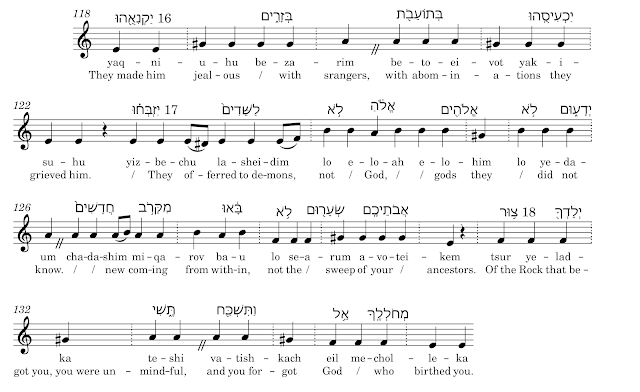
It would have been much easier not to have done the English underlay - but it is the best way of proving the usability of the translation for the music.
Deuteronomy 32:16-18
Sweep is an odd gloss. I wonder where I got that one from. O for the time to annotate every translation decision! The word is rare, used twice in the psalms 50:3 and 58:10(9). There was much overlap of English synonyms in the domain of storminess in English translations, making it impossible to discern the soundscape of the Hebrew. This was part of my combing of the hair of traditional translations, a root glossed as stormy, whirlwind, in the domain of Destroy (see under wyr). These are words I refused to use for more than one Hebrew stem. Perhaps we should capitalize it as a unique name of God -- the Sweeper.

Again in this passage we see jealous, a word used 7 times in the Psalms, reflecting the grief of God. Notice how the music of verse 18 begins on the second note of the scale. This signals that the verse is connected to the previous one. Abomination (tyb) is a favorite word in this fifth of the books of Moses. It is also one that occurs 7 times in the Psalms. 

Reading the psalms helps one to read Torah -- that is why they are called both a key to Torah, and also the Torah of David (though it is clear that they tell a story that goes well beyond David's authorship).

The phrase new coming from within seems remarkably psychological. Maybe that's my 20th century bias coming out. I should add some syllables there - perhaps new things.

יַקְנִאֻ֖הוּ בְּזָרִ֑ים
בְּתוֹעֵבֹ֖ת יַכְעִיסֻֽהוּ ס
16 They made him jealous with strangers,
with abominations they grieved him.
'tz iqniauhu bzrim
btoybot icyisuhu s
7
9
i/qna\hv b/zr\im
b/tvyb\t i/cys\hv
יִזְבְּח֗וּ לַשֵּׁדִים֙ לֹ֣א אֱלֹ֔הַ אֱלֹהִ֖ים לֹ֣א יְדָע֑וּם
חֲדָשִׁים֙ מִקָּרֹ֣ב בָּ֔אוּ לֹ֥א שְׂעָר֖וּם אֲבֹתֵיכֶֽם ס
17 They offered to demons, not God, gods they did not know,
new coming from within, not the sweep of your ancestors.
iz izbku lwdim la aloh alohim la idyum
kdwim mqrob bau la wyrum aboticm s
17
17
i/zbk\v l/wd\im la alh alh\im la idy\vm
kdw\im m/qrb ba\v la wyr\vm ab\ticm
צ֥וּר יְלָדְךָ֖ תֶּ֑שִׁי
וַתִּשְׁכַּ֖ח אֵ֥ל מְחֹלְלֶֽךָ ס
18 ♪f Of the Rock that begot you, you were unmindful,
and you forgot God who birthed you.
ik xur ildç twi
vtwck al mkollç s
6
9
xvr ild\c t/wi
vt/wck al m/kl\lc

#Psalmtweet #Psalter 108:3 57:9

 Wake up call

This psalm repeats two earlier psalms: 57 and 60
ע֭וּרָֽה הַנֵּ֥בֶל וְכִנּ֗וֹר אָעִ֥ירָה שָּֽׁחַר 3 ♪g Be roused O lute and harp. I will rouse the dawn.
g yurh hnbl vcinor ayirh wkr 13
yvr\h h/nbl v/cnr a/yir\h wkr

Comparing the music is instructive. Here is 57:9

More words, but the second statement is identical music to the first

Comparisons of accent sequences were never this easy. Once you have the music, the ear and the eye can manage the comparison.

ע֤וּרָה כְבוֹדִ֗י ע֭וּרָֽה הַנֵּ֥בֶל וְכִנּ֗וֹר אָעִ֥ירָה שָּֽׁחַר 9 ♪C Be roused my glory. Be roused O lute and harp. I will rouse the dawn.

't yurh cbodi yurh hnbl vcinor ayirh wkr 18
yvr\h cbvd\i yvr\h h/nbl v/cnr a/yir\h wkr