Sunday, 20 August 2023

Psalms - tweeting a test

 Join the #Psalter Journey beginning Sept 1, 2023.

A daily dose of music and the language it sets.

Psalms 118:8
The opening of the music beginning as it does with an ornament that avoids starting on the default tonic (e) implicitly joins this verse to the prior verse. May we indeed find refuge.

ט֗וֹב לַחֲס֥וֹת בַּיהוָ֑ה
מִ֝בְּטֹ֗חַ בָּאָדָֽם
8 ♪~ Good it is to take refuge in Yahweh,
over trusting in a human.
k 'tob lksot bihvh
mb'tok badm
6
6
'tvb l/ks\vt b/ihvh
m/b'tk b/adm

The Music of the Law (Exodus 20:1-3)

I have set this in a different mode. It surprises me. I don't remember changing it from the default mode with its f natural and raised g#. Instead we have f# and g natural. Instead we have a mode with normal perfect fourths and no devil's interval, the augmented fourth. The tonal feel is a mixture of e-minor and g-major, rather than the default a-minor with frequent approaches from the diminished triad.

The whole of the first 5 verses concerns the exclusiveness of Yahweh as God. In that presence we are essentially without any of our excuses standing by us. -- No other gods in my face. The one who brought us out of the house of servitude -- whatever that was to us -- is to have our complete attention.

Exodus 20:1

וַיְדַבֵּ֣ר אֱלֹהִ֔ים אֵ֛ת כָּל־הַדְּבָרִ֥ים הָאֵ֖לֶּה לֵאמֹֽר ס 1 And God spoke all these words, saying,
a vidbr alohim at cl-hdbrim halh lamor s
Exodus 20:2

אָֽנֹכִ֖י֙ יְהוָ֣ה אֱלֹהֶ֑֔יךָ
אֲשֶׁ֧ר הוֹצֵאתִ֛יךָ מֵאֶ֥רֶץ מִצְרַ֖יִם מִבֵּ֣֥ית עֲבָדִֽ֑ים
2 I am Yahweh your God,
who brought you forth from the land of Egypt, from the house of servitude.
b anoci ihvh alohiç
awr hoxatiç marx mxriim mbit ybdim


The first three words, I -- the name -- your God, make a sentence without a verb. The verb 'to be' is understood. Where would you put it? I am Yahweh your God or I Yahweh am your God. What does it mean that the addressees have a God? What call does that God have on them?

This is 'explained' in the next phrase: awr, who, hoxatiç, brought you up -- formed from the root ixa, begins with an h so it's a hiphil form, perfect. If we were a child hearing our native tongue, would we know this tidbit of grammatical form? Unlikely but I think we would know that we were cared for. The opening sound of the h perhaps would tell us that the action stated was enabled (caused) by a larger resource than ourselves. For what seems at first sight a clear resource for verb senses and paradigms, see here. Super - that takes me off the hook entirely for explaining such details. Instead we can concentrate on how the music sets the tone of the verb and its usage.

The pronoun suffix (c) is singular. Does that mean it is addressed to a single person, or to each one individually, or to the corporate persona addressed as a  unit--? This singular unit is from the land of -- marx -- a single letter prefix m indicating from or out of. We could have a look at the page of data on the letter m. But BDB puts all this under mn, and m as prefix is an abbreviation of the same. To keep it simple, mn m is a preposition "expressing the idea of separation, hence out of, from, on account of, off, on the side of, since, above, than, so that not" - and pages of usage following.

Egypt, mxriim (sounds like mitsraim) a grand subject all on its own. The word derives from xrr - trouble, straits, adversity. It's a dual form - double-straits! And the explanation is in the appositional phrase, it is a house of servitude.
Exodus 20:3

לֹֽ֣א יִהְיֶֽה־לְךָ֛֩ אֱלֹהִ֥֨ים אֲחֵרִ֖֜ים עַל־פָּנָֽ֗יַ 3 ♪B Not it is for you: other gods over my presence.
g la ihih-lç alohim akrim yl-pnii

What are the other gods that we worship? Our cultural and legal assumptions must rank high among them. Our opinions especially of ourselves. We forget that our thoughts are not God's thoughts. I was very tempted to translate עַל־פָּנָֽ֗יַ as 'in my faces'. God's faces - just where do we find this plurality? More often than we think. Consider the lily or the ferocious hummingbird, lovingly tailored from a dinosaur.

Thursday, 3 August 2023

The prefix c

Music for grammar? "Really, you insist on the music when all we want is the abstract truth." Sorry friend but I cannot speak to truth in the abstract. These days among Christians, I can scarcely speak of truth at all. There is little mutual trust. Some trust in logic and fall into their own unquestioned assumptions. I have seen this even among scholars. Ordained Christian scholars in particular may trust in the power base that they operate from and the correctness of its foundations. It is evident though that all established churches are saturated with assumptions. Still others are 'beyond the pale' to me. I can speak their language and they will thrill in it, but their enthusiasm, sadly, has been misplaced in some alternative universe. So I look to the music for unexpected suggestions, things that are beyond my assumptions.
Ezekiel 1:24 - illustrating three uses of the prefix 'c'.
(Looks like there is a bug in my transcription of Shaddai.)

וָאֶשְׁמַ֣ע אֶת־ק֣וֹל כַּנְפֵיהֶ֡ם כְּקוֹל֩ מַ֨יִם רַבִּ֤ים כְּקוֹל־שַׁדַּי֙ בְּלֶכְתָּ֔ם ק֥וֹל הֲמֻלָּ֖ה כְּק֣וֹל מַחֲנֶ֑ה
בְּעָמְדָ֖ם תְּרַפֶּ֥ינָה כַנְפֵיהֶֽן
29
10
24 And I heard the voice of their wings as the voice of many waters, as the voice of the Sufficient. When they go, the voice of the speech, as the voice of a camp.
When they stand, slackened are their wings.


cd vawmy at-qol cnpihm cqol mim rbim cqol-wdii blctm qol hmulh cqol mknh
byomdm trpinh cnpihn

The phrase cqol mim rbim occurs only in Ezekiel - here and again near the end of the book (43.2). You could not tell this from a translation unless it is done with framing and concordance in mind. (And yes, that is abstraction -- let it not be a distraction!)

I need another approach to the letter /c/ as prefix and preposition. In a typical complete lexicon, I will find another arcane and unreadable paragraph - albeit with lots of useful stuff. 

One thing to note is the similarity of /c/ as prefix to cmo as word. This word cmo is essentially the same as /c/ when used in the sense of likeness. This word is needed for use with pronoun suffixes, cmonu, (like us) 4 times, cmoni (like me) 17, cmoç (like you singular), 31 including two instances of כָּמֹכָה, cmocm (like you plural) once only Job 12:3, [also ccm (like you) 7 times], cmohu (like him/it), 24, cmohm, (like them) 3 times, and cmoh (like her/it) 4 times in 3 verses.

I checked all these counts using search in the SimHebrew Bible, against the counts in the BDB article on the letter caf, and we differ only in the last one where I count 4 to BDB's 3. See Ex 30:38, 1 Sam 21:10, Zech 5:3 (twice).

/c/ as prefix in its role as like or as is very similar to cmo. Which is derived from which, I wonder. (Note that likeness is also expressed with a verb dmh).

The prefix /c/ may also take the sense of according to, or about, and other phrases. Chatgpt summarized the hierarchic section of BDB--(I used a copied dog's breakfast), as follows: /c/ can function as both an adverb and a conjunction. As an adverb, it is used to mean "like," "as," or "about." (Adverbs?) As a conjunction, it can be translated as "according to," "as," or "when." The word is used to express similarity or comparison between two objects or actions.

Here is another example where the concept is slightly different again.

1 Samuel 20:3

I asked chatgpt what the sentence in BDB meant related to this verse. 

Working on Hebrew again - the letter kaf and its uses. What do you make of this sentence out of a lexicon: "Prop. an undeveloped subst., capable of standing in any case and followed (like) always by a gen., as 1 S 20:3  כי כפשׂע or there is (nomin.) the like of a footstep (Arabic ) between me and death." Here's what the bot said:

Here's a breakdown of the sentence:

  1. "Prop." stands for "properly" or "proper." It indicates that the following explanation relates to the correct or accurate usage of the letter "kaf."

  2. "an undeveloped subst." likely refers to the idea that "kaf" can serve as a root or core of a word that hasn't been fully developed into a full-fledged word on its own.

  3. "capable of standing in any case" suggests that "kaf" can be used in various grammatical cases within Hebrew sentences.

  4. "followed (like ) always by a gen." implies that "kaf" is often followed by a genitive construction (a construction that indicates possession or close relationship).

  5. As an example, the sentence cites 1 Samuel 20:3:  כי כפשׂע, which may be translated as "for there is (nomin.) the like of a footstep between me and death." This demonstrates the usage of "kaf" in context, showing how it is used with a genitive construction.

  6. The mention of "Arabic" likely indicates a parallel or similarity between the use of "kaf" in Hebrew and a similar concept in the Arabic language.

Overall, this sentence seems to be explaining how the Hebrew letter "kaf" functions as an undeveloped substantive (a root word), and it is typically used in conjunction with a genitive construction, allowing it to be employed in various grammatical cases. The example from 1 Samuel 20:3 illustrates the usage of "kaf" in a specific context.


No wonder I can't read BDB. A further direct question whether the Arabic reference indicated that the word pwy (or psy rather than pshy) being from Arabic and chatgpt responded with

It's possible that the Hebrew word פשׂע (pronounced as "psy") was either derived from or influenced by a similar word in Arabic. Language borrowing and influence between neighboring cultures are quite common, and it's fascinating to see how words and concepts can travel and evolve over time. ... Both versions likely represent the same root word with similar meanings, and such variations might be attributed to regional dialects, different time periods, or copyist errors in ancient manuscripts.

In later Hebrew the lexicon at the Blueletter Bible site says that the word pwy in this case is psy (samekh in the middle rather than sin). Curious though that peh-shin-ayin would work as well - one more transgression by David against Saul and he would be a goner.

Every post I do on grammar using this approach of music plus the abstraction of the words to express the experience -- every post raises questions for me for translation. And I read more closely.

What will I do with the translation?
g viiwby yod dvid viamr idoy idy abiç ci-mxati kn byiniç viamr al-iidy-zat ihontn pn-iiyxb,
vaulm ki-ihvh vki npwç ci cpwy bini ubin hmvvt.
3 And David swore further and he said, Your father knows that I find grace in your eyes, and he said, Do not let Jonathan know this lest he be tortured,
but as Yahweh lives and you live, there is but one false step between me and death.

I think there is but one false step is a good shot - but more literally I could render it as for the like of one false step is between me and death. Curious that transgression works just as well as the sibilant s (reading w as shin rather than sin).

Is it pwy or anticipating psy as in Isaiah 27:4-- the only other place where this root may occur? 

Sunday, 30 July 2023

Engaging with the source of being

I noticed this note from early 2022.

Being — passage of time. 
No time. No being.

Character of the source?

Loves large numbers. 
Loves chance. 
Loves fragility. 
Hide and seek. 
Movement. 
Seven times round with elegant swiftness. 
Variety. 
Legion. 
Deception and parasite.

Must create time. Aeveternal apparently.

Fundamental of pleasure.

Troubled by totalitarian impulse. 
Needs desire for knowledge. 
Unavoidable conflict.

Necessity of breath. 
Spirit whispers body into being. 
Self opposite other. 
Self in presence of other. 
Opposite, face to face, not necessarily opposition.

Thursday, 27 July 2023

The letter l - a cursory look

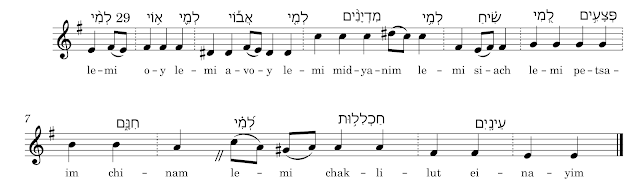
 Here's the only verse in Scripture that uses lamed (l), that great camel of a letter, 6 times.

לְמִ֨י א֥וֹי לְמִ֪י אֲב֡וֹי לְמִ֤י מִדְיָנִ֨ים ׀ לְמִ֥י שִׂ֗יחַ לְ֭מִי פְּצָעִ֣ים חִנָּ֑ם
לְ֝מִ֗י חַכְלִל֥וּת עֵינָֽיִם
29 Whose is woe? whose is appetite? whose is dissension? whose is blather? whose are inflicted wounds for nothing?
whose are flushed eyes?
c't lmi aoi lmi aboi lmi mdiinim lmi wik lmi pxyim kinm
lmi kclilut yiniim
25
8


Proverbs 23:29
I'm sure you can find the answer. It's people who read lexica who inflict wounds on themselves for nothing. This return to the low tone of voice sums up the first four statements and underlines the approach to the cadence. Thank God for a rest in the middle of a verse. But what about the grammar: mi is itself a word signifying the question who. So lmi repeated 6 times is this verse is belonging to whom, or whose. Six verbless sentences. A plural noun on either side of the rest.

The prefixed l is another prefixed preposition with multiple glosses attached to it. In fact the article in BDB is too long for the chatgpt interface. The bot made up a little bit of nonsense when I asked it about lamed. So I have abandoned that approach in favor of a manual summary.

I found myself disappointed in the layout of the 7 different classes of usage that BDB lists. There is no end to layout options these days with our screen real-estate, but in BDB's day, paper was at a premium and the book promised to be very big, so almost all white space was eliminated in structural lists.

לְ prep. to, for, in regard to and used in many varied applications, in some of which the idea of direction predominates, in others that of reference.

1. very often, with various classes of verbs, to, towards, for ...
2. Expressing locality, at, near, idiom. 
3. To denote the object of a vb. —
4. Into ( εἰς ), of a transition into a new state or condition, or into a new character.
5. With reference to, 
6. Of time: towards, against, sometimes with collat. idea of in view of, for, during
7. With an infinitive. 

 I suspect that no one person actually sat down to write that section. It must have been contributed to by many grad students. Here's what I found. It's unreadable. My eyes are definitely tired and flushed after scanning this paragraph. There's no way one can learn easily from such a breakdown, however comprehensive it seems to be. 

Monday, 24 July 2023

And you will talk about these words etc.

How is one to approach by example the more than 15,000 instances of the prefix b (beth)? I found a verse with 7 instances and at least two differing uses. (Can't learn everything at once.)

Deuteronomy 6:7 (we've been near here before)

וְשִׁנַּנְתָּ֣ם לְבָנֶ֔יךָ וְדִבַּרְתָּ֖ בָּ֑ם
בְּשִׁבְתְּךָ֤ בְּבֵיתֶ֙ךָ֙ וּבְלֶכְתְּךָ֣ בַדֶּ֔רֶךְ וּֽבְשָׁכְבְּךָ֖ וּבְקוּמֶֽךָ
7 And you will sharpen them for your children, and speak in them,
when you sit in your house, and when you walk in the way, and when you lie down, and when you arise.
z vwinntm lbniç vdibrt bm
bwbtç bbitç ublctç bdrç ubwocbç ubqumç
13
23


Note first the pulse of the music and the accents and cadence on the word them. See bar 2 (-tam) and bar 5 (bam). In the second half of the verse, the accent is on the your of each noun. It's curious that I rendered these as verbs rather than nominal forms of the verb. Each action is owned by the hearer, whether sitting, or walking or lying down, or arising. But it is quite natural to translate them as verbs and lose the musical emphasis on the second person singular suffixes. So there are clearly three usages of b here: one containing the idea of time and rendered by when, another containing the idea of place and rendered by in, and a third with the idea of speech and thought and rendered awkwardly by in. Perhaps about would be suitable but surely it loses the immersion. Clearly there is a relationship set up here between the words and the people, in this case individually, though the plurality may be implied in the sense of corporately and severally.

Where the preposition is used without a root, such as is collected here, you can see b rendered by several English prepositions, in, about, by, against, etc. BDB summarizes these. It is very hard to read on its own so I asked Chatgpt to summarize the section. What I fed it was somewhat garbled with LTR and RTL errors, but it made a good stab at it.

The preposition "בְּ" (beth) is primarily used to indicate various relationships of proximity and accompaniment, such as "in," "with," "by," "among," and "through." It is also used to denote various meanings, including location, presence, means, instrument, and price.

The text further divides the uses of "בְּ" into different categories, such as "in a place," "presence in a multitude," "within enclosing limits," "motion into a place," "state or condition," and "proximity."

It also discusses how "בְּ" is used in relation to God, indicating actions done by or with the aid of God, such as prophesying in the name of God or swearing by God.

The preposition "בְּ" is also used to express cost or price, where the price of something is considered the means by which an action is accomplished, as in "buying for a certain price" or "exchanging one thing for another."

Overall, the text presents a detailed analysis of the various nuances and uses of the preposition "בְּ" (beth) in Hebrew, providing valuable insights into its multifaceted functions in the language. However, understanding the specific linguistic and grammatical points would require a deeper understanding of Hebrew language and its syntax.


Does anything here surprise you? I had not particularly associated beth with economic or political cost - but it is definitely there and the translation might be as simple as "I did x for [the cost of] y". To cover the prefixed preposition b will require many worked examples.

Sunday, 16 July 2023

Single letter prefixes, w

Eleven of the 22 letters in Hebrew are used in grammatical forms. These are א ב ה ו י כ ל מ נ ש ת in SimHebrew a b h v i c l m n w t. Tet, ט, 't sounds like t, is a minor player on the grammatical team, occasionally changing place in a word, (a feature called metastasis that occurs with the letter taf also).

Of the main 11, the following act as single letter prefixes: b, h, v, c, l, m, and w. This last seems a late development in Biblical Hebrew, but is more common in modern Hebrew. It occurs a little over 150 times in the Bible, roughly 2/3 of these in the Song and Qohelet. So if it is a late development, then perhaps these books too are late.

For example, wli, pronounced as shli, reads 'that is mine'. Here it seems to me like an abbreviation of awr li. This occurs exactly twice in the Song of Solomon only. It forms a frame, 1:6 and 8:12. Note how this is not abbreviated in the alliterative verse 1: wir hwirim awr lwlmh. The song of songs which is of Solomon.

So here are two verses encompassing a whole book. And what a book. Of course you may think it is 'of Solomon' but be warned, single letter prefixes (in this case l) do not translate rigidly always into the same sense. Nor does the attribution to Solomon imply that the ancient king wrote it.

Song 1:6 and 8:12, a frame for the song

Song 1:6 is a unique musical phrase. Again there is a change of reciting note in bar 6 that is striking - mother mine! Perhaps the young one is a tad impetuous. Song 6:12 has the same sequence of accents as 4 other verses. Exodus 2:24, Joshua 8:28, Jeremiah 20:17, and Hosea 4:9. It occurs also as part of Genesis 39:15. One can read significance into these similarities, but I did not test the syllable counts, so the music, even if a similar shape, is not identical. Nor would the shape be easily remembered in this case. 

How many single letter prefixes can you see / hear (!) in these two verses? w (6), b (1), c (0), h (3), l (5), m(0), v(1). Have I got them all? In the case of wli I have to treat the l as the root - though really there is no root in the word. But I had to have a place to put every word exactly once in my concordance.

Here are the data and syllable counts. Note that there is much more to say about grammar for these verses. Perhaps we will come back to them for suffix analysis.
אַל־תִּרְא֙וּנִי֙ שֶׁאֲנִ֣י שְׁחַרְחֹ֔רֶת שֶׁשֱּׁזָפַ֖תְנִי הַשָּׁ֑מֶשׁ
בְּנֵ֧י אִמִּ֣י נִֽחֲרוּ־בִ֗י שָׂמֻ֙נִי֙ נֹטֵרָ֣ה אֶת־הַכְּרָמִ֔ים כַּרְמִ֥י שֶׁלִּ֖י לֹ֥א נָטָֽרְתִּי
6 You will not stare at me that I am swarthy, that the sun has glanced on me.
My mother's children were scorched by me. They set me up to mind the vineyards. My vineyard that is mine I could not mind.
v al-trauni wani wkrkort wwzptni hwmw
bni aimi nikru-bi wmuni no'trh at-hcrmim crmi wli la n'trti
19
26

כָּרְמִ֥י שֶׁלִּ֖י לְפָנָ֑י
הָאֶ֤לֶף לְךָ֙ שְׁלֹמֹ֔ה וּמָאתַ֖יִם לְנֹטְרִ֥ים אֶת־פִּרְיֽוֹ
12 My vineyard that is mine is before me.
The thousand is for you Solomon, and two hundred for those who mind his fruit.
ib crmi wli lpnii
half lç wlmh umatiim lno'trim at-priio
7
17


I asked chatgpt about the single character prefixes. It missed several and we had quite a conversation defining terms.