Monday, 15 November 2021

Oratorio part 6, Psalms 116

 Psalms 116 took a form that was completely unexpected. I had been setting psalms from 110-115 and they all seemed to be homophonic chorales. Psalms 116 turned into an aria instead, with verse 5 serving as a repeating chorus as the soloist works through the first 4 verses and verse 16. Verse 16 is the release given the prayer announced by verses 3 and 4. Verses 1 and 2 then provide a recap. 

Psalms 116

Psalms 116 verse 5, and the beginning of the aria

Syllables: 298. Words: 131. Roots: 77. Root Recurrence: 61%. Average per verse: 4.2.
adm ahb alvh amh amn amr ana (2) ani (4) app arx asr at (3) azn bit bn ci (6) cl (4) cvs czb dbr dkh dll dmy gml (2) hlc hll idh igh ih ihvh (15) iqr irvwlm ivm iwy (2) kbl kih klx knn (2) kpz ksid kxr l (3) mad mh ml't mn mvt (3) mxa (2) na (2) ndr (2) n'th ngd (2) npw (3) nvk nwa pnh pti ptk qra (4) qvl rgl rkm tvc wavl wlm (2) wm (3) wmr wmy wvb (2) xdiq xrr (2) ybd (2) yin (2) yl (2) ym (2) ynh zbk (2)
אָ֭הַבְתִּי כִּֽי־יִשְׁמַ֥ע ׀ יְהוָ֑ה
אֶת־ק֝וֹלִ֗י תַּחֲנוּנָֽי
1 ♪g I love, for Yahweh heard,
the voice of my supplication.
a ahbti ci-iwmy ihvh
at-qoli tknunii
8
7
ahb\ti ci i/wmy ihvh
at qvl\i t/knvn\i
כִּֽי־הִטָּ֣ה אָזְנ֣וֹ לִ֑י
וּבְיָמַ֥י אֶקְרָֽא
2 For he bent his ear to me,
and in my days I will call.

b ci-h'th aozno li
ubimii aqra
5
5
ci h/+h azn\v l\i
vb/im\i a/qra
אֲפָפ֤וּנִי ׀ חֶבְלֵי־מָ֗וֶת וּמְצָרֵ֣י שְׁא֣וֹל מְצָא֑וּנִי
צָרָ֖ה וְיָג֣וֹן אֶמְצָֽא
3 The pangs of death enveloped me and anguish of Sheol found me.
Trouble and sadness I find.
g appuni kbli-mvvt umxri waol mxauni
xrh vigon amxa
16
7
app\vni kbl\i mvt vm/xr\i wavl mxa\vni
xr\h v/ig\vn a/mxa
וּבְשֵֽׁם־יְהוָ֥ה אֶקְרָ֑א
אָנָּ֥ה יְ֝הוָ֗ה מַלְּטָ֥ה נַפְשִֽׁי
4 So in the name of Yahweh I will call,
beseeching, Yahweh, make an escape for my being.

d ubwm-ihvh aqra
anh ihvh ml'th npwi
6
8
vb/wm ihvh a/qra
an\h ihvh ml+\h npw\i
חַנּ֣וּן יְהֹוָ֣ה וְצַדִּ֑יק
וֵ֖אלֹהֵ֣ינוּ מְרַחֵֽם
5 Gracious is Yahweh and righteous,
and our God is compassionate.
h knun ihvh vxdiq
valohinu mrkm
8
7
knvn ihvh v/xdiq
v/alh\inv m/rkm
שֹׁמֵ֣ר פְּתָאיִ֣ם יְהֹוָ֑ה
דַּ֝לּוֹתִ֗י וְלִ֣י יְהוֹשִֽׁיעַ
6 Yahweh keeps the simple.
I was brought low and me he saves.

v womr ptiim ihvh
dloti vli ihowiy
8
9
wmr pt\aim ihvh
dl\ti v/l\i ihv/wy
שׁוּבִ֣י נַ֭פְשִׁי לִמְנוּחָ֑יְכִי
כִּֽי־יְ֝הוָ֗ה גָּמַ֥ל עָלָֽיְכִי
7 Return, O my being, to your rest,
for Yahweh has matured you.
z wubi npwi lmnukiici
ci-ihvh gml yliici
8
9
wvb\i npw\i lm/nvk\ici
ci ihvh gml yl\ici
כִּ֤י חִלַּ֥צְתָּ נַפְשִׁ֗י מִ֫מָּ֥וֶת
אֶת־עֵינִ֥י מִן־דִּמְעָ֑ה
אֶת־רַגְלִ֥י מִדֶּֽחִי
8 ♪C For he rescued my being from death,
my eyes from tears,
my foot from tripping.

k ci kilxt npwi mmvvt
at-yini mn-dmyh
at-rgli mdki
9
6
6
ci klx\t npw\i m/mvt
at yin\i mn dmy\h
at rgl\i m/dk\i
אֶ֭תְהַלֵּךְ לִפְנֵ֣י יְהוָ֑ה
בְּ֝אַרְצ֗וֹת הַֽחַיִּֽים
9 ♪g I will walk in the presence of Yahweh,
in the lands of the living.
't athlç lpni ihvh
barxot hkiim
7
6
at/hlc l/pn\i ihvh
b/arx\vt h/ki\im
הֶ֭אֱמַנְתִּי כִּ֣י אֲדַבֵּ֑ר
אֲ֝נִ֗י עָנִ֥יתִי מְאֹֽד
10 ♪g I believed so I spoke.
I myself was much afflicted.

i hamnti ci adbr
ani yniti maod
8
7
h/amn\ti ci a/dbr
ani yn\iti mad
אֲ֭נִי אָמַ֣רְתִּי בְחָפְזִ֑י
כָּֽל־הָאָדָ֥ם כֹּזֵֽב
11 ♪g I myself said in my haste,
Every human lies.
ia ani amrti bkopzi
cl-hadm cozb
8
6
ani amr\ti b/kpz\i
cl h/adm czb
מָֽה־אָשִׁ֥יב לַיהוָ֑ה
כָּֽל־תַּגְמוּל֥וֹהִי עָלָֽי
12 What will I return to Yahweh,
for all his benefits to me?
ib mh-awib lihvh
cl-tgmulohi ylii
5
7
mh a/wb l/ihvh
cl t/gmvl\vhi yl\i
כּוֹס־יְשׁוּע֥וֹת אֶשָּׂ֑א
וּבְשֵׁ֖ם יְהוָ֣ה אֶקְרָֽא
13 The cup of salvation I will bear,
so in the name of Yahweh I will call.
ig cos-iwuyot awa
ubwm ihvh aqra
6
6
cvs iwvy\vt a/wa
vb/wm ihvh a/qra
נְ֭דָרַי לַיהוָ֣ה אֲשַׁלֵּ֑ם
נֶגְדָה־נָּ֝֗א לְכָל־עַמּֽוֹ
14 ♪g My vows to Yahweh I will pay,
may it be before all his people.

id ndrii lihvh awlm
ngdh-na lcl-ymo
8
7
ndr\i l/ihvh a/wlm
ngd\h na l/cl ym\v
יָ֭קָר בְּעֵינֵ֣י יְהוָ֑ה
הַ֝מָּ֗וְתָה לַחֲסִידָֽיו
15 ♪g Precious in the eyes of Yahweh,
is the death of those under his mercy.
'tv iqr byini ihvh
hmvvth lksidiv
7
7
iqr b/yin\i ihvh
h/mvt\h l/ksid\iv
אָֽנָּ֣ה יְהוָה֮ כִּֽי־אֲנִ֪י עַ֫בְדֶּ֥ךָ
אֲ‍ֽנִי־עַ֭בְדְּךָ בֶּן־אֲמָתֶ֑ךָ
פִּ֝תַּ֗חְתָּ לְמוֹסֵרָֽי
16 Yahweh beseeching, for I myself am your servant,
I myself your servant and child of your maidservant.
You have loosed my bonds.
'tz anh ihvh ci-ani ybdç
ani-ybdç bn-amtç
pitkt lmosrii
9
9
7
an\h ihvh ci ani ybd\c
ani ybd\c bn am\tc
ptk\t lmv/sr\i
לְֽךָ־אֶ֭זְבַּח זֶ֣בַח תּוֹדָ֑ה
וּבְשֵׁ֖ם יְהוָ֣ה אֶקְרָֽא
17 To you I will offer the offering of thanksgiving,
so in the name of Yahweh I will call.
iz lç-azbk zbk todh
ubwm ihvh aqra
8
6
l\c a/zbk zbk tv/dh
vb/wm ihvh a/qra
נְ֭דָרַי לַיהוָ֣ה אֲשַׁלֵּ֑ם
נֶגְדָה־נָּ֝֗א לְכָל־עַמּֽוֹ
18 ♪g My vows to Yahweh I will pay,
may it be before all his people,
ik ndrii lihvh awlm
ngdh-na lcl-ymo
8
7
ndr\i l/ihvh a/wlm
ngd\h na l/cl ym\v
בְּחַצְר֤וֹת ׀ בֵּ֤ית יְהוָ֗ה בְּֽת֘וֹכֵ֤כִי יְֽרוּשָׁלִָ֗ם הַֽלְלוּ־יָֽהּ 19 in the courts of the house of Yahweh, in your centre, O Jerusalem. Hallelu Yah.
i't bkxrot bit ihvh btocci iruwlim hllu-ih 17
b/kxr\vt bit ihvh b/tvc\ci irvwlm hll\v ih
I remember being surprised that some psalms would lend themselves to aria rather than chorus. But of course, some might lend themselves to drama, dialogue, and other forms as well. I haven't set them all by any means. 

My computer programs have generated all the scores, see the music page on this blog. Suzanne Haïk-Vantoura did all hers by hand, and she completed many chapters throughout the Bible including all 150 psalms. A link to her scores is also on the music page. Here for instance is Psalms 116. You can see that I did not use the mode she suggested in this case. We need composers to discover these and set more of them for performance or even just perform those that we have. All the raw material for the music is available freely in score form and in music XML. There's a vast amount of beauty here to be discovered. 

It sure beats arguing about hierarchies, and disjunctive and conjunctive accents. - All thoroughly distracting from the real thing in my opinion. As it is written - And the ransomed of the Lord shall return and come to Zion with songs of everlasting praise on their heads. - remembering the setting by S.S.Wesley - 

Isaiah 35:10

This translation is in a word order that might fit the contours of the music. It will be clear to a musician that there are lyric problems that arise when one tries to match the feel of the music to a foreign language. Sometimes one can just leave out a note or two and let the rhythm of the words carry the cantus firmus. I hope the restrictions of the harmonic structure will not prove too taxing. It is different from modern western music. It is not tonic-dominant - but tonic-subdominant, creating a different music. Working under such a constraint will provide some surprises too.

Isaiah 35

וּפְדוּיֵ֨י יְהוָ֜ה יְשֻׁב֗וּן וּבָ֤אוּ צִיּוֹן֙ בְּרִנָּ֔ה וְשִׂמְחַ֥ת עוֹלָ֖ם עַל־רֹאשָׁ֑ם
שָׂשׂ֤וֹן וְשִׂמְחָה֙ יַשִּׂ֔יגוּ וְנָ֖סוּ יָג֥וֹן וַאֲנָחָֽה ס
10 And the ransomed of Yahweh will return and enter Zion with a shout of joy and gladness everlasting over their heads.
Joy and mirth they will overtake, and sadness and sighing will withdraw.
i upduii ihvh iwubun ubau xion brinh vwmkt yolm yl-rawm
wwon vwmkh iwigu vnsu igon vankh s
24
18
v/pd\vii ihvh i/wb\vn v/ba\v xivn b/rn\h v/wmk\t yvlm yl raw\m
ww\vn v/wmk\h i/wg\v v/ns\v ig\vn v/ank\h

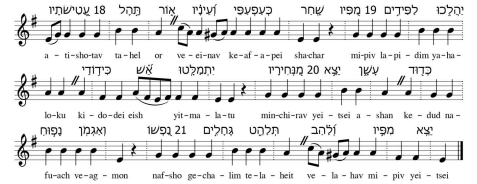
Oratorio part 6, Job 41, a handful of verses

Job is a wonderful story set to music. You can't read it without the music. It will just be a horror show to you. The whole mess is built on Deuteronomy 28. What the story teller is doing is binding and loosing the Torah right in front of you - so you should be able to see it now. It is truth for each one of us due to the slings and arrows of outrageous fortune, but it is story of a human with real backbone and he is solidly affirmed as such. The speeches and Behemoth and Leviathan are the stuff of art.

Job 41

Job 41, raw material - write me a fugue

Syllables: 62. Words: 24. Roots: 21. Root Recurrence: 25%. Average per verse: 1.5.
עֲֽ֭טִישֹׁתָיו תָּ֣הֶל א֑וֹר
וְ֝עֵינָ֗יו כְּעַפְעַפֵּי־שָֽׁחַר
18 ♪g His sneezing praises light,
and his eyes are like the eyelids of dawn.
ik y'tiwotiv thl aor
vyiniv cypypi-wkr
7
8
y+iw\tiv t/hl avr
v/yin\iv c/ypyp\i wkr
מִ֭פִּיו לַפִּידִ֣ים יַהֲלֹ֑כוּ
כִּיד֥וֹדֵי אֵ֝֗שׁ יִתְמַלָּֽטוּ
19 ♪g From his mouth torches walk,
and infatuations of fire escape.
i't mpiv lpidim ihlocu
cidodi aw itml'tu
9
8
m/p\iv lp\idim i/hlc\v
ci/dvd\i aw it/ml+\v
מִ֭נְּחִירָיו יֵצֵ֣א עָשָׁ֑ן
כְּד֖וּד נָפ֣וּחַ וְאַגְמֹֽן
20 ♪g From his sniffler he makes smoke emerge,
as one who is infatuated stokes bulrushes.
c mnkiriv iixa ywn
cdud npuk vagmon
7
8
mn/kr\v ixa ywn
c/dvd npk v/agm\n
נַ֭פְשׁוֹ גֶּחָלִ֣ים תְּלַהֵ֑ט
וְ֝לַ֗הַב מִפִּ֥יו יֵצֵֽא
21 ♪g His very self blazes coals,
and flame from his mouth emerges.
ca npwo gklim tlh't
vlhb mpiv iixa
8
7
npw\v gkl\im t/lh+
v/lhb m/p\iv ixa

Here is the traditional fire-breathing dragon. Chorus: 18g His sneezing praises light, // and his eyes are like the eyelids of dawn. 19g From his mouth torches walk, // and infatuations of fire escape. 20g From his sniffler he makes smoke emerge, // as one who is infatuated stokes bulrushes. 21g His very self blazes coals, // and flame from his mouth emerges.

The beginning of the fugue


Sunday, 14 November 2021

Oratorio part 6, who are we?

The next section of the oratorio in day 6 - reflects on the question, what is this humanity in a trio, Job and the two similar verses that book end the psalter: Trio (Psalms 144:3-4, Job 7:17,19, reprise Psalm 8:4-5 - page 120).

The Bible is full of conundrums here - we can't escape that the characters in miniature reflect the same confusion and conflicts that we have today. Who are we and how will we take responsibility for what we have done? 

But the churches of course have a great deal of confusion to rid themselves of before they will be useful to the world and truly reflect love. There is no defense for the churches here. The banner wavers operate with lust to power, oversimplification, denial of the gift of science, all blended with ignorance and self-protection.

Psalms 144:3-4 - humanity - futility - as a shadow passing away

Syllables: 30. Words: 13. Roots: 12. Root Recurrence: 15%. Average per verse: 1.
יְֽהוָ֗ה מָה־אָ֭דָם וַתֵּדָעֵ֑הוּ
בֶּן־אֱ֝נ֗וֹשׁ וַֽתְּחַשְּׁבֵֽהוּ
3 Yahweh, what is this humanity that you know it,
a mortal child that you devised it?
g ihvh mh-adm vtdyhu
bn-anow vtkwbhu
10
7
ihvh mh adm vt/dy\hv
bn anvw vt/kwb\hv
אָ֭דָם לַהֶ֣בֶל דָּמָ֑ה
יָ֝מָ֗יו כְּצֵ֣ל עוֹבֵֽר
4 ♪g Humanity is like futility,
its days as a shadow passing away.

d adm lhbl dmh
imiv cxl yobr
7
6
adm l/hbl dmh
im\iv c/xl yvbr

Psalms 8:4-5 - mortal, remembered, visited, crowned
Syllables: 43. Words: 17. Roots: 15. Root Recurrence: 18%. Average per verse: 1.5.
כִּֽי־אֶרְאֶ֣ה שָׁ֭מֶיךָ מַעֲשֵׂ֣י אֶצְבְּעֹתֶ֑יךָ
יָרֵ֥חַ וְ֝כוֹכָבִ֗ים אֲשֶׁ֣ר כּוֹנָֽנְתָּה
4 For I see your heavens that your fingers make,
moon and stars which you have established.
d ci-arah wmiç mywi axbyotiç
irk vcocbim awr connt
14
12
ci a/rah wm\ic m/yw\i axby\tic
irk v/cvcb\im awr cvn\nth
מָֽה־אֱנ֥וֹשׁ כִּֽי־תִזְכְּרֶ֑נּוּ
וּבֶן־אָ֝דָ֗ם כִּ֣י תִפְקְדֶֽנּוּ
5 What is a mortal? for you remember it.
And a child of humanity? for you visit it,
h mh-anow ci-tzcrnu
ubn-adm ci tpqdnu
8
9
mh anvw ci t/zcr\nv
v/bn adm ci t/pqd\nv

Job 7:17-19 - a mortal, made great, imposed on, visited in the morning, tested
Syllables: 48. Words: 21. Roots: 18. Root Recurrence: 29%. Average per verse: 2.
מָֽה־אֱ֭נוֹשׁ כִּ֣י תְגַדְּלֶ֑נּוּ
וְכִי־תָשִׁ֖ית אֵלָ֣יו לִבֶּֽךָ
17 What is a mortal that you make him great,
and that you impose on him your heart?
iz mh-anow ci tgdlnu
vci-twit aliv libç
8
8
mh anvw ci t/gdl\nv
v/ci t/wit al\iv lb\c
וַתִּפְקְדֶ֥נּוּ לִבְקָרִ֑ים
לִ֝רְגָעִ֗ים תִּבְחָנֶֽנּוּ
18 And you visit him in the mornings.
At every moment you test him.
ik vtpqdnu lbqrim
lrgyim tbknnu
8
7
vt/pqd\nv l/bqr\im
l/rgy\im t/bkn\nv
כַּ֭מָּה לֹא־תִשְׁעֶ֣ה מִמֶּ֑נִּי
לֹֽא־תַ֝רְפֵּ֗נִי עַד־בִּלְעִ֥י רֻקִּֽי
19 ♪g How long till you not look at me,
or desist from me, even as I swallow my spit?
i't cmh la-twyh mmni
la-trpni yd-blyi ruqi
8
9
c/mh la t/wyh m/mn\i
la t/rp\ni yd bly\i rq\i

The above are a trio - A T B

Where is Jonah when we really need him to preach to Nineveh - and then himself to act in love rather than schadenfreude. (I've set Jonah as a cantata - it's a hoot as well as a good lesson. I even managed to get in an allusion to Gershwin - and that directly from the music that is in the Bible. Didn't know Gershwin was in the Biblical text, did you. Well, the things you are liable to read in the Bible, it ain't necessarily so.)


Oratorio part 6 Jeremiah and Genesis

I continue to revisit the oratorio I wrote in 2019, Unleashing Leviathan. 

Part 6 begins with day 6 of Genesis. Again this performance is the example for all recitative singing. 

One area that absolutely struck me is the detailed allusion to Genesis 1 in Jeremiah 4:23-27. This little section begins with the obstinacy of the people (v22): 

For obstinate are my people. Me, they do not know. Silly children, they are, and without understanding they are.
Shrewd they are to do evil, but to do good they do not know.

I really should add this verse to the score - A four part fugue?

Jeremiah 4:22

Then the four verses following reflect Genesis 1 - so I have put the music of Genesis 1 as a reprise against Jeremiah's allusions. I won't go line by line here but you can see the music on page 118 in the pdf of the score here.

The curious thing is that erets (arx) can be either 'land' or the 'earth' (Psalms 24:1) - both are Yahweh's as if to say that our exploitation of them, land or earth as a whole, does not proceed from our 'ownership' of them. Not that we should read too much into three letters, aleph, resh, tsade. But the overall effect is to recognize that the earth as described in Genesis is there in miniature in Jeremiah's reflection on the land of Israel. 

I have set the music according to the te'amim in the Hebrew text. In this piece I have set it in two conflicting keys. Jeremiah is a bass singing with d as his tonic. In Genesis I have made e the tonic. The results are quite dismal at times.

Jeremiah 4:22-27
Syllables: 155. Words: 66. Roots: 44. Root Recurrence: 53%. Average per verse: 5.8.
adm ain (2) al amr ap arx (2) at (2) avil avr bhv bin bn ch ci (2) cl (4) clh crml 'tvb gby hih hm (3) hnh (4) hr idy (2) ihvh (2) kcm krh la (4) mdbr ndd ntx pnh (2) qll rah (4) ryw ryy scl thv wmim (2) wmm yir ym yvp ywh
כִּ֣י ׀ אֱוִ֣יל עַמִּ֗י אוֹתִי֙ לֹ֣א יָדָ֔עוּ בָּנִ֤ים סְכָלִים֙ הֵ֔מָּה וְלֹ֥א נְבוֹנִ֖ים הֵ֑מָּה
חֲכָמִ֥ים הֵ֙מָּה֙ לְהָרַ֔ע וּלְהֵיטִ֖יב לֹ֥א יָדָֽעוּ
22 ♪B For obstinate are my people. Me, they do not know. Silly children, they are, and without understanding they are.
Shrewd they are to do evil, but to do good they do not know.
cb ci avvil ymi aoti la idyu bnim sclim hmh vla nbonim hmh
kcmim hmh lhry ulhi'tib la idyu
25
15
ci avil ym\i avt\i la idy\v bn\im scl\im hm\h v/la n/bvn\im hm\h
kcm\im hm\h lh/ry vlhi/+b la idy\v
רָאִ֙יתִי֙ אֶת־הָאָ֔רֶץ וְהִנֵּה־תֹ֖הוּ וָבֹ֑הוּ
וְאֶל־הַשָּׁמַ֖יִם וְאֵ֥ין אוֹרָֽם
23 I saw the land, and behold, formless and void,
and to the heavens, and their light was not.
cg raiti at-harx vhnh-tohu vbohu
val-hwmiim vain aorm
15
9
ra\iti at h/arx v/hnh thv v/bhv
v/al h/wmim v/ain avr\m
רָאִ֙יתִי֙ הֶֽהָרִ֔ים וְהִנֵּ֖ה רֹעֲשִׁ֑ים
וְכָל־הַגְּבָע֖וֹת הִתְקַלְקָֽלוּ
24 I saw the hills and behold, quaking,
and all the hillocks, dwindling.
cd raiti hhrim vhnh roywim
vcl-hgbyot htqlqlu
12
9
ra\iti h/hr\im v/hnh ryw\im
v/cl h/gby\vt ht/ql\qlv
רָאִ֕יתִי וְהִנֵּ֖ה אֵ֣ין הָאָדָ֑ם
וְכָל־ע֥וֹף הַשָּׁמַ֖יִם נָדָֽדוּ
25 I saw and behold, there was no human,
and all the fowl of the heavens have fled.
ch raiti vhnh ain hadm
vcl-yof hwmiim nddu
10
9
ra\iti v/hnh ain h/adm
v/cl yvp h/wmim ndd\v
רָאִ֕יתִי וְהִנֵּ֥ה הַכַּרְמֶ֖ל הַמִּדְבָּ֑ר
וְכָל־עָרָ֗יו נִתְּצוּ֙ מִפְּנֵ֣י יְהוָ֔ה מִפְּנֵ֖י חֲר֥וֹן אַפּֽוֹ ס
26 I saw and behold, the plantation in the wilderness,
and all its cities were broken down from the face of Yahweh, before his fierce anger.
cv raiti vhnh hcrml hmdbr
vcl-yriv nitxu mpni ihvh mpni kron apo s
12
17
ra\iti v/hnh h/crml h/mdbr
v/cl yr\iv ntx\v m/pn\i ihvh m/pn\i kr\vn ap\v
כִּי־כֹה֙ אָמַ֣ר יְהוָ֔ה שְׁמָמָ֥ה תִהְיֶ֖ה כָּל־הָאָ֑רֶץ
וְכָלָ֖ה לֹ֥א אֶעֱשֶֽׂה
27 Because thus says Yahweh, Desolate, will be all the land,
but a consuming end, I will not make.
cz ci-ch amr ihvh wmmh thih cl-harx
vclh la aywh
15
7
ci ch amr ihvh wmm\h t/hih cl h/arx
v/clh la a/ywh
Selected recurrence

Recurrence patterns in Jeremiah 4:22-27

Oratorio part 5, Psalms 114-115

Here is the promised pair of psalms to end part 5. Psalms 114, as sung today from both the Anglican Psalter and the Plainsong Psalter, preserves a melody nearly identical to the one determined from the deciphering key of Suzanne Haïk-Vantoura. She remained unaware of this during her lifetime. 

Psalms 115 is connected to 114 by the first note. I have taken the starting of a verse or a chapter or a book as the signal of a connection with what has gone before. This is a thesis yet to be disproved. Certainly I can find arguments against it, but so far every example I have noted (many on this blog) shows a possibility that could easily be considered deliberate by the scribal musician. In this case, the warning in the first verse of 115 is that the exodus is not to the glory of Israel but to the name of Yahweh. The Latin is famous for its popularity in song. Non nobis Domine.

The chorus is a chorale in 5/4 time, suitable to the angularity of the melody of Psalms 115:1.

Psalms 114:1-3a, 115:1 Tonus Peregrinus and the response.

In Exitu Israel
Syllables: 47. Words: 18. Roots: 17. Root Recurrence: 11%. Average per verse: .7.
בְּצֵ֣את יִ֭שְׂרָאֵל מִמִּצְרָ֑יִם
בֵּ֥ית יַ֝עֲקֹ֗ב מֵעַ֥ם לֹעֵֽז
1 When Israel came out from Egypt,
the house of Jacob from an exotic people,
a bxat iwral mmxriim
bit iyqob mym loyz
9
8
b/xa\t iwral mm/xr\im
bit iyqb m/ym lyz
הָיְתָ֣ה יְהוּדָ֣ה לְקָדְשׁ֑וֹ
יִ֝שְׂרָאֵ֗ל מַמְשְׁלוֹתָֽיו
2 Judah became his sanctuary,
Israel his parables.
b hiith ihudh lqodwo
iwral mmwlotiv
8
7
h/i\th ihvdh l/qdw\v
iwral m/mwl\vtiv
הַיָּ֣ם רָ֭אָה וַיָּנֹ֑ס
הַ֝יַּרְדֵּ֗ן יִסֹּ֥ב לְאָחֽוֹר
3 The sea saw and withdrew.
The Jordan was surrounded from behind.
g him rah vinos
hirdn iisob lakor
7
8
h/im rah vi/ns
h/irdn i/sb l/akvr
1 foreign לעז (lyz) or strange tongue, a hapax in the Bible.
2 parables, משׁל(mwl) or more traditionally the domain of his rule, but it is plural, not singular, so it does not support a dominance or a colonial model.
3 was surrounded סבב (sbb) quite common, rich in potential glosses, trad. 'driven' since only here in the Psalter does this word appear to have the sense of change in direction as opposed to surrounding or encircling so I first rendered it as if taken by surprise.

Saturday, 13 November 2021

Habakkuk 1:1-2:1

Tomorrow I read NRSV Habakkuk 1. NRSV manages to get punishment into the text in verse 12. About half the modern translations use punish for the root ick (no that's not the origin of the English word, icky). The root is pronounced roughly as ykhach - i.e. the i (yod) is a consonant, the c (kaf) is a hard c with some air, and the k (chet) is ch as in loch.

Why is it that we have such punishment on the brain? ick signifies correction, reproof, and so on. It is a key word for understanding the book of Job. Such things are not punishment but they are evidence of presence. What if translators cooperated with God rather than imputing to God things that are not in God's character?

I do not like the NRSV. I am happy that scholars try, and I use whatever results of scholarship that seem useful that come across my desk. I am not anti-scholarship. Is my prejudice that God does not punish worse than the prejudice that God is one who punishes? Did you believe them when they said, "This will hurt me more than it does you"? 

That was a false statement by the wielders of corporal punishment. They were fighting the last war. Perhaps I am a losing battle.

The committees I suspect have a bias towards doctrines like penal substitution. I am Christian but I don't accept this idea of punishment since reading the Old Testament. There is no Hebrew root that has punishment as its dominant sense. We can certainly read that into several words but their other senses give the lie to our readings. I've gone on about this before.

Anyway - here is Habakkuk 1:1-2:1 - ick (reprove, correct) occurs in Hab 2:1 also and the NRSV renders it as complaint. What! Where did the committee get that gloss from? Must have been a dusty shelf they pulled it off at random. None of the glossaries derived from the last 400 years of English translation give complaint as a gloss for ick.

There is no simple rule to follow when glossing a word in Hebrew. Several of them have multiple senses, often related, but distinguishing different things. In Hab 1:12 and Hab 2:1 there are two words that are shared, ick and xvr. The second is rock, or fortification. You can see all my choices for glosses at the links.

So what will I read tomorrow? Last time I read I read my own translation of Ecclesiastes 11-12 (aka Qohelet). This time is it too different?

There is another change in verse 12 - 'we will not die' (Hebrew) is rendered as 'you will not die'. Apparently this is one of the scribal corrections to the text. (According to Wiki at least.) Some scholars put it down to a squeamish pious scribe who can't see that the prophet would appeal to the deathlessness of God. I doubt it. As far as I can see, and that's not far, this reading goes back to the Aleppo codex. The Greek is first person plural. So if it reflects the text prior to the common era, the change must have been very early indeed. I can't see a notification of this reading as a correction from the Habakkuk in the Dead Sea Scrolls. 

Anyone out there got any advice? (Other than just do as you're told, MacDonald.)

This is my translation. 

1 The load which Habakkuk the prophet gazed on.

2 How long please, Yahweh, will I cry and you will not hear?
Will I appeal to you of violence and you will not save?

3 ♪B Why do you show me mischief and misery you make me notice, and devastation and violence before me?
And there is contention and sentence borne.

4 Therefore numbed is instruction and lasting judgment fails to emerge,
for wickedness encircles the righteous one, therefore crooked judgment emerges.

5 See among the nations and take note and marvel with astonishment,
for he worked a work in your days you would not have believed though it were recounted.

6 For note me well, I raise up the Chaldeans, the bitter and swift nation,
to rush into the broad land to possess dwellings that are not theirs.

7 Horrible and feared it is.
From this its judgment and its forbearance will emerge.

8 And fleeter than leopards are its horses, and keener than wolves of evening, its cavaliers frisk about.
And its cavaliers come from afar. They fly like an eagle hurrying to eat.

9 All for violence it comes, their faces pumped up as the east wind,
and it gathers captives as in a dance.

10 And it, among sovereigns, ridicules them, and the rule-makers laugh at it.
Itself, at all enclosure it laughs and it accumulates dust and catches it.

11 ♪B Then it is renewed in spirit when it has passed through and been declared guilty.
This is its power for its god.

12 Are not you from the east, Yahweh my God, my Holy One? We will not die.
Yahweh, for judgment, you have set it up, and for a rock of correction you have founded it.

13 Too clean of eyes than to see evil and you cannot notice misery?
Why do you notice the treacherous? You are silent when wickedness swallows one more righteous than itself.

14 And you make humanity as the fish of the sea,
as a creeper that has no governor over it.

15 All of it with a fishhook brought up, it gullets them in utter destruction, and it gathers them into its own cravings,
therefore it will be glad and it will rejoice.

16 Therefore it will offer its utter destruction and burn incense to its own cravings,
for in them is the oil of its share and its plenteous food.

17 ♪f Will it therefore empty its utter destruction,
and continually slay nations without pity?

1 On my watch I will stand and I will station myself on the fortification.
And I will be on lookout to see what he will speak in me and what I will bring back concerning my correction.

This translation is part of the English guide to the SimHebrew Bible. The whole Bible in Simulated Hebrew with English, verse by verse is available through this link. Look around, there are good deals available.

Oratorio part 5, Job 7:12, 40:15-19

Part 4 begins with day 5 of Genesis. Again this performance is the example for all recitative singing. 

The incipit is from Psalms 73:22. The psalmist helps us to understand the use of animal imagery in Job.

Psalms 73:22 - I myself was a brute without knowledge. // Behemoth I was with you. Mode 2
A Psalm of Asaph
Syllables: 16. Words: 7. Roots: 7. 
וַאֲנִי־בַ֭עַר וְלֹ֣א אֵדָ֑ע
בְּ֝הֵמ֗וֹת הָיִ֥יתִי עִמָּֽךְ
22 I myself was a brute without knowledge.
Behemoth I was with you.

cb vani-byr vla ady
bhmot hiiti yimç
8
8
v/ani byr v/la a/dy
bhm\vt h/i\iti ym\c

The character of Job with the text from 7:12, becomes 4 voices, playing on the corporate nature of our humanity as being insubordinate like the sea.

Syllables: 13. Words: 8. Roots: 8. 
הֲֽיָם־אָ֭נִי אִם־תַּנִּ֑ין
כִּֽי־תָשִׂ֖ים עָלַ֣י מִשְׁמָֽר
12 Am I the sea or a dragon,
that you put a guard over me?
ib him-ani am-tnin
ci-twim ylii mwmr
7
6
h/im ani am tnin
ci t/wim yl\i m/wmr

Then we follow with the description of Behemoth.
Job 40:15-19
Syllables: 82. Words: 36. Roots: 33. Root Recurrence: 17%. Average per verse: 1.2.
הִנֵּה־נָ֣א בְ֭הֵמוֹת אֲשֶׁר־עָשִׂ֣יתִי עִמָּ֑ךְ
חָ֝צִ֗יר כַּבָּקָ֥ר יֹאכֵֽל
15 Behold, if you will, Behemoth, whom I made with you.
Grass like an ox he eats.
'tv hnh-na bhmot awr-ywiti yimç
kxir cbqr iacl
13
7
hnh na bhm\vt awr yw\iti ym\c
kxr c/bqr i/acl
הִנֵּה־נָ֣א כֹח֣וֹ בְמָתְנָ֑יו
וְ֝אֹנ֗וֹ בִּשְׁרִירֵ֥י בִטְנֽוֹ
16 Behold if you will his power in his loins,
and his virility in the navel of his belly.
'tz hnh-na coko bmotniv
vaono bwriri b'tno
8
8
hnh na ck\v b/mtn\iv
v/avn\v b/wr\iri b+n\v
יַחְפֹּ֣ץ זְנָב֣וֹ כְמוֹ־אָ֑רֶז
גִּידֵ֖י פַחֲדָ֣יו יְשֹׂרָֽגוּ
17 He delights in his tail like a cedar.
The sinews of his dreads are intertwined.
iz ikpox znbo cmo-arz
gidi pkdiv iworgu
8
9
i/kpx znb\v cmv arz
gid\i pkd\v i/wrg\v
עֲ֭צָמָיו אֲפִיקֵ֣י נְחוּשָׁ֑ה
גְּ֝רָמָ֗יו כִּמְטִ֥יל בַּרְזֶֽל
18 ♪g His bones are channels of brass,
his cartilage like cast-iron.
ik yxmiv apiqi nkuwh
grmiv cm'til brzl
9
7
yxm\iv apiq\i nkw\h
grm\iv cm/+l brzl
ה֭וּא‬ רֵאשִׁ֣ית דַּרְכֵי־אֵ֑ל
הָ֝עֹשׂוֹ יַגֵּ֥שׁ חַרְבּֽוֹ
19 ♪g He is the beginning of the ways of the One.
He who made him can make overture to his sword.
i't hua rawit drci-al
hyowo igw krbo
6
7
hva raw\it drc\i al
h/yw\v i/gw krb\v
15 Tur Sinai claims that Behemoth is simply 'the beasts' and not a single creature. He says the whole of the last speech is about one creature Leviathan, not identified till the middle of the poem. I can't find anyone who agrees with him. Pope has two pages of serious notes here - proving it is not the Egyptian hippo. Again we have plural antecedent with singular pronouns.(Curiouser and curiouser - said Alice!). Good has a whole chapter I will reflect on later.

Chapter 40 has 24 verses in KJV and 32 in JPS. A little more investigation at Church this morning into the REB shows that they have two chapter 41's - one preceding chapter 40 consisting of 41:1-6, a complete non-sequitur to the eagles. The REB has marvelous English - but it isn't even close to the Hebrew in places and there is no attempt at concordance. So in chapter 3 Leviathan and in chapter 41, the same word is whale. In chapter 3 'the eyelids of the morning' and in chapter 41 the same phrase is translated 'the shimmering dawn'. If you do this, the English reader doesn't have a chance at seeing or hearing frame and thread.

I will not subject my first reading to dictatorial and undocumented textual changes or shifts and will go with two creatures, Behemoth and Leviathan. It is not important to try and identify these beasties. (By the way if we go with one monster he eats oxen like grass.)
16 Pope has two pages of serious notes here - proving it is not the Egyptian hippo.
19 There is no doubt this is about creation!
And of new creation - hidden in the sword that pierces the heart.

The beginning of the description of Behemoth