Showing posts sorted by date for query acrostics. Sort by relevance Show all posts

Monday, 15 December 2025

Hebrews 1:9-14

The source for this text cantillated by Ezekiel Margoliouth is here. I've been buried with other work on Tanach and publishing as well as walking the dog and other chores in the wet of an atmospheric river, -- so no time to give to this passage. Here is the rest of the music and a few notes for chapter 1.

Hebrews 1:9 You have loved righteousness and hate wickedness, therefore God, your God, has anointed you with the oil of joy above your companions.
Citing Psalm 45:8, compare with the Masoretic text:
Margoliouth does not use the te'amim of the poetry. He is reporting on the psalm in a work of prose, so the music is quite different. No genre of poetry is recognized in the NT as are the three books, Psalms, Proverbs, and the speeches of Job in the Tanach. Also the poetry uses different modes from the 21 books of prose, so comparison of the music is moot in any case. Notice that the psalmist has no internal rest point in this verse. The breath invited on the zaqef-qatan is not a cadence. 

The psalms are frequently quoted in Hebrews. They are used for most of the conversation between the Father and the Son. They are also our conversation and the record of the conversation of ancient Israel with the Most High.

Hebrews 1:10 And again, You, my Lord, long ago, you founded the earth, and the deeds of your hands, the heavens.

Hebrews 1:11 They will perish, but you, you will stand, and they all, like a garment, will wither.

Hebrews 1:12 Like raiment you will renew them and they will be renewed, and you are he, and your years will not be complete.
These three verses are from Psalm 102. The images are from my latest volume on the psalms.
Again the music is substantially different because the te'amim are the different set. There are connections from verse 10-11 in Hebrews and between the corresponding verses 26-27 of the psalm. But the verses themselves do not correspond in their content. I look upon prose that cites poetry as a 'report' rather than a poetic performance.

Hebrews 1:13 And to which from the messengers has he said ever, Sit at my right hand till I set your enemies as a stool for your feet.
This verse invokes Psalm 110, a vital part of the framework of the Psalter as a whole, being the second oracle of two in the Psalter -- matching Psalm 36 in Book 1 and drawing together the whole Psalter with Psalms 8 and 144 also being in correspondence to each other. The other psalms joining in this structural chiasm are 9-10, 145, 37, 111-112 -- all of them acrostics celebrating the psalm that just precedes them. See this post for the diagram.

Psalm 110, the most enigmatic of all the psalms

To end the chapter here is verse 14:

Hebrews 1:14 Are not they all ministering spirits, they, sent to minister on behalf of those eager for the new wine of salvation.

The complexity of this first chapter is overwhelming as it draws the First Testament into the foundation of the faith in Christ, the inheritor of all messianic titles whether of ruler or of suffering servant.

Here's a link to the pdf of my ancient diagram including Hebrews 1 based on the work of Vanhoye.  It is a full circle for me representing where I came from 20 years ago and inviting several more books! Can't go there. There's a reason I studied Hebrew. It was easier than taking on the New Testament and the massive hopes and fears of that first century so much of which the record is lost because of the destruction of Jerusalem by 'the empire'.

Friday, 29 November 2024

Composing a verse - another quiz.

Suppose we had to compose a verse, one that was missing and had to be reconstructed from the Greek or some other version.  Well there is at least one such candidate. In psalm 145 the verse between 13 and 14, Nun, is missing. We know it's missing because the four acrostics in book 4 of the psalms are perfect. So why is one of them missing a verse? (The four acrostics in book 1 are all flawed. Maybe we could find some of those missing verses too. Then we would need to understand the conventions and the customs of this accent system to get something to match.)

Here is a reconstruction based on the Septuagint and the DSS. What sort of errors are in it?

Questions
  1. Bar 3 has a potential error. What action would you take to fix it?
  2. Bar 5 is suspicious -- is it wrong?
  3. Bar 7 -- where is the end of the verse?
  4. Bar 9 -- where is the caesura?
  5. What is the ornament in bar 9?

Two verses in one -- restoring the music of a missing verse

Psalms 145: (Verses 13 to 13) Syllables: 35; Longest recitation: 6; Tenor: e 51.43%;
Ornament density: 14.3%; Average phrase length: 8.8.

13 Making your reign a reign for every era,
and your governance in all generations.
Note that faithful is Yahweh in his words,
and merciful in all his deeds. (1-4-1)
יג מֽלכותך֗ מלכ֥ות כל־עֽלמ֑ים
ו֝מֽמשלתך֗ בכל־ד֥ור ודֽור
נאמ֗ן יהו֣ה בדבר֑יו
וחס֡יד בכ֥ול מעשֽיו
9
10
8
8
ig mlcutç mlcut cl-yolmim
ummwltç bcl-dor vdor
namn ihvh bdbriv
vksid bcol mywiv


Solutions
  1. Check the silluq against the Aleppo codex. Remove the silluq from עֽלמ֑ים. Bar 5 now bar 4 agrees with Aleppo.
  2. Check the silluq in bar 5 above against the Aleppo codex. It's there. So no change. But the question still is: how often does this interval occur on the ornament that leads back to the tonic from the subdominant.
  3. Put in a rest or a break if you can't renumber the verses for historical reasons.
  4. This is two verses, not one, so mark the caesura between the last syllable of the word that has the atnah and the first syllable of the rest of the verse.
  5. The ornament is pazer. The pazer is never used after the atnah in the three poetry books, so don't use it. Replace it with revia-mugrash if you want to use that poetic ornament that prepares for the return to the tonic. 
Corrections
Consequences
Questions we've all been thinking about :)

What ornaments occur or not before or after a cadence? The ornaments used in the poetry are qadma, revia, tsinnor, pazer, zarqa, geresh, shalshelet, revia-mugrash, illuy, ole.

We know about ole. It occurs exclusively with merkha following and is called ole veyored. Ole occurs on several reciting notes and is always followed by its paired merkha which moves the recitation to f#. We know about revia-mugrash. It occurs only as part of the return to the tonic in a verse.

The amount of data is too large to display with any degree of useful abstraction. I have a query that will summarize it by verse type but statistics with a summary for each accent is beyond me to reduce to anything useful. These are the observations for the poetry.
  1. 1-1 shape: what ornaments and notes are used in verses where there is no internal cadence. All the poetic ornaments occur in this type of verse. There are 68 patterns for the 147 such verses in the psalms.
  2. 1-2-1 shape: leading to the ole-veyored and returning to the tonic where there is no atnah. There are 45 such verses with 32 patterns leading to the mid-verse cadence and 30 distinct patterns returning to the tonic. Pazer occurs in the second part but tsinnor does not.
  3. 1-4-1 is the most common verse-type (2,037 occurrences): All ornaments can appear in the first part of a verse except the combination revia-mugrash which if it is used, appears only in the last phrase of a verse. All ornaments appear in one or other of these verses following the atnah except tsinnor and pazer. 
  4. 1-2-4-1 the tricolon, occurs 298 times in the psalms. There are 131 distinct patterns leading to the ole veyored, 46 distinct patterns leading from the cadence on the supertonic to the cadence on the subdominant, and 34 distinct patterns leading to the tonic.
There is overlap between the opening frames of the 1-2-1 and the 1-2-4-1 and the closing frames of 1-4-1 and the 1-2-4-1. See the data details in the next post.

Tuesday, 26 November 2024

Psalm 119 - parts 1 to 4 - verses 1-32

Overall, Psalm 119 is a restful adoration of God and God's promises. So one would expect an overall tenor of A. I have scheduled these posts every 3 days for the next 2 weeks.

Psalms 119: Syllables: 2837; Longest recitation: 11; Tenor:  A  23.30%;
Ornament density: 7.3%; Average phrase length: 8.7.

The tenor of each part varies. 

I think of each reciting note as having a characteristic sense. 
The high C, I consider as appeal and sometimes emotions like grief. The B, the harmonic dominant and the first natural harmonic of the shophar or a natural brass instrument, is for proclamation and story telling. The A is for rest, a note of stability. The g, the third degree of the scale is often the tenor in the poetry but rarely in the prose. I think it may have associations with adoration in this psalm. What do you think? The f#, the note of the supertonic and the cadence on the ole-veyored to me is pending, telling us there is something more to come.

The low e, the tonic, has the tonal sense of home, and it is the place where a verse starts if it is not overridden by another accent. Every place where the silluq occurs inside a verse I have verified from the Aleppo codex. The ones that remain are in the earliest manuscript we have. What do the musical shapes of each line suggest to you? I think we must sing them, even if to ourselves, to imagine what we are listening to and how the psalmist thought about these words.

E.g. in verse 1 the return to e on the second word temimei in bar 3 brings low tessitura to the sense of completeness. To be at home 'completes' each verse. So the e fits. The way, derek, is on the rest note, A. The way is stable. The one who walks is recited on the A also. So the walk is stable. It enters into rest. We return quietly to the tonic by way of the subdominant. The verse begins e f# and ends f# e. It is not announcement as it would be if the melody included the B; or appeal, or complaint, or grief as it would be if a high C was used. Notice in part 1 how the first seven verses are connected by the music.

Law -- God's 'law' which here I render as instruction (and never as law) -- is a beautiful thing. And this acrostic celebrates it in response to the previous psalm 118. All acrostics celebrate the psalm just prior to them. This I have shown to be a key structural aspect of the psalter as a whole. Click the acrostic label for more on the acrostics. I had better schedule psalm 118 soon.
Psalms 119: (Verses 1 to 16) Syllables: 234; Longest recitation: 9; Tenor: f# 28.33%;
Ornament density: 8.6%; Average phrase length: 8.6.

(Verses 1 to 8) Syllables: 113; Longest recitation: 9; Tenor: f# 38.94%;
Ornament density: 8%; Average phrase length: 8.7. 
(Verses 9 to 16) Syllables: 121; Longest recitation: 7; Tenor: A 28.10%;
Ornament density: 9.2%; Average phrase length: 8.6.
  
1 All joy for the complete of the way,
who walk in the instruction of Yahweh. (1-4-1)
א אשר֥י תמֽימי־ד֑רך
הֽ֝הלכ֗ים בתור֥ת יהוֽה
6
8
a awri tmimi-drç
hholcim btort ihvh
2 ♪g All joy for those observing his testimonies. With a whole heart they search him out. (g-1-1)
ב א֭שרי נצר֥י עדת֗יו בכל־ל֥ב ידרשֽוהו 14
b awri noxri ydotiv bcl-lb idrwuhu
3 ♪g Also they do not work injustice,
in his ways they walk. (g-1-4-1)
ג א֭ף לא־פעל֣ו עול֑ה
בדרכ֥יו הלֽכו
6
6
g af la-pylu yvvlh
bdrciv hlcu
4 ♪g And you commanded your precepts to keep in full. (g-1-1)
ד א֭תה צו֥יתה פקד֗יך לשמ֥ר מאֽד 13
d ath xivvit piqudiç lwmor maod
5 ♪g Ah that established were my ways to keep your statutes. (g-1-1)
ה א֭חלי יכ֥נו דרכ֗י לשמ֥ר חקֽיך 14
h aklii iiconu drcii lwmor kuqiç
6 ♪f And then I would not be ashamed,
to take note of all your commandments. (~1-4-1)
ו א֥ז לא־אב֑וש
ב֝הביט֗י אל־כל־מצותֽיך
3
10
v az la-abow
bhbiTi al-cl-mxvotiç
7 ♪g And I will thank you with an upright heart,
when I learn the judgments of your righteousness. (g-1-4-1)
ז א֭ודך בי֣שר לב֑ב
ב֝למד֗י משפט֥י צדקֽך
7
9
z aodç biowr lbb
blomdi mwpTi xdqç
8 And your statutes I will keep.
Do not forsake me in full for ever. (1-4-1)
ח את־חק֥יך אשמ֑ר
אֽל־תעזב֥ני עד־מאֽד
6
8
k at-kuqiç awmor
al-tyzbni yd-maod
9 But how will a youth clear his path,
to keep it according to your word? (1-4-1)
ט במ֣ה יזכה־נ֭ער את־ארח֑ו
ל֝שמ֗ר כדברֽך
10
6
T bmh izch-nyr at-aorko
lwmor cdbrç
10 By all my heart I have searched you out.
Do not let me stray from your commandments. (1-4-1)
י בכל־לב֥י דרשת֑יך
אל־ת֝שג֗ני ממצותֽיך
8
9
i bcl-libi drwtiç
al-twgni mmxvotiç
11 ♪g By my heart I have treasured your promise,
in order that I will not sin against you. (g-1-4-1)
יא ב֭לבי צפ֣נתי אמרת֑ך
ל֝מ֗ען ל֣א אחטא־לֽך
10
8
ia blibi xpnti amrtç
lmyn la akTa-lç
12 Blessed are you Yahweh. Teach me your statutes. (1-1)
יב בר֖וך את֥ה יהו֗ה למד֥ני חקֽיך 12
ib bruç ath ihvh lmdni kuqiç
13 By my lips I have recounted,
all the judgments of your mouth. (1-4-1)
יג בשפת֥י ספ֑רתי
כ֝֗ל משפטי־פֽיך
6
5
ig bwptii siprti
col mwpTi-piç
14 By the way of your testimonies I joy as above all value. (1-1)
יד בד֖רך עדות֥יך ש֗שתי כע֣ל כל־הֽון 13
id bdrç ydvotiç wwti cyl cl-hon
15 By your precepts I will ponder,
and I will take note of your paths. (1-4-1)
טו בפקד֥יך אש֑יחה
ו֝אב֗יטה ארחתֽיך
8
8
Tv bpiqudiç awikh
vabiTh aorkotiç
16 By your statutes I will revel,
nor will I forget your word. (1-4-1)
טז בחקת֥יך אֽשתעש֑ע
ל֭א אשכ֣ח דברֽך
9
7
Tz bkuqotiç awtywy
la awck dbrç

Psalms 119: (Verses 17 to 32) Syllables: 255; Longest recitation: 9; Tenor: A 25.98%;
Ornament density: 7.1%; Average phrase length: 8.7.

(Verses 17 to 24) Syllables: 130; Longest recitation: 9; Tenor:  e  21.54%;
Ornament density: 7%; Average phrase length: 9.2.
(Verses 25 to 32) Syllables: 125; Longest recitation: 9; Tenor:  A  31.20%;
Ornament density: 7.3%; Average phrase length: 8.3.

17 Grow your servant. I will live and keep your word. (1-1)
יז גמ֖ל על־עבדך֥ אֽחי֗ה ואשמר֥ה דברֽך 16
iz gmol yl-ybdç akih vawmrh dbrç
18 Give discovery to my eyes,
and I will take note of wonders in your instruction. (1-4-1)
יח גל־עינ֥י ואב֑יטה
נ֝פלא֗ות מתורתֽך
7
8
ik gl-yinii vabiTh
nplaot mtortç
19 ♪B Guest I am on the earth,
do not hide from me your commandments. (B-1-4-1)
יט ג֣ר אנכ֣י בא֑רץ
אל־תסת֥ר מ֝מ֗ני מצותֽיך
7
10
iT gr anoci barx
al-tstr mmni mxvotiç
20 Ground down is my being for longing,
for your judgments at all times. (1-4-1)
כ גרס֣ה נפש֣י לתאב֑ה
אֽל־משפט֥יך בכל־עֽת
8
8
c grsh npwi ltabh
al-mwpTiç bcl-yt
21 ♪g Giving, you rebuke the presumptuous, cursed,
straying from your commandments. (g-1-4-1)
כא ג֭ערת זד֣ים ארור֑ים
ה֝שגים ממצותֽיך
8
8
ca gyrt zdim arurim
hwogim mmxvotiç
22 ♪B Get from me reproach and contempt,
for your testimonies I have observed. (B-1-4-1)
כב ג֣ל מֽ֭עלי חרפ֣ה וב֑וז
כ֖י עדת֣יך נצֽרתי
8
8
cb gl mylii krph vbuz
ci ydotiç nxrti
23 ♪C Grand sultans sat. Against me they spoke.
Your servant will ponder on your statutes. (C-1-4-1)
כג ג֤ם יֽשב֣ו ש֭רים ב֣י נדב֑רו
ע֝בדך֗ יש֥יח בחקֽיך
9
10
cg gm iwbu wrim bi nidbru
ybdç iwik bkuqiç
24 Grand your testimonies and my revel. They are my personal counsels. (1-1)
כד גֽם־ע֭דתיך שעשע֗י אנש֥י עצתֽי 14
cd gm-ydotiç wywuyii anwi yxti
25 Dust-cleaved is my being.
give me life according to your word. (1-4-1)
כה דֽבק֣ה לעפ֣ר נפש֑י
ח֝י֗ני כדברֽך
7
7
ch dbqh lypr npwi
kiini cdbrç
26 Declared have I my ways and you answered me. Teach me your statutes. (1-1)
כו דרכ֣י ס֭פרתי וֽתענ֗ני למד֥ני חקֽיך 17
cv drcii siprti vtynni lmdni kuqiç
27 Direct my discernment in the way of your precepts,
and I will ponder on your wonderful works. (1-4-1)
כז דֽרך־פקוד֥יך הבינ֑ני
ו֝אש֗יחה בנפלאותֽיך
10
10
cz drç-piqudiç hbinni
vawikh bnplaotiç
28 Drips my being with sadness.
Raise me according to your word. (1-4-1)
כח דלפ֣ה נ֭פשי מתוג֑ה
ק֝ימ֗ני כדברֽך
7
7
ck dlph npwi mtugh
qiimni cdbrç
29 Deceitful way put aside from me,
and with your instruction grace me. (1-4-1)
כט דֽרך־ש֭קר הס֣ר ממ֑ני
וֽתורתך֥ חנֽני
9
7
cT drç-wqr hsr mmni
vtortç konni
30 Deliberated have I a way of faith.
With your judgments I have agreed. (1-4-1)
ל דֽרך־אמונ֥ה בח֑רתי
משפט֥יך שוֽיתי
8
7
l drç-amunh bkrti
mwpTiç wivviti
31 Determined I cleave to your testimonies.
Yahweh, do not put me to shame. (1-4-1)
לא דב֥קתי בעֽדות֑יך
י֝הו֗ה אל־תבישֽני
8
7
la dbqti bydvotiç
ihvh al-tbiwni
32 Directed by your commandments I will race,
for you enlarge my heart. (1-4-1)
לב דֽרך־מצות֥יך אר֑וץ
כ֖י תרח֣יב לבֽי
8
5
lb drç-mxvotiç arux
ci trkib libi

The music in these posts is derived from the accents in the Hebrew Bible. Introductions - letters, music, text and music, and terminology, are here.

Thursday, 31 October 2024

Psalm 110

Psalms 110: Syllables: 146; Longest recitation: 7; Tenor: f# 21.92%;
Ornament density: 13.1%; Average phrase length: 9.1.

This psalm, one of two oracles in the psalter, is so special it is followed by two acrostics. There are no performances of the raw data that I am aware of. The psalm has great lines that lend themselves to chorale treatment. The willingness of the people is ornamented by a tsinnor in verse 3. Qadma appear in verses 1 and 4 both ornamenting the divine name. 

The music of some of the verses of Psalm 110 anchors the first part of my oratorio Unleashing Leviathan. Lots more could be done with it.

1 Of David a psalm,
an oracle of Yahweh to my Lord. Sit at my right hand,
till I set your enemies as your footstool. (1-2-4-1)
א לדו֗ד מ֫זמ֥ור
נא֤ם יהו֨ה לֽאדנ֗י ש֥ב לֽימינ֑י
עד־אש֥ית א֝יב֗יך הד֣ם לרגלֽיך
5
11
12
a ldvid mzmor
naum ihvh ladoni wb limini
yd-awit aoibiç hdom lrgliç
2 Yahweh will send the rod of your strength out of Zion.
Rule within and among your enemies. (1-4-1)
ב מטֽה־עזך֗ ישל֣ח י֭הוה מצי֑ון
ר֝ד֗ה בק֣רב איבֽיך
11
8
b mTh-yuzç iwlk ihvh mxion
rdh bqrb aoibiç
3 Your people are willing in the day of your weal.
In the honour of holiness from the womb of the dawn,
yours is the dew of your childhood. (1-2-4-1)
ג עמך֣ נדבת֮ בי֪ום ח֫יל֥ך
בֽהדרי־ק֭דש מר֣חם משח֑ר
ל֝ך֗ ט֣ל ילדתֽיך
10
10
7
g ymç ndbot biom kilç
bhdri-qodw mrkm mwkr
lç Tl ildutç
4 Yahweh has sworn and without a sigh, You are a priest forever,
by the word of Melchizedek. (1-4-1)
ד נשב֤ע יהו֨ה ול֥א ינח֗ם אתֽה־כה֥ן לעול֑ם
על־ד֝ברת֗י מלכי־צֽדק
16
8
d nwby ihvh vla iinkm ath-cohn lyolm
yl-dbrti mlci-xdq
5 My Lord is at your right hand.
He will wound kings in the day of his anger. (1-4-1)
ה אדנ֥י על־ימֽינך֑
מח֖ץ ביום־אפ֣ו מלכֽים
7
9
h adonii yl-iminç
mkx biom-apo mlcim
6 He will advocate among the nations, a fullness of bodies.
He will wound exceedingly a head on earth. (1-4-1)
ו יד֣ין ב֭גוים מל֣א גוי֑ות
מ֥חץ ר֝֗אש על־א֥רץ רבֽה
10
8
v idin bgoiim mla gvviiot
mkx raw yl-arx rbh
7 ♪g He will imbibe from the torrent in the way.
Therefore he will lift a head high. (g-1-4-1)
ז מ֭נחל בד֣רך ישת֑ה
על־כ֝֗ן יר֥ים רֽאש
8
5
z mnkl bdrç iwth
yl-cn irim raw

The music in these posts is derived from the accents in the Hebrew Bible. Introductions - letters, music, text and music, and terminology, are here.

Wednesday, 30 October 2024

Psalm 36

Psalms 36: Syllables: 236; Longest recitation: 12; Tenor: e 22.46%;
Ornament density: 9.4%; Average phrase length: 8.7.

This is one of the psalms that begins with a trumpet fanfare - the impact of the illuy as interpreted in this deciphering key derived by Suzanne Haïk-Vantoura. (Or shofar). It is one of two psalms labeled as an oracle. The other is psalm 110. Both these psalms are followed by acrostics. That makes them special. This psalm is about 'me'. It is not any 'other'. The qadma is common in the prose books but rare in the poetry, it occurs in only 353 verses.

1 For the leader. Of a servant of Yahweh. Of David. (1-1)
א למנצ֬ח לעֽבד־יהו֬ה לדוֽד 12
a lmnxk lybd-ihvh ldvid
2 An oracle on the transgression of the wicked within my heart,
there is no dread of God before its eyes. (1-4-1)
ב נאֽם־פ֣שע ל֭רשע בק֣רב לב֑י
אֽין־פ֥חד א֝לה֗ים לנ֣גד עינֽיו
12
11
b naum-pwy lrwy bqrb libi
ain-pkd alohim lngd yiniv
3 For it divides itself in its own eyes,
to find hate for its iniquity. (1-4-1)
ג כֽי־החל֣יק אל֣יו בעינ֑יו
למצ֖א עונ֣ו לשנֽא
8
7
g ci-hkliq aliv byiniv
lmxoa yvono lwnoa
4 The words of its mouth are mischief and deceit.
It leaves off insight to do good. (1-4-1)
ד דברי־פ֭יו א֣ון ומרמ֑ה
חד֖ל להשכ֣יל להיטֽיב
8
8
d dbri-piv avvn umrmh
kdl lhwcil lhiTib
5 ♪C Mischief it devises when it lies down.
It stations itself on a way that is not good.
Evil it does not refuse. (C-1-2-4-1)
ה א֤ון יחש֗ב עֽל־משכ֫ב֥ו
י֭תיצב על־ד֣רך לא־ט֑וב
ר֝֗ע ל֣א ימאֽס
8
8
4
h avvn ikwob yl-mwcbo
itiixb yl-drç la-Tob
ry la imas
6 ♪g Yahweh, to the heavens is your kindness,
your faithfulness to the skies. (g-1-4-1)
ו י֭הוה בהשמ֣ים חסד֑ך
א֝מ֥וּנתך֗ עד־שחקֽים
9
5
v ihvh bhwmiim ksdç
amוּntç yd-wkqim
7 Your righteousness as the hills of God, your judgments an exceeding abyss.
Human and beast you save, Yahweh. (1-4-1)
ז צדקֽתך֨ כֽהררי־א֗ל מ֭שפטך תה֣ום רב֑ה
א֤דֽם ובהמ֖ה תוש֣יע יהוֽה
15
10
z xdqtç chrri-al mwpTiç thom rbh
adm ubhmh towiy ihvh
8 How precious your kindness, O God.
And the children of humanity,
in the shadow of your wings take refuge. (1-2-4-1)
ח מה־יק֥ר חסדך֗ אל֫ה֥ים
ובנ֥י אד֑ם
בצ֥ל כ֝נפ֗יך יחסיֽון
9
4
10
k mh-iqr ksdç alohim
ubni adm
bxl cnpiç iksiun
9 ♪g They will be saturated from the fatness of your house,
and the torrents of your enthrallment they will drink. (g-1-4-1)
ט י֭רוין מד֣שן בית֑ך
ונ֖חל עדנ֣יך תשקֽם
9
9
T irvviun mdwn bitç
vnkl ydniç twqm
10 For with you is the fountain of life.
In your light we see light. (1-4-1)
י כֽי־ע֭מך מק֣ור חי֑ים
ב֝אורך֗ נראה־אֽור
7
6
i ci-yimç mqor kiim
baorç nrah-aor
11 Draw out your kindness to those knowing you,
and your righteousness to the upright of heart. (1-4-1)
יא מש֣ך ח֭סדך לידע֑יך
ו֝צדקֽתך֗ לישרי־לֽב
9
8
ia mwoç ksdç liodyiç
vxdqtç liwri-lb
12 Do not let a proud stride come to me,
nor the hand of the wicked make me waver. (1-4-1)
יב אל־ת֭בואני ר֣גל גאו֑ה
ויד־ר֝שע֗ים אל־תנדֽני
10
10
ib al-tboani rgl gavvh
vid-rwyim al-tnidni
13 ♪B There the workers of mischief are fallen.
They are pushed over and will not be able to arise. (B-1-4-1)
יג ש֣ם נ֭פלו פ֣עלי א֑ון
ד֝ח֗ו ולא־י֥כלו קֽום
8
7
ig wm nplu poyli avvn
doku vla-iclu qum

The music in these posts is derived from the accents in the Hebrew Bible. Introductions - letters, music, text and music, and terminology, are here.

Thursday, 21 December 2023

#Psalmtweet #Psalter 112:5

  The second of two acrostics to celebrate Psalm 110.

טֽוֹב־אִ֭ישׁ חוֹנֵ֣ן וּמַלְוֶ֑ה
יְכַלְכֵּ֖ל דְּבָרָ֣יו בְּמִשְׁפָּֽט
5 This is a good person, gracious and lending.
Yea, he will rein in his words with judgment.
h 'tob-aiw konn umlvvh
iclcl dbriv bmwp't
7
9
'tvb aiw kvnn vm/lvh
icl/cl dbr\iv bm/wp't

Wednesday, 20 December 2023

#Psalmtweet #Psalter 111:5

 Psalm 111 is the first of a pair of acrostics to celebrate Psalm 110. 

Prey?

טֶ֭רֶף נָתַ֣ן לִֽירֵאָ֑יו
יִזְכֹּ֖ר לְעוֹלָ֣ם בְּרִיתֽוֹ
5 ♪g To those who fear him he gives prey,
Yea, he remembers forever his covenant.
h 'trf ntn liraiv
izcor lyolm brito
7
8
'trp ntn l/ira\iv
i/zcr l/yvlm brit\v

The poet requires a first letter tet, that oddball second 't' in the Hebrew script, the only SimHebrew letter that requires an escape character.

English translations incorrectly search for meaning. That is such a mean thing to do. It reduces everything to a minimal shape and sound. 

For the role of this psalm see further here.

Wednesday, 4 October 2023

#Psalmtweet #Psalter 34:9 Acrostic 3

 Acrostics celebrate the poem just prior to them. Apart from Psalms 1-2 which introduce the psalter as a whole, and Psalm 10 which continues Psalm 9,  Psalm 33 is the only one in Book 1 lacking the inscription ldvd.

An invitation to science -- knowledge -- experiment and result

טַעֲמ֣וּ וּ֭רְאוּ כִּי־ט֣וֹב יְהוָ֑ה
אַֽשְׁרֵ֥י הַ֝גֶּ֗בֶר יֶחֱסֶה־בּֽוֹ
9 Taste and see for Yahweh is good.
Happy the valiant that takes refuge in him.
't 'tymu urau ci-'tob ihvh
awri hgbr iksh-bo
9
9
'tym\v v/ra\v ci 'tvb ihvh
awr\i h/gbr i/ksh b\v

Do your research.

Notice that the name of the musical accents is te'amim טעמי המקרא. 'tymi hmqra This root is translated as taste above. These accents are sometimes called marks of taste. There are a thousand things that you will have 'discovered' that point you to a religious framework of one kind or another. If the religious framework produces violence, jealousy, envy, and unhappiness, then maybe something needs to be reconsidered. There is no conflict between the scientific method and religion. We are to have confidence in our shared reality and what we discover about it.

Monday, 25 September 2023

#Psalmtweet #Psalter 25:20 Acrostic 2

 I wonder if on this pass, I should restore soul to my translation. The possible glosses for npw are many and the whole idea of soul is a misconstruction of the reality in which we live - a very real and tangible space-time chunk built from a billion decisions, linked to both past and future, and replete with the self, integrity, physical being, both individual and corporate that we are, and permeated with the Hidden Reality that insists we learn the difference between good and evil and have the courage to turn away from the evil that is so readily to hand. You need help turning? Sing the Psalms.

The second acrostic in Book 1 (psalms 1-41), the shin verse

שָׁמְרָ֣ה נַ֭פְשִׁי וְהַצִּילֵ֑נִי
אַל־אֵ֝ב֗וֹשׁ כִּֽי־חָסִ֥יתִי בָֽךְ
20 ש Shelter my self and deliver me.
Let me not be ashamed for I take refuge in you.
c womrh npwi vhxilni
al-abow ci-ksiti bç
9
7
wmr\h npw\i vh/xl\ni
al a/bvw ci ks\iti b\c

This acrostic celebrates the prior psalm, 24, (as do all acrostics).

No access or involvement with evil? The prophets would not agree.

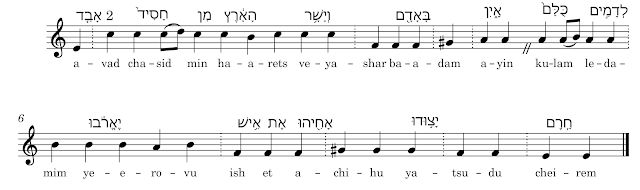
Micah 7:2 - a reflection of a few psalms we have already seen

אָבַ֤ד חָסִיד֙ מִן־הָאָ֔רֶץ וְיָשָׁ֥ר בָּאָדָ֖ם אָ֑יִן
כֻּלָּם֙ לְדָמִ֣ים יֶאֱרֹ֔בוּ אִ֥ישׁ אֶת־אָחִ֖יהוּ יָצ֥וּדוּ חֵֽרֶם
2 Perished is the merciful from the earth. And of the upright within humanity, there is none.
All of them are bloodied. Each lies in wait for its kin, hunts to utter destruction.
b abd ksid mn-harx viwr badm ain
culm ldmim iarobu aiw at-akihu ixudu krm
16
19
abd ksid mn h/arx v/iwr b/adm ain
cl\m l/dmm i/arb\v aiw at ak\ihv i/xvd\v krm

Sunday, 10 September 2023

#Psalmtweet #Psalter 10:1 Acrostic 1 part 2

Psalm 10 is the continuation of Psalm 9, the second half of a broken acrostic.

Whether this psalm as a children's game is deliberately broken or is an accident of textual transmission, I don't know. It is curious however, that the four acrostics in book 1 are all missing one letter or another, and the four of book 5 are not missing any verses. The game is played in Lamentations also. The first four chapters are acrostics - with the special note that peh (p) and ayin (y) are reversed in each chapter. There is an acrostic also in Proverbs 31 -- all worth reading. The sentiment in this 'l' verse is clear for all to understand.

There is no inscription for this psalm. This is true (in Book 1 Psalms 1-41), for Psalms 1, 2, and 33. All others are 'of / to  / for David'.
לָמָ֣ה יְ֭הוָה תַּעֲמֹ֣ד בְּרָח֑וֹק
תַּ֝עְלִ֗ים לְעִתּ֥וֹת בַּצָּרָֽה
1 LORD why do you stand in the distance,
obscure in times of trouble?
a lmh ihvh tymod brkoq
tylim lyitot bxrh
10
8
lmh ihvh t/ymd b/rkq
t/ylm l/yt\vt b/xr\h

Friday, 8 September 2023

#Psalmtweet #Psalter 8:5

This post has the chromatic mode with the augmented fourth. Sung here.

Mode is a subjective decision. In earlier days I thought this mode too difficult to sing, but hear the performance of Chanticleer in Psalms 29. It is a striking performance. Occasionally my software will change a g to g# in this mode. I haven't found the place where I should correct it! For this mode, as the performance indicates, the change on an ornament is not required.

This is the first key verse that illustrates a broad structure within the 150 Psalms as a whole. There is a chiasm formed by the poems that precede the acrostics and certain keywords. Psalms 8:5 and 144:3 are the outer pair. Psalms 36 and 110 the inner pair, these being the only two oracles in the Psalter. The music for this verse and the corresponding one in 144 are described here in a trio I wrote to explore this key question - just what is this human being that we are - now the second largest biomass on the earth - second only to cows.

Here is the image of the structure.

A chiastic relationship between the poems prior to the acrostics in the Psalter

מָֽה־אֱנ֥וֹשׁ כִּֽי־תִזְכְּרֶ֑נּוּ
וּבֶן־אָ֝דָ֗ם כִּ֣י תִפְקְדֶֽנּוּ
5 What is a mortal? for you remember it.
And a child of humanity? for you visit it,
h mh-anow ci-tzcrnu
ubn-adm ci tpqdnu
8
9
mh anvw ci t/zcr\nv
v/bn adm ci t/pqd\nv

Saturday, 1 April 2023

On abcedaries

 Lovely article Here on the acrostics in the Bible and the origin of the ayin pe sequence in the alphabet. The long and short of it is, there may have been two alphabetic sequences, one pre-exilic, and one post exilic, being the Aramaic sequence.

Friday, 17 March 2023

Suggested answers to the first note questions

Without being exhaustive, here are my suggestions for why psalms, and some psalms in particular, begin on a note other than the tonic.

This post continues the question I asked here in January.

What are possible explanations? How is it that the whole Psalter begins on 'f'? Why is 9 saying something about 8? or 22 about 21? And so on. What do you think?

Psalm First
Note
1 f Psalms continues and comments on Torah and Prophets
2 g Psalm 2 continues Psalm 1
9 g Psalm 9-10 (acrostic) is a celebration of Psalm 8
22 g Psalm 22 outlines the cost of the monarch's role in Psalms 20-21
40 f Psalm 40 expresses the confidence that psalm 39 requests
48 f Psalms 47 and 48 share 25% of their words, most significant perhaps is the recurrence of Yahweh the great king and the kings of the earth.
60 g Psalms 59 and 60 share just under 25% of their words. Psalm 60 is repeated in part in Psalm 108, along with part of Psalm 57. Psalms 56 to 60 are a group of miktamim. Perhaps 60's start on the third note of the scale rather than the first is an indication of the end of this group.
66 g Psalms 65 and 66 share 30% of their words. The inclusio here is prayer.
70 f This analysis gives some room to interpret the psalms that repeat. Psalm 70 is a repeat of part of Palm 40. So it is a commentary, recalling the context of Book 1, on Psalm 69.
83 g The Most High in the context of speech in Psalm 82 and silence in Psalm 83.
88 f 87-89 form the hope of Israel contrasted with two great laments over its failures.
89 f
91 g 90 and 91 share 27% of their words - but there are adjacent pairs of psalms that share many words yet are not connected musically. Psalm 90 is a response to Psalm 89 and the laments in Books 2 and 3. Psalm 91 in turn is a response to Psalm 90, an answer to the prayer.
95 g The series 94-96 connects 92-93 to the final royal celebrations of 96-99.
96 B
102 g Is the prayer a response to the annihilation of Psalm 101?
108 g 107, 108 and 109 appear to be a unit - why?
109 g
111 f Psalms 111 and 112 (acrostics) celebrate psalm 110
112 f
113 f 113 continues the trio of 110-112. 
115 C Psalm 115 - non nobis domine is a counterfoil to psalm 114 - in exitu Israel
116 g 116 is unique in this series from 110 in its singular view. It is a solo song rather than a chorus hymn. 
122 f Among the Sons of Ascent (120-134) there is a very detailed structure. See Mitchell, The Psalms of Ascent. Brief summary here. Mitchell does not mention a non-tonic starting note. I suspect it would support his closely reasoned structures.
124 f
127 f
130 f
131 f
133 f
135 f
137 f 135 and 136 are very closely related as if each was commenting on the series from 120-134. How is it that 137 refers back to this whole series?
139 g Psalms 138 and 139 share 33% of their words. 139 elaborates on the last verse of 138.
147 f Psalms 146 to 50 are a single continuous praise -- so they are joined by the music.
148 f
149 f
150 f

Friday, 4 February 2022

Forbes - sketching his overall divisions of the Psalter.

What has Forbes done in dividing the Psalms into their 7's, 10's, 12's, 20's, and 22's? 

I am using my cleaned-up copy of his treatise here. Help yourself to a copy. I update this copy as I discover more typos from the OCR process. [Updated Feb 5 to reduce my Editorial notes - I will put my impressions on the blog and only use editorial notes to clarify the few typographical errors I have found in the text.] This is also available on the Internet archive. I had trouble figuring out how to update it so the link has changed since the first one. I think I can keep them in sync by delete and replace now. The archive copy has more potential longevity, but my copy has immediate update.

Forbes was also a mathematician and 150 is a number with many possibilities for subdivisions: 150 = 3*7**2+3. Its prime factors are even simpler in base 10 thinking: 2 x 3 x 5 x 5. It is also the sum of the 7 consecutive primes from 7 to 31 - but that is not an attractive design principle. 

The number lends itself to endless divisions by 7. All such divisions have a centre. Centres are beloved by those who design and think in circular structures. Circular structures, also called chiastic, allow for writers to frame what seems important to them in what we otherwise might read only as sequential, or in the case of a book of poetry, random. It is a credible construction process that can be discovered by a sequential reader. There are many today who construct these when reading. All a human reader requires is a little bit of short-term memory (3 bits actually - binary 111 = 7 - each bit carrying a 1 or a 0, so 3 bits can carry 7 simple things or 3 complex ones in your short-term memory). No magic needed, but a pencil might be useful. The design should also be tested by the music embedded in the hand-signals in the text of the Tiberian tradition.

One of his divisions is: isolate Psalms 1 and then allow 2-22 (21 psalms) to be 3 'heptades' (that's his name) and counting back from 41, consider the series 20-40 as a second overlapping alphabet-1 of psalms, i.e. 3 heptades. The last of these has Psalms 37 as its centre. (Every 7 has a centre 3+1+3.) Psalms 37 is indeed an important psalm in the overall structure of the Psalter as I have noted before, and there are hints in the acrostics that the Psalmists might have considered 22 an 'important' structural number.

Several parts of the book point to Forbes' numerical thinking. E.g. this bit:

Ps. xxii., as has been already observed (see p. 82), would seem to be the termination of such an arrangement, being the concluding member of the trilogy xx.-xxii., which forms the centre of Book 1, there being 19 Psalms on either side of it. [Forbers-1888 in the section on Psalm iv.]

Book 1 is three short of 2 alphabets, so the trio 20-22 is included in each and so the book defines a triptych. I also note his division of the first 89 psalms into 44 + 1 + 44:  2 equal alphabets on either side of Psalms 45. (Nice touch). The final Book 5 is 44 psalms = 2 alphabets worth of psalms (but I don't think he mentions this). This book he divides into the three hallelujah books, creating a sevenfold structure for the psalter in the shape of a menorah.

The place and number of the Amens and Hallelujahs are found to be adjusted with remarkable precision, two Amens closing each of the three Amen Books, and forming, with the single Amen of the Central Book, in all seven Amens; while the Hallelujah Books, beginning each with the words, “O give thanks unto the Lord, for He is good: for His mercy endureth for ever,” close with Hallelujah Psalms, the whole number of Hallelujahs in the Psalter being twenty-four (in reference to the twenty-four orders of Levites and singers), allotted in significant proportions to each of the several books. [Forbers-1888 in the section on Book 5.]

Here's a grid with foreground and background colours to show the groupings that Forbes suggests. Of course he substantiates these numerical divisions with analysis - and at least to some extent he does, using recurring key words as his mechanism. I have not yet followed his full arguments to see if I concur. 

I {{1 2 3 4 5 6 7 8
9 10 11 12 13 14 15
16 17 18 19 {20 21 22}
23 24 25 26
27 28 29 30 31 32 33
34 35 36 37 38 39 40 41}
II 42 43 44 }45{ 46 47 48
49 50 51 52 53 54 55
56 57 58 59 60 61 62
63 64 65 66 67 68 69 70 71 72
III 73 74 75 76 77 78 79
80 81 82 83 84 85 86 87 88 89}
IV 90 91 92 93 94 95 96 97 98 99
100 101 102 103 104 105 106
V 107 108 109 110 111 112 113 114 115 116 117
VI 118 119 120 121 122 123 124 125 126 127
128 129 130 131 132 133 134 135
VII 136 137 138 139 140 141 142 143
144 145 146 147 148 149 150

There is not much analysis of the substance of Books 2 and 3 in his volume, though there is considerable detail on psalms 72 and 89. Nor have I found yet much on the last 15 psalms, the last 5 being obviously tied together in a crescendo of praise.