Showing posts sorted by relevance for query science. Sort by date Show all posts

Tuesday, 2 April 2019

Did I mention science?

I searched in my current blog for science to see if I have been respectful of how I learn. Testing and seeing...

And behold, there are almost 100 mentions of science going back to 2010 including this gem - what was I thinking!
I hope to address the whole nine yards of the science of God at some point: Unity, relationship to humanity, reward and punishment, Anointing and the world to come, time and science, election and the scandal of particularity, predestination, providence, and miracles, and who knows what else. This is my death-wish I suppose. For I like anyone else, cannot see God's face and live (Exodus 33:20). Whatever... I have died already in the Anointed. I will start and end there.
100 mentions may be worth a book... There can be no conflict between science and steadfastness (or faith by another name). Those who refuse science refuse God. Not that science is God but that God is not the author of confusion, superstition, or nonsense. Fearful humans author these things to their own detriment and that of others.

Some people might think my translations are 'literal'. No. They are not. They are ruled by a sense that the language is close enough to itself that it should be interpreted as pattern recognition. That is a subject I spent my life with as a programmer. (Apart from the music,) that is what I have done to the Hebrew Scripture, recognized the verbal patterns and read accordingly. It may be impossible to do this with a committee or a multiple person translation. Divergence is almost inevitable without algorithmic pattern recognition.

I have been proofing the prophets and I found a mislabeled score. Also I noted some unique words that really surprised me but they withstood my scrutiny.
I will sing, if you will, for my beloved, a song of my beloved for his vineyard.
A vineyard there is for my beloved against an intensely bright destiny of density.
Whoa - where did that wordplay come from? A unique phrase in the Hebrew,
כֶּ֛רֶם הָיָ֥ה לִֽידִידִ֖י בְּקֶ֥רֶן בֶּן־שָֽׁמֶן
 קרן followed by בן followed by שׁמן is unique as are the two sub-sequences of each pair of these stems. Everyone seems to render it as 'on a fruitful hill'. I have no idea why. Literally it is 'a horn of the son of oil'. Or 'an intensely bright child of an octave'. (Just kidding).

בן children (2,535) child (1,694) son (367) sons (189) he- (50) Ben- (31) squab (10) little one (6) -- (5) ben- (3) male foal (3) -kin (2) Ben (2) calf (2) cubs (2) grandson (2) kids (2) Son (1) destiny (1) eaglet (1)
קרן horn (84) intensely bright (4) two horn (4) intense brightness (2) Intense Brightness (1) Karen- (1)
שׁמן oil (183) eight (106) eighty (37) eighteen (21) stout (16) eighteenth (9) dense (7) stout thing (4) octave (3) oils (3) compared oil (1) density (1) eigh- (1) eightieth (1) oily (1) ointment (1)

These words are frequent, but the combination is unique. What will one do with it? The Hebrew is also alliterative.  beqeren ben-shemen.

Listen to Yahweh's determined hope for his people. (I didn't even mention this in my original posting on Isaiah 5.) But I did have a lot of other points to make.

Monday, 4 September 2023

The latest project - 150 #psalmtweet from the #psalter in daily succession

You might have noticed that I am scheduling daily verses. Yes - software. I am about half-way through drafting the first 72 psalms. I hope to complete the draft in the next month, assuming I live so long. Last night I spent 6 hours in emergency with a sudden inexplicable explosive nosebleed. I am more fragile than I thought. Too much stress. But that's another story. Today I am swollen (an inflated balloon in half my soul) but still alive. 

My posts are unique. Words without music are dangerous. They create a false abstraction not to be believed. There is only one place in the world where the music can be generated from the Hebrew Unicode text verse by verse - that's on my computer. I line up the verse on my translation form and press the music button. Then I open the XML with Musescore - and presto a verse of music, isomorphic to the Scripture -- nothing added -- and more importantly, nothing taken away. So the computer has to last until the draft is completed.

Also there is only one place where the four quadrant Hebrew, English, SimHebrew, and automated parsing can be produced. The same computer - still going strong with a new solid-state drive (thanks to science). This table is produced ad hoc by an Oracle routine I wrote a year or two ago. It's not perfect, but it doesn't destroy information -- following the commandment in a few psalms: Do not destroy. I may make the odd comment too and point to the odd performance -- all on my blog already if you look for them.

It's not quite a religious thing with me to do daily study or daily verses. I have resisted this practice. 

But I have been meditating on science, culture, and faith for several weeks recently. I follow a number of things on Twitter, that app with the most lame rebranding I have ever noted. But it is still a source of confused, contradictory, and interesting tweets.

Religion is too often used to justify the status quo, to hearken back to a false narrative on the truth, and to support propaganda for war. The last is evident with the imperial Russian story and now also with the lunatic fringe of Pope Francis praising violence - how disappointing.  The middle -- hearkening back to earlier stages of ambiguity -- is a common refuge for a certain class of scholarship and also for the fearful, searching for certainty. And the first - justifying the status quo - is all too common in power structures. "It shall not be so with you." I think we have not learned this well.

The psalms tell the truth about the poet. Poetry -- admittedly with metaphor -- but how else do we speak of anything.

Science was to some also a search for certainty but in another direction. Certainty turned out to be a false narrative. Science, (fully supported by the honesty of the Scriptures and their invitation to question, is as uncertain as the religious framework). Faith is best termed faithfulness, i.e. rendering the adherent trustworthy. (Not 'faith' as if it were believing a lie.) With such exploratory faithfulness, science yields true delight in the intricacy of its patterns. The most religious experience I had as a teen was my fourth year class on special relativity. Learning time dilation was more revelatory to me of God's work than some of the learning of Scripture that I fell into fearfully shortly thereafter. Now I think that the uncertainty principle supports the doctrine of co-creation and theosis, but I don't want to give either the Anglicans or the Orthodox any reasons to boast. And I'm not about to explain my hunch.

Culture is yet another question. Science and religion both are part of it. The New Testament has the phrase - in the world but not of the world, and that phrase has had several busses drive through it and cause immeasurable damage. Damage is not what religion should be about. Doesn't God love the world, and the created order, and the cultures that develop as the people learn to govern and to care?

What if the Gospel, like a good sourdough, ate up the world, flour and milk cup by cup, and taught the world to care? It is like the yeast that works in the lump, leavening everything. And now that living and working culture, like its sourdough starter analogue, is trying to teach the churches what caring means because the churches in the rigid application of their own history, jurisprudence, and prejudice have forgotten what their purpose is. In the same way that the fifth book of Torah rewrites earlier laws and statutes for a later time, so the churches must research just how it has its tendencies to stray.

Lost sheep they are. Forgot their knowledge.

תָּעִ֗יתִי כְּשֶׂ֣ה אֹ֭בֵד בַּקֵּ֣שׁ עַבְדֶּ֑ךָ
כִּ֥י מִ֝צְוֺתֶ֗יךָ לֹ֣א שָׁכָֽחְתִּי
176 Time and again I wander like a newborn lamb that is perishing. Seek your servant,
for your commandments I do not forget.
qyv tyiti cwh aobd bqw ybdç
ci mxvotiç la wckti
12
9
ty\iti c/wh abd bqw ybd\c
ci m/xv\tic la wck\ti

All the music is available for every chapter of the Hebrew Bible in single PDFs, e.g. the psalms are here or combined PDFs. The combined are more recent. Feel free to use them native or as input to arrangements.

Saturday, 28 May 2022

8. Perfect

Dear children,

Another invitation comes to us in the same form as the invitations to be holy and compassionate or merciful: You will be perfect as your father in heaven is perfect. This word perfect has the sense of completeness. And it's a completeness that includes what we might think of as imperfections. This invitation comes from the stories of Jesus that we have in the Greek New Testament. (Jesus is the Greekish pronunciation of Jehoshua - Yahweh saves - in Hebrew.)

I was thinking the other day about music and time that passes by during a performance when we are captivated by the music for its rhythm, or multiple interlocking voices, the grandeur of its sound. And I thought - this is a kind of stoppage of time. Though it has a beginning and an end, it is also making the voice of the composer in the past heard and it ties together our moments into a single shared experience.

Remarkable really - so I thought the commonplace phrase, Practice makes perfect. What is perfect in this context has the sense of flawless. To be rather than the sense of completion. My thought then is about the experience of performer and audience - how there is a presence of something more in the passage of time. In a sense, time is tied together: performance perfects the present. A great performance captures us and makes time stand still. This is the sense of completeness that is in the command. In music, it is very memorable. I still remember the first performance I heard of Gershwin's opera Porgie and Bess. One day maybe you will hear it. And of course you will remember the very well behaved 'perfect' children in The Sound of Music.

I am sure you can see that these letters of mine are going to take some teasing out to see if there is usefulness in them. At a minimum they have some historical usefulness. They reflect how I think about a whole bunch of things from God to human social attitudes and structures and science.

But ... I say, God is not 'a thing' that we can know it. And Science is what we think we know about things from our theories and experiments. Science is itself a great wonder and it strives for its own completeness. Science works by hypothesis and testing to see what can and cannot be repeated. Tests are successful even if they fail, because failure demonstrates that something is incomplete, that we have more to learn.

Science can then describe how things work, but it cannot describe or explain puzzle pieces such as we have looked so far: like safety, holiness, trust, truth, or others like courage, faithfulness, fear, discipline, persistence, respect, justice, love. For that we need mutual agreement on how we will live together. If that agreement is broken then all sorts of other things will break and have to be mended in some way.

I should eventually get to the agreement that God lays out in the 5th book of Moses, Deuteronomy (chapter 28). It is like a peace agreement after war with promises and penalties. And it is fun, but oversimplified. An answer to this almost military covenant is in the book of Job. People think of this long poem as if it is a horror story, but it is a setup for managing our expectations. It is an epic poem. The idea of punishment is removed from the discussion. It is not in the character of God to punish.

I think this is very important. There is no Hebrew word that is used consistently for punishment in the old English translations, and none where punish is used more often than other senses of the word. This not to say that actions do not have consequences and the consequences can be undesirable. 

People miss too that God can be grieved. God, in other words, can be saddened. But Heaven rejoices when someone says thank-you. People will tell you that God is all-knowing, all-powerful etc, but they are just repeating a formula by rote. You remember how I said that any sentence containing God is not fully known - as if we somehow had God under our control.

To review: so far I have sketched a beginning (letter 1) - to the earth, the heavens, and the stars, each one of them unique and differing from the others in brightness and complexity, and to the structures of life, (letter 2) our human situation, genes and cells, and microbes, the invisible half of the life on earth and in the waters much more than half.

And I wrote a brief intro to our responsibility in life (letter 3) as if we were working with hidden and uncertain puzzles. And I have begun to explore some language to talk about what is good and what is not good. I have done these things so that somehow we can find a place where we can stand and make suitable judgments - even if we are incomplete (as we all are).

I began that search for shared language with holiness (letter 4) - and wrote that it is like the table on which we could examine some hefty and complex puzzle pieces. Then I began with trust, (letter 5) and next with the idea of instruction, (letter 6) perhaps even instruction from God. And next with image (letter 7).

Such sketches attempt to describe, but description cannot fully catch the depth of things. We still need the whole web. So I will keep throwing out my threads into the wind of experience and examples to explore but I will hope to do it in the context of real life examples like these - in no particular sequence:

  • war and violence in our lives and the lives of others and our failure to change old attitudes.
  • the inequality between rich and poor everywhere and how we might approach caring for the weak.
  • the protests we have seen in our country and whether we can answer the flaws in their approach.
  • the breakup of families, and the character of human intimacy.
  • the work of the poets and the ways that words are used and abused
  • the music around us and the creation of beauty.
  • the systems we build in real cooperation with each other and how difficult it is to learn how to do this flawlessly and to manage the processes, for example, the long learning process that produced the Webb telescope - and the resulting power that we have in our hands for extending our knowledge.
Then I think we may find some language to explore the good and the bad that you already face and are going to face, and the foundation you will need so that you be able to stand and thrive.
    That is a tall order, and I will admit that some of my web segments may be weaker than others. I tell you the truth that I find this process very hard to do. I am heading towards some conclusions, but I am not at all sure how to express them. It's important to have discernment in yourselves and to draw your own conclusions.

    Till the next letter ...

    Saturday, 13 July 2013

    Back from a month in the UK

    We began our UK journey with a conference in London at the Open University where I had been invited to speak on Seeing the Psalter. This conference will lead me to write some articles...

    We continued with a week in Cambridge from where I had posted on the English garden.  Then after train to Edinburgh, we rented a Fiat 500, a car that needs an octopus to drive it, the four extra legs pushing it on the Scottish roads. With this little piper, we went across Mull to Iona where we walked through the abbey, and also managed 18 holes on the pastoral golf links. On the first hole Diana lost a ball into a cow-pie (I found it) and on the 14th, we found the green heavily populated with sheep. Mother ewe was trying to suck milk from the hole, savagely tugging at the plastic cup much as her lambs suckled her with astonishing violence.  (All the other greens and fairways were more lightly populated though occasionally we had to pick up rather than hit any balls.)  Greens are mowed once a year. The rest of the time, they are maintained by the cattle and sheep.

    We then toured the north of Scotland, stopping at the clan Donald museum on Skye, staying at Kyle of Localsh, playing 18 holes in Ullapool on a very difficult course (best official score is 1 over par), an overnight in Strathy, then to the Orkneys where we traced our fourth child's ancestors to 1798 - something I will write up in more detail.

    Then we went south, exchanging the underpowered Fiat at Inverness for an Audi automatic, and finally to the International SBL conference at St Andrew's (where the car stayed on the street for 3 days). More to come on the conference ...

    Re recent blog posts, this one seems worth looking at if anyone is concerned with faith and science and things like that. Here's a touch:
    It looks as though the Christian Church, but particularly the Roman Catholic hierarchy, both collected wealth to produce a leisure class (good for science) and suppressed creativity (bad for science). Given that the system produced Copernicus, Galileo, and Mendel (and later Lemaitre and Secchi), we’d be hard pressed to say it’s been bad for science. ... Meanwhile, the Anglican strand of Christianity in England and Scotland produced many more scientists and some of the foundational philosophies that make modern science possible.

    Saturday, 10 July 2010

    Science so-called, faith so-called, and the dread of reading

    Leap of faith - no.
    Science in conflict with religion - no.
    Literal readings of myth and poetry possible - no.
    The denial of sin - the denial of the good - compatible - yes
    The uniqueness of the Revelation of Jesus, Anointed supportable - yes.

    What is possible evidence in the individual life and in the corporate life of the world?

    It seems daunting to try and address such questions and still maintain the imagery of the Anointed Jesus as power, word, and example for us. Word of invitation, example of a faithful self, and the power given to all to hear and follow in that same path. This post is entirely in English. There will no salting with unreadable words.

    I have already raised too many issues for one post. Science so-called is an allusion to one of the pastoral epistles where the writer addresses the reader with the problem of dispute. What is it we are disputing when science, a method of testing, confirming, and predicting behaviour of things conflicts with our thought processes that arise with some readings of the canon of ancient writings called the Bible?

    Faith so-called is a counterpoint - how can we have the faith of this or that historical confession and somehow identify it with the faith referred to in the Scriptures? Is Calvinism a faith? Or Methodism? Or Evangelical fundamentalism? If these are sets of definitions encompassing a practice of 'the faith', then perhaps they are stepping stones to the real thing, but if they in any form define and limit the individual in that person's work of faith, then they are a stumbling block and to be put aside. Faith in the Scriptural sense is an invitation to trust an invisible person and is not a set of rules to which intellectual assent must be given. In fact, real trust involves exactly the same things that scientists do when they test, confirm and predict behaviour of things. We too are to taste and see that the Lord is good. We are to take other people's word for it, and also discover the same for ourselves. There is no leap just an assent to 'try me - and see'. (Not me of course)

    The dread of reading. One who tastes of the heavenly gift will be called to learn and the learning will be very matter of fact and tangible. It will be word made flesh in that very one who trusts - i.e. in you, whoever you are. It is a marvel, is it not, that humans have language and can teach beyond their death in what is written. Why you may even be reading this after I have died. Certainly we read Calvin and Luther, Shakespeare, the Countess Mary Herbert Pembroke, Milton, Blake, the Wesleys, Eliot, Lewis, Milne, Christie, James, and so on after they have died. And some are dated and some are not.  Do I dread reading? I find it hard to define such a dread, but I think it expresses itself in my ignorance. I cannot help the fact that I know so little. But this helps me not to insist that I know so much that I should impose my ignorance on others.

    That is the secret of hearing spin. Stop and listen for your own insistence that everyone think like you. Then spin the other way. That is listening to the other. The problem with fundamentalists is that they are too shallow. They are not fundamental enough, seeking the true root. The true root is not subject to our definitions. Science recognizes this by stating assumptions and when things don't work out, revising theory to meet the changed perception of reality. (This changes their reality also - and ours!) So the proton is now a bit smaller than thought - scientists gasp!

    So how do I read Genesis? With love. With Love. Is it subject to my idea of what really happened? How could it be! Am I concerned with a special creation? Of course - I read this book as Adam and as Eve in my male and femaleness. I read it as one who has sinned and is in trouble (of course I know more about this from the Psalms - but it is right there in Genesis, not to mention that it is right there in my life.) I read it as a real person in conversation with the author and with the Author - and I keep asking questions. And every day I get more answers - not so I can stuff them in my briefcase and tell my friends to obey my reading - no no no - but I get them from the Living One who teaches me in real time even though I forget also in real time. But some things I do not forget.

    I am sieve incarnate. I retain some and I shed some - but the Water keeps flowing. And this tells me I know little about time, about consciousness, about memory, and about something else [gravity, glory] I can't remember at this point, but it also tells me that I am somehow in this Anointing Anointed One and known in this Mystery - and somehow fearless in my dread.  That they might know thee, the only true God, and Jesus Christ whom thou hast sent. The rest is not so vital - and often not life-giving. In fact the objections from our scientists to the foolishness of faith should be taken seriously. For some they are true objections.

    Where do I come to a border of my faith? It's easy to say. I lived through the most brutal of centuries so far in the great circle of time. We killed more people, more animals, more trees than all other centuries combined. We have the worst record for persecution and abuse of all prior centuries. We grow in our ignorance and greed. Even the self-styled righteous non-profits can suck the teat of donations and grants and blame the corporations while not understanding a whit about the responsibilities of running a business. Saint and sinner alike can pretend to deny sin and can say 'it is good' out of one side of their mouths and 'give me more' out of the other - even when they have enough. This has not changed since Ecclesiastes. There is just more of it.

    But - you will say - no Adam, no Christ? What! Did you define Christ for the world? And have you known the full mystery of the Anointing in the Scripture?  The uniqueness of the Revelation of Jesus, the one who is called 'the' Christ, the one to whom the Spirit is given without measure, this uniqueness is supportable without reading the Bible wrong. It is as simple as 'taste and see'. And impossible without letting go of our trust in our own reading. We are not complete in ourselves. But in the gift of God, there is no end to our completeness.

    Saturday, 21 September 2024

    Excursus -- Hell for those enemies

     Extract from Seeing the Psalter, page 78

    The opening psalms place some emphasis on fire and brimstone as punishment for the enemies.

    you will set them as a fiery oven 
    of the time of your presence
    יהוה in his anger will swallow them
    and fire will devour them

    Speaking personally and subjectively, the Psalter draws me away from the traditional objectivized view of Hell. The traditional imagery for Hell is drawn in part from such psalms, but traditional Hell over-determines their intent. Jesus (Matthew 10:28, Luke 12:5) tells his disciples to fear him who can destroy both body and soul in hell, and this fear has been transposed in our traditions to a fear of judgment after death or fear of an apocalyptic day of wrath (Dies Irae). The psalms speak to me about a present fear that knows the reality of psalms like 6 and 38, where the wrath being known now is faced. Then, as John 5:24 explains, we are past the judgment. The wrath endures but a moment (Psalm 30:6).

    In Psalms 20 and 21, each of us, male and female, is to identify with the king. And the enemies which are destroyed in the second half of the psalm are our own self-destructive impulses. They are swallowed up in fire, but we, each, are saved and crowned and filled with joy not of our own making.

    What is our heart’s desire? This is scarcely expressible, but when the gift is known, the receiver of such a gift recognizes that this was the prayer being prayed, as Paul says, the Spirit prays in us with groaning that can not be uttered (Romans 8:26). It would seem that we are not even aware of it.

    Can such a claim be made with appropriate knowledge in a scientific age? The psalms are prayer. Prayer is not subject to the categories or assumptions of science. Its mode is subjective. Yet the unmeasurable and inexpressible is a truth even in science. If I tell you that you cannot know at the same time both the colour and the spin of an elementary particle, am I not expressing something oddly that is unmeasurable? Or if I speak of bosonic string theory in 26 dimensions focused on cubic Open String Field Theory in the presence of two parallel D24-branes,[1] as do doctoral students in science such as Longton, am I not speaking with metaphor? It seems to me that both disciplines, prayer and science, require appropriate inference from evidence, even when the evidence is inexpressible.

    There are things that we can know but cannot pin down in so many words. What if, for the sake of example, the presence of יהוה was a real benefit and was sensed by faith. It has been said by many people that there is a reality to the experience of this presence of God. Are their words not to be counted as evidence? So the poet writes in Psalm 21, you have cheered him with the gladness of your presence.

    Yet is the cost perceived? The next psalm will reveal that prayer and answer are not simple and that hell will be known personally by the beloved.

    [1] Brane, short for membrane; 24 indicates the number of dimensions.

    Saturday, 20 October 2012

    Time - the first mystery

    First is relative. Here's an interesting note on Science and Theology from the BBC (HT Entangled States).

    I look on time, consciousness, and gravity as three big unknowns. If we could only explain these, we could overstand creation.

    Augustine of Hippo, in his Confessions, writes:
    What, then, is time? If no one asks me, I know; if I wish to explain to one who asks, I know not. 
    Time just is. Somehow we are aware of all those things that show its passing. No one gets more of it per day than anyone else. We can’t see it. We can measure it and it changes us, yet we remain the same person we were as a child. Listen in common speech for all the arguments and for all the things that are based on time. Listen for these words: now, then, after, before, growing, fading, evolving, learning, remembering, generation, predictability, experiment. This list might get very long.

    A great many of the laws of science contain a dependency on time. That the laws of science are discoverable is an indication that time is somewhat predictable. Time is directly related to the first act of creation in the Book of Genesis. It seems that God spoke and time was. It seems that God implicitly submitted to time and and its corollary, memory, as contained in the fragments of ‘the depths’. Science notes the memory of the birth of time in the background microwave radiation in the universe. We know (via Einstein's theory of special relativity) that theoretically, we can stop time by moving at the speed of light. And light was, according to the love song, the first thing created.
    וַיֹּ֥אמֶר אֱלֹהִ֖ים יְהִ֣י א֑וֹר וַֽיְהִי־אֽוֹר
    Genesis 1:3. And Elohim said, let light be, and light  was.
    How do we know it is the third verse? The music tells us. The text of each verse generally starts on the tonic and finishes on the tonic. And it rests in the middle of each verse at the sub-dominant (but not always). At this point in Genesis we have twice rested and twice begun and twice finished. And the third is God speaking and time being created. I can say that the creation of time is noted in the third verse because time is dependent on light.

    And here’s something to note about music. Music subtends time. A performance can be as powerful as moving at the speed of light. Time is not dilated, but it is held together by the performance as a single unit. Drama, dance, poetry and liturgy have a similar effect. Our minds are attuned to rhythm, pace, rhetoric, pulse, tone, and timbre. All these things are held in the music that is contained in a compact score in the signs above and below the Biblical text. The music slows us down to hear the text one jot, one letter, one syllable, one word at a time.

    Thursday, 13 August 2020

    Controlling translation

    It is not surprising that translation as a tag is frequent on this blog. I checked out the posts under that label in order to see how much of my control system I have documented. How to distract yourself when figuring out what you've done and where you might go from there.

    From the first few posts (more or less in reverse historical order), I see that many of my principles are clearly stated. Also some astonishing words that I don't remember writing. It's the thing about being old. E.g. this one on Did I mention Science?

    I hope to address the whole nine yards of the science of God at some point: Unity, relationship to humanity, reward and punishment, Anointing and the world to come, time and science, election and the scandal of particularity, predestination, providence, and miracles, and who knows what else. This is my death-wish I suppose. For I like anyone else, cannot see God's face and live (Exodus 33:20). Whatever... I have died already in the Anointed. I will start and end there.

    Really!

    In another post, I noted a comment by Tim Bulkeley. How I miss his voice! There are undoubtedly many who miss him more than I and who think of him every day.

    In yet another post on translation without commentary, in which I mention my friend and Hebrew coach, Jonathan Orr-Stav, whose input has always encouraged me, I reveal my bias. It is not a Christological bias, but a theological bias that God is steadfast and reliable. I don't know of anywhere in the Hebrew Bible that would allow a translator to be fickle on this theological subject. Perhaps this reliability can also be seen in the children, whether the example be Jeremiah or Jesus, or even Paul. I wondered what I had done with Jeremiah 15 when I read this post. And it was all about translating that notorious word npw. נפשׁ.

    Jeremiah 15

    וַיֹּ֤אמֶר יְהוָה֙ אֵלַ֔י אִם־יַעֲמֹ֨ד מֹשֶׁ֤ה וּשְׁמוּאֵל֙ לְפָנַ֔י אֵ֥ין נַפְשִׁ֖י אֶל־הָעָ֣ם הַזֶּ֑ה
    שַׁלַּ֥ח מֵֽעַל־פָּנַ֖י וְיֵצֵֽאוּ

    a viamr ihvh alii am-iymod mwh uwmual lpnii ain npwi al-hym hzh 
    wlk myl-pnii viixau

    1 And Yahweh said to me, Though Moses and Samuel stood before me, it would be nothing for me, against this people.
    Send from before me, and let them go forth.

    וְהָיָ֛ה כִּֽי־יֹאמְר֥וּ אֵלֶ֖יךָ אָ֣נָה נֵצֵ֑א
    וְאָמַרְתָּ֨ אֲלֵיהֶ֜ם כֹּֽה־אָמַ֣ר יְהוָ֗ה אֲשֶׁ֨ר לַמָּ֤וֶת לַמָּ֙וֶת֙ וַאֲשֶׁ֤ר לַחֶ֙רֶב֙ לַחֶ֔רֶב וַאֲשֶׁ֤ר לָֽרָעָב֙ לָֽרָעָ֔ב וַאֲשֶׁ֥ר לַשְּׁבִ֖י לַשֶּֽׁבִי

    b vhih ci-iamru aliç anh nxa 
    vamrt alihm ch-amr ihvh awr lmvvt lmvvt vawr lkrb lkrb vawr lryb lryb vawr lwbi lwbi

    2 And it will be that when they say to you, How, please, will we go forth?
    And you say to them, Thus says Yahweh, Whoever is for death, to death, and whoever is for the sword, to the sword, and whoever is for famine, to famine, and whoever is for captivity, to captivity.

    וּפָקַדְתִּ֨י עֲלֵיהֶ֜ם אַרְבַּ֤ע מִשְׁפָּחוֹת֙ נְאֻם־יְהוָ֔ה אֶת־הַחֶ֣רֶב לַֽהֲרֹ֔ג וְאֶת־הַכְּלָבִ֖ים לִסְחֹ֑ב
    וְאֶת־ע֧וֹף הַשָּׁמַ֛יִם וְאֶת־בֶּהֱמַ֥ת הָאָ֖רֶץ לֶאֱכֹ֥ל וּלְהַשְׁחִֽית

    g upqdti ylihm arby mwpkot naum-ihvh at-hkrb lhrog vat-hclbim lskob 
    vat-yof hwmiim vat-bhmt harx lacol ulhwkit

    3 Then I will visit upon them four families, an oracle of Yahweh, the sword to slay, and the dogs to shred,
    and the fowl of the heavens and the beasts of the earth to eat and to destroy.


    And there are in the list
    • several posts on my search for concordance in my work and the difficulty of controlling it. 
    • a post on what we consider self-evident and how that has changed even in our lifetimes.
    • a post on masks - prior to COVID-19!!!!!
    Today is Transfiguration Sunday. Traditionally the text read is Exodus 34:29-35. The word in the chapter מסוה occurs only there. It is not the same as other uses of veil פרך in traditional translations (however spelled). I used mask in Exodus 34 so that the English reader knows it is not the same term. Do we not all wear masks?

    And what does this say about 2 Corinthians - we are unmasked.

    I say to you, do not be unmasked today - become all things to all people that by any means you make be kind, be calm, and by all means keep yourself and others safe. 

    About half way through the posts, about 2017, I have a post on the process I used to control translation. It immediately reminds me of my chief programmer, David Driver, who died so young, leaving behind wife and 7 children. There is another man from Granby, Que whom I miss as I use the software framework that he was so effective at building as team leader. Here I find the note: So there is an outline for a set of posts. I may get to them...

    That is what I was looking for. Perhaps it will be useful.

    But Bob's Bible, as my work has been called, among other things, has this note just a bit further down.
    No soul, no repentance, no punishment in Bob's Bible. It's not that I know anything, but when I read, I do not write what I know is undecidable by the translator. No soul because soul, lovely though the word is, it is not a bodiless substance that lives on after death. The problem with this Greek idea is the implied linearity of time. It also denies the body. It is heresy. No repentance, because the word, important though it is, has come to mean a psychological torture chamber. No punishment, because important though discipline and discipleship is, punishment is not part of it, rather it is governance. I do not deny pain or suffering or consequences but punishment is the imposition of a distorted human violent action that is not in the mind of God.

    Monday, 5 April 2010

    Time for a change of pace

    I was going to push on with Lamentations - but I think I could mellow a bit before finishing the last two chapters. Maybe 70 days from now, there will be another suitable season for it. There are a number of outstanding questions among my blog acquaintances. There are many questions I don't take on any more. I think they are peripheral - like the creation vs science debates. There are many questions that are vital and central that I don't debate because I think there can be no debate - like sexual attraction and the place of men and women in the church. In all these, I apply a rule of thumb - since everyone can get very upset by the polarizations in these debates, I just let my current position be known and then "stop me vitals" so that a little peace can reign.

    Science - let's learn what we can, meditate on all the math and thought experiments that we can fathom, and not worry our heads too much about dimensions we cannot see. Let's learn from science too that axioms are open to critique - if you don't need the axiom of parallelism then question it and see where the questions lead.

    On sexual attraction - They that are Christ's have crucified the flesh and its desires. (You could ask why this is important - and I would not dare answer - but you could ask the one who made you and you will get a good answer - if you persist as the woman did with the unjust judge.)

    On the place of female and male in the Church. It is likely no surprise to anyone who has read my writing that I am probably of the egalitarian mindset. I wasn't always but I should have hesitated when I was a younger man in expressing the apparent inequalities in Christ that are in the NT.


    What else do I think are red herrings? Those are the worst of the distractions. So what questions remain for me?

    I am stumped over the governance of the churches. - There is a good set of questions on a post from Dr. Alan Wilson here. I don't expect to solve anything in this area, but the questions are ones that I think need addressing.
    • What kind of continuity are we meant to seek and experience with our past sisters and brothers?
    • What kind of accountability do we hold to our present sisters and brothers around the world, especially those beyond our own expressions?
    • How do we interact with our context openly enough to engage, but with a solid enough core to offer something that is salt and light?
    • Law can’t do the discipleship for us; it’s a boundary around the pitch that makes civilised interaction possible, not an end in itself
    You will see immediately that the last question is not a question. What do we say about law and grace?  Have we misunderstood Paul? (Yes - of course we have - and more than once.) And I think Bishop Alan is overstating the 'boundary' image. What do we do with some of the central parts of the 'boundary' like the Sabbath? And what of the peripheral - like shellfish?  Here is a brief summary of where I am at the moment on law.
    We have a complex relationship with Torah - which through the Septuagint became known in Greek as nomos and hence in English as law. Law is a dreadful translation. Torah = instruction, teaching, such as you were taught by your mother. It is anointed interaction with God. The Pentateuch as 'Torah' is a special gift to Israel - those words are read and studied like no others in history. But they are also an example to the nations and ‘all who fear Hashem’ as the inclusive invocations in the psalms indicate.  I think Christendom has often missed the point of 'the teaching' even though its own history among the nations has included many blessings from 'this instruction'.  How can we interact creatively - and not destructively - with our creator and redeemer as we perceive such through the words that we are given?

    It is not helpful simply to put down the 'law' as having been 'superseded'. I admit though I have translated (= read closely) only a few chapters of Torah. Almost all my work has been in poetry. I hope I will get to Torah – if I live long enough, I intend to do my own translation of every book – if this is the will of my hidden teacher. I expect to find in TNK every anointing that I have found through the New Testament witness. It is the same Spirit though Spirit is not explicit in the OT compared to the explosion of references in the New.
    And I think the exploration of atonement is a question I would like to approach - well it is really many questions. Is there a coherent interpretation of the sacrificial traditions in Hebrew and Christian history that will help us to rejoice more fully in the gift of the Spirit to us? A friend in our Bible study has prepared a short research paper and a set of questions.

    Discussion questions on the subject of Atonement in Christianity and Judaism:
    • How is God related to Humanity, and what if anything can influence this relationship?
    • What is Atonement? How would you define it?
    • Is Atonement a single act in time, or is it continuous, on-going? Does that matter?
    • Is humanity active or passive in atonement or is it strictly the providence of God?
    • What is meant by 'a doctrine of Atonement'?
    • What is meant by 'a theory of Atonement'?
    • Can the Atonement be considered 'dogma'?
    • Are questions of 'doctrine', 'theory', or 'dogma' relevant to the subject of Atonement?
    • Is/ how is Atonement important to Christianity/Judaism?
    • Has/ how has the understanding of Atonement changed since the time of Christ?
    • What does Atonement have to say about the nature of Christ, of God in general, of Humanity?
    • What is the Church's role in Atonement?
    • How is Atonement dealt with in the Old and New Testaments? Do they differ?
    • Do the Prophets regard Atonement differently from the Judaic Priesthood, from the Apostles?
    • What is the difference between the Judaic and Christian concepts of atonement, and how have they evolved over time?
    • What do the Gospels have to say about Atonement? Do they offer a 'theory' of Atonement? If so, is it consistent throughout them?
    • Is there a difference between the Synoptic Gospels' and St. John's Gospel's treatment of Atonement?
    • What does Jesus have to say about Atonement?
    • What do the Epistles have to say about Atonement, and is there any variation amongst them? Do they differ in their treatment of Atonement from the way the Gospels treat the subject?
    • What is Saint Paul's concept of Atonement, does it constitute a theory? Does Saint Paul's understanding of Atonement conflict with the views of other Apostles?

    I think the questions on ecclesiology and atonement are important for me because I am a mystery to myself as well as to others and others are a mystery to me. We who are one in the Beloved ought to be better acquainted if we really are members of one body. I hope that studying some of these things will help me be such a member. There is a fear in me that I will isolate myself - not that I would be alone. But there is another fear - that I should conform to some party spirit ... surely we could do better than either of these extremes. What do you think?  Perhaps this post will stimulate some other bloggers to write.  (I will be keeping my eye out for the next Barth conference announced here.)

    Sunday, 29 March 2020

    Maker of all things, visible and invisible

    In a recent post, I wrote,
    I have seen many theories about the God of the Bible and I subscribe to none of the shortcuts.
    What is the path that is not a shortcut? What is it I really 'believe'?

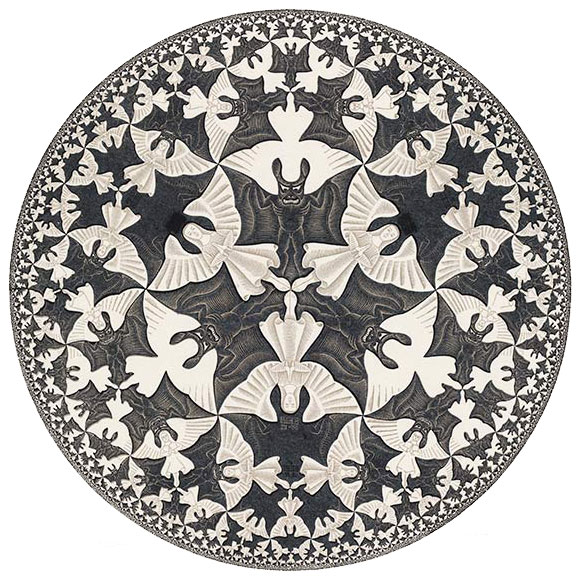
    Escher, a hyperbolic image
    Angels and Devils
    Perhaps some of my readers would like to know about my hyperbolic geometry, the non-straight lines that seem to govern my thoughts. One of them is the Christian tradition which I have encountered. This is one line with all its roots and tangents. The other is experimental science, as it is written,
    And Yahweh God fashioned from the ground every living thing of the field and all the fowl of the heavens and had them come to the earthling to see what it would call to it.
    And all that the earthling called it, the self that has life, that was its name.
    This verse is the pattern of experimental science, observation and naming. We see how something actually works, and then we assign a tag to it.

    We live in every day of Creation. The days are all contemporaneous with every generation. We are immersed in the great act of birth-giving. Just look at the birth imagery in the Psalms:

    e.g. Psalm 90
    from ere mountains were born or you birthed earth and world
    and even from everlasting to everlasting you are God.
    and 96
    worship Yahweh in the honour of holiness
    let all the earth be brought to birth from his presence
    and 97
    his lightnings light the world
    the earth saw and was in birth
    I really went to town on this in my book on the Psalms in a long section on Psalm 110:
    A Black Hole and its music,
    making the invisible visible
    This too is a day of his power. Given the nature of his rest, we live in the day in which the LORD God created the earth and heaven (Genesis 2:4). The womb of old time is the black hole of the cross where time is slowed to nil and transcendence radiates in all lives forward and backward, redeeming the time. So it is in the Lamb slain before the foundation of the world that our birth in the Spirit is grounded. So it could be said that the Lord both precedes and follows this oracle of David.
    Ha! Who would dare anwer the Lord's question?

    The birth imagery continues in Psalm 114, revealing the ambiguous image of earth / land being birthed, particular (the land of Israel), and universal (the earth), and applicable to both individual and corporation, the emergence of holy and caring relationships throughout our offices and countries.
    from the presence of the Lord let earth be brought to birth
    from the presence of the God of Jacob
    And the birth imagery does not end until the last verse of Psalm 150.
    All the breath-bearing praise Yah Hallelu Yah
    breath-bearing, נשׁם (nshm), used of a woman in childbirth (also Psalm 18:16, at the breath of the wind of your nostrils).

    It is most curious that birth, dance, and writhe are all the same stem חול in Hebrew. It is a difficult and time-consuming process. We the woman, are giving birth. There is no shortcut.

    How should we behave toward what we are giving birth to?

    The pervasive image of the invisible
    We should behave as Yahweh behaves, with care and with prodigality. We should love as God loves. If you love only those who you think are like you, what profit is there in it?

    We should recognize our kin. We should love them as we love ourselves.

    When the science of all life is done, and we recognize the commonality of our DNA, we, as the earthling in the garden, should name our kin and act with care towards them, whether they be human, or animal, or creepy-crawly, and I won't even draw the line at viruses, for we are learning their capabilities. Just look at the benefits of COVID-19: the reduction in pollution, and even preventing aggressive acts from rich, thoughtless, and grasping countries. May we recognize the tendency to evil that we must work against.

    (Read Psalm 146, read any of the second parts of Paul's epistles, following therefore - such as Romans 12-16.)

    Yes you can read these sorts of helps in Seeing the Psalter. [PDF copy to be available soon from selected distributors.] But hey, this is art, and music, and all the discipline required of these gifts, whether to write or read, or perform. There are no shortcuts.

    Monday, 9 February 2026

    Some notes on the first 7 verses of Job 38

    There is a reason that I have limited my comments in my Music of the Bible series. The complexity of this presentation of the Bible, through the work of Suzanne Haïk-Vantoura will take many lifetimes to critique. I worked through the first dozen or so verses of Job 38. This post is only on the first 7. Many more words could be written than I have time to absorb or you time to read.

    I began with a look at recurrence patterns. The final recurring word in the chapter focuses the single long passage as leading towards wisdom. I can do a maximum of 40 roots at once, so I had to eliminate a few (two of which do follow wisdom, but these join chapter 38 to a new section on animals that continues in chapter 39). There were no circular structures that were highlighted. The chapter comes across with force. 

    Job 38 -- beginning

    I used the prose default mode in verse 1 to distinguish the narrator from the actors. There is never a rest note in the narrator's introductory snippets until chapter 33 when the narrator comes on stage to introduce Elihu. And there, the narrator speaks in poetry. 

    Verse 2: Who is this? begins the  speech on the high C with the qadma ornament carrying the tessitura even higher. This verse through its opening note connects the speech to the prior speeches. It has no mid verse rest. Verses three and four are traditional poetry with mid verse rest points. Verse three approaches the subdominant from the B, and verse four approaches from the g. 

    Verse 4: Where were you when I founded Earth? Notice it is founded, not created. יָסַד is architectural: laying foundations, establishing stability, setting something so it can bear weight.

    Not 'What do you know?' but 'Where were you?' Before any claim to discernment, there must be a place from which discernment could arise. בִּינָה is the ability to distinguish, to perceive relations, to tell one thing from another within a structure.

    'Make it clear' is an invitation. הַגֵּד is imperative, but does not require silence from Job. It is not saying that humans know nothing, or that inquiry is illegitimate, or science futile. It is saying that wisdom begins with acknowledging where one stands, foundational ordering precedes explanation. 

    Verse 5: Who set her measure? For you know.
    Or who stretched out on her a line? 

    We measure. We may even measure well -- and do intricate projects like the Webb Telescope. But, as is ironically implied, it is a philosophical puzzle that measurement is possible within reality. Why is it that physics can be described by equations. And we know our knowledge is limited by the probability distributions of the quantum fields. We are not mechanism and neither is creation.

    Job 38 -- a place to pause for a moment
    On what were her sockets sunk? I am moved by this image. It is very carefully stated. One must not translate sockets as pillars as though we were a construction project. The word for socket (adn -- close to the same letters as in Adonai) occurs twice outside of Torah, the sections in Exodus on the building of the tabernacle and the continuation in Numbers. In the building of the tabernacle it occurs 51 times. With its usage here, the earth becomes a holy place, just as the beloved of the Song is holy in the description that also uses this word socket.

    Song 5:15
    Who instructed her corner stone? The corner stone (אֶבֶן פִּנָּה) is not just structural. That word pnh is multifaceted. The corner stone, the facing stone, aligns walls, determines orientation, governs coherence. And yet the verb is יָרָה to instruct, to teach, to throw, or cast. If the cornerstone is 'nstructed' then, as science requires of creation: order becomes intelligible, coherence is sensible, alignment is reliable, but the instruction is more than 'ours'. We must align ourselves to the stone that faces us. But we did not instruct it. These verses are a revelation of the conditions of knowing. And we do know, in part.

    The music is restrained. Apart from the revia-mugrash (which I call tuba announcing the return to the tonic), there are no ornaments. There are no verses from verses 2 to 11 starting on a pitch other than the tonic, i.e. no explicit verse connections as there are later in the chapter. I am still looking for some clues as to why some verses approach the tonic from below and why some from above. I also ask why some verses return gently to the tonic, some without tuba, some with, and others (in poetry only) move from B to e -- munach to silluq.

    3. e B A, tuba e.
    4. e B g A, tuba, f# e.
    5. e B g B A, C e g B e.
    6. e g B A, f# tuba, B e.
    7. e g B A, tuba, f# e.

    Verse 7 lifts us from support to celebration, from grounding to witness. That's why we love the beauty of mathematics and science and the order of creation. It's not important that it is big, but that it is ordered both in the infinitesimally small and enormously large, and even in the infinities of the real number system. And we should be encouraged.

    People say the Word is written. But note the absence of the word socket from most of the books of the Hebrew canon. Part of reading with comprehension is to discern what is not written.

    We can face the questions and sing the music. Someone should mount this stage play. The book with the music for every verse is available here. 

    Thursday, 3 March 2022

    Theology and the Psalms - preliminaries

     Dr. D in his first statements on preliminaries asks first what is our standpoint — and he underlines three possibilities:

    • the standpoint of the poet, 
    • or the standpoint of the Old Testament church, 
    • or the standpoint of the church of the present dispensation
    This will take some digging since these are not how I see my standpoint today. Dispensation is a term I leave to one side. The assemblies of the emerging faith of Torah and Psalms I do not characterize as 'church'. There must be a standpoint of the poet. That is where I began. I don't expect it encompasses the totality of either Torah or Psalms.

    But I must also stand in my own time, past the era of the imposition of salvation (as if that were even possible!) and into the cacophony of bullying such as is seen in China's century of humiliation —following the opium wars, Russia's pride and fear —following the second world war, Ukraine's terror today, the inability of Canada (temporarily we hope) to manage false claims of freedom and the American right's inability to count, to trust, to be civil, and the overall failure to manage "whatsoever things are true, whatsoever things are honest, whatsoever things are just, whatsoever things are pure, whatsoever things are lovely, whatsoever things are of good report;". 

    The notion of what is 'Christian' is so torn from its roots that it is almost completely dead for lack of suitable nutrients and water. The problem has been from the beginning of course, but I cannot put to one side the Shoah, nor the facts of climate change and the human capacity for self-destruction through nuclear annihilation. We have become so good through our sin at destroying each other. There is not one that doeth good, as the poet says.

    A few 'facts' that trouble me and 'theories' that encourage me:

    'Facts' - the blockaders in Canada did not and do not speak for most of us in this country. A blockade that exposes its own stupidity and makes itself obnoxious is not speaking to any notion of freedom that can be acceptable. If indeed they die for their sins, well let that be an end of them. Sin has no resurrection. Vindication requires angels beholding the face of God, and the childishness of these mockers does not qualify. Those who support them are equally obnoxious. I am sure they include many who think that the US election was stolen. The end of this lie has yet to be seen. The Canadian government's response was overly reasonable. These people could not see the will of God for our freedom but they should be able to see the will of the people they have damaged. Let them live then and pay their dues for the consequences of their actions. Ignorance masking itself as faith, and bluster masking itself as hope, stand against love, the greatest of these three gifts. The obnoxious do not will the good of others.

    Encouraging 'theories' - we live in a time of immensely productive science. There are some doing good for the environment, some for the fauna and flora of the world, and some for the knowledge of the beginnings and endings of the cosmos, the dark matter that helped the visible form into stars and galaxies, that shapes the gravity of our situation cosmically and caused light to shine in the universe. If we as a species want to continue, we must incorporate a full science into our faith. 

    I am also encouraged by faithful scholarship applied to the source of our ability to read, write, and think across the centuries. It is not a bad thing to pay attention to this emergence of knowledge, physical and spiritual. We still know 'in part'. We are all still bound by our assumptions. 

    I wrote the above before the current war. What consequences are there for power and lies, evil and wickedness in this world? These will be determined, but putting aside the mad actions of a deranged and self-deluded man attempting to mislead everyone with his lies, if we all survive another 10 years, I hope we will see the international criminal court bring Putin to justice for war crimes. Anyone who praised him is as sick as he is. 

    The psalms end in praise because Yahweh relieves the afflicted. He humbles the wicked to earth. And the job is given to those who know mercy: to bind this sovereign in chains, and this self-glorifying one with iron fetters. 

    The oppressed of the earth know this is true and are showing their support for the one who has been attacked. We don't need correct theology to figure this out. 

    It turns out that when I read the preliminaries, as Delitzsch calls this section, they raise so many questions about his thinking that I feel I am in an episode of Vienna Blood. So I will leave any further immediate comment. Dr D's theological summary is as would be expected, thorough, well-informed, and coherent for him. [He only uses the punish word twice in the theological preliminaries]. 

    He does have a section that justifies wrath in the face of such injustice as we see today not only from Putin and his cronies, but from all the rich whose wealth is extracted from the people to their detriment and to the detriment of their earthly homes, "vine and fig tree" as given to them.

    But as to the so-called imprecatory psalms, in the position occupied by the Christian and by the church towards the enemies of Christ, the desire for their removal is certainly outweighed by the desire for their conversion: but assuming, that they will not be converted and will not anticipate their punishment by penitence, the transition from a feeling of love to that of wrath is warranted in the New Testament (e. g. Gal. v. 12), and assuming their absolute Satanic hardness of heart the Christian even may not shrink from praying for their final overthrow. For the kingdom of God comes not only by the way of mercy but also of judgment; and the coming of the kingdom of God is the goal of the Old as well as of the New Testament saint (vid. ix. 21, lix. 14 and other passages), and every wish that judgment may descend upon those who oppose the coming of the kingdom of God is cherished even in the Psalms on the assumption of their lasting impenitence (vid. vii. 13 sq. cix. 17).

    [I doubt that the Gal. 5:12 proof text is apt, Dr. D. It is a fit of pique from Paul. We don't need proof texts for this kind of judgment at this stage of human learning - though it remains to be seen if we have maturing within our current international consensus against the aggression of Russia - Gog or no Gog.]

    As for what the OT and NT distinguish - here Dr. D and I are going to diverge. While I see the fullness of the Firstborn, I do not doubt that 'life after death' in an everlasting linearity is a misunderstanding of the eternal. We are still exploring the extremes of our knowledge of the heavens and the earth and there is no final theory that could have been expressed pre-science any more than the Patristic authors who had no Hebrew could effectively do grammar with Dr. D. As I quoted him in an earlier post, there is still more to come.

    I will leave you dear reader to chose for yourself whether to read the whole epub section for this beginning. I want now to see more into what Delitzsch writes for a psalm. I may start with Psalms 1 - but may or may not proceed in sequence. In any case this is a long process, up to two years if I do the whole Psalter. And I have to intersperse it with other things, like music and grandchildren, and so on.

    Wednesday, 30 December 2020

    The Today of Psalm 2

    This article on Psalm 2 is a superb exploration of its reception history. What imaginary, what imagery, what metaphor do we inhabit? What is “today” in the time of our quanta and our decisions?

    We live within the metaphors that we create, whether they be religious or scientific. We use theology and science to create and explain our imagery that we live within. These words seek to approach what we experience. My brother Bill, among many, rejected the religious framework as describing a god of the gaps in our knowledge. He said science will explain everything. This is a fine movement forward in time, testing the limits of our knowledge but subject to the same difficulty we have in glossing the gaps everywhere. But?

    Imagine if it were possible for humanity to explain everything! We would think we had become gods?  

    When I think God has a son - what do I think. First I recognize that all our words are metaphor. They stand for something that may or may not be shared. With respect to 'son', I replace it with a non-masculine metaphor, 'child'. We are all (like) children of God. What is God that this God should have a child? A child is a chip off the old block. Such a child is like the parent, whether male or female. What is the parent like?

    Here we need some help from other parts of Scripture. A large number of Psalms cite Exodus 34:6:

    And Yahweh, passed over before him, and he called, Yahweh, Yahweh, a God compassionate and gracious, // slow to anger and abundant in kindness and truth,

    You will find this verse reflected in 23 verses of the remainder of the Hebrew Bible. See the verses under compassion rkm or slow arc or gracious knn or kindness ksd. It is possible we could find more verses that might have been influenced by Exodus 34:6 under abundant and truth. You can browse the concordance pages for these too.

    There are many associations raised for me by the above article at TheTorah.com. One I want to follow up is the notion of today. Kimchi's argument does not stand because it is too dependent on the passage of time. 

    Today is poetry. We are present at the Exodus. Our presence is made real in the congregation whether in the First Testament or the Newer Testament. See the passage in the latter part of Deuteronomy 6. Then you will say to your child, Servants we were to Pharaoh in Egypt, // and Yahweh brought us out from Egypt with a courageous hand. See also the instructions at the beginning of Psalms 78. And note how the poet speaks with a parable.

    We are not separated by time. This is Einstein's "spooky action at a distance". Time is both limited and created even though we experience it as unidirectional and absolute. We are not absolute in our knowledge. There is no complete argument for or against a theological position. So we must hold them in tension. We are not out to win arguments. We should be suspicious when we seem to be heading in this direction. 

    Last Lent, I followed the 40+ posts on the poetry of Herbert at Living Wittily, Jim Gordon's site. He ends with the poem Easter. This use of language is life giving. About time and today, Herbert writes: we count three hundred but we misse, there is but one and that one ever. 

    This is the today I am thinking about. The problem with the absolute value of time is that it makes Jesus into a magician instead of a son, unique or one among many.

    spr thlim

    Book of Psalms

    b

    2

    almh rgwu goiim?
    ulaumim ihgu-riq?
    1Why such a throng of nations?
    and tribes in empty muttering?
    bitiixbu mlci-arx vroznim nosdu-ikd,
    yl-ihvh vyl-mwiko:
    2They station themselves, these sovereigns of earth, these rule-makers reasoning as one,
    over Yahweh and over his anointed:
    gnntqh at-mosrotimo,
    vnwlich mmnu ybotimo.
    3Let us snap their bonds,
    and kiss good-bye to their cords.
    diowb bwmiim iwkq.
    adonii ilyg-lmo.
    4The one sitting in the heavens, he laughs.
    My Lord derides them.
    haz idbr alimo bapo,
    ubkrono ibhlmo.
    5Then he will speak to them in his anger,
    and in his burning vex them.
    vvani nscti mlci,
    yl-xion hr-qodwi.
    6I myself have offered as libation my own king,
    on Zion, my holy hill.
    zasprh al-koq.
    ihvh amr alii bni ath.
    ani hiom ildtiç.
    7I will recount the decree.
    Yahweh promised to me: You are my son.
    I myself this day gave birth to you.
    kwal mmni vatnh goiim nkltç,
    vakuztç apsi-arx.
    8Ask me and I give the nations as your legacy,
    and as yours to hold fast, the ends of the earth.
    'ttroym bwb't brzl.
    ccli ioxr tnpxm.
    9You will injure them with an iron sceptre.
    Like fashioned vessels, you will smash them.
    ivyth mlcim hwcilu.
    hivvsru wop'ti arx.
    10So now, you sovereigns, let there be insight.
    Be warned you who judge on earth.
    iaybdu at-ihvh birah,
    vgilu brydh.
    11Serve Yahweh in fear,
    and rejoice in trembling.
    ibnwqu-br pn-ianf vtabdu drç
    ci-ibyr cmy't apo,
    awri cl-kosi bo.
    12Kiss, each of you, pure lest he be angry and you perish in the way,
    for he kindles as a hint of his anger. Happy are all who take refuge in him.