Showing posts with label elaborate. Show all posts

Sunday, 22 December 2024

Recitation note stories low and high

Low c is never used in the poetry. But it has a role in the prose. It is not heavily used for recitation and allows for only one ornament and that rarely, as noted here in the tarsin table. The low c allows for a full octave leap up or down in the music. As in the Bach Mass in B Minor, where the Sanctus has the octave leap down in the bass part, so also in Isaiah 6, the Seraphim leap an octave down on the word holy -- I am not kidding. But who am I to say that Bach copied the seraphim!

B Minor Mass Sanctus -- octave leap
image thanks to imslp

In Isaiah 6 - where the Sanctus comes from, the seraphim open the music with an octave leap down.
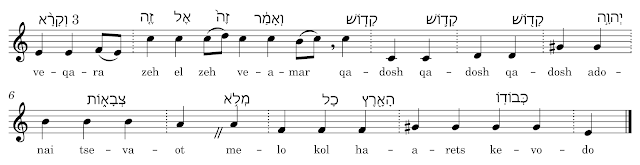
Isaiah 6 verse 3 showing that the Seraphim knew Mr Bach
though the rhythm is different between Hebrew and Latin.

In truth rather than in jest, the leap up from the low c also allows for some cool pickup notes like that in Ruth 1 on Bethlehem in verse 1. I was surprised not to see the octave leap up, but I was thinking of the leap from d to C in these psalms: 23 verse 4 bar 21. You will find similar features in 27:6, 32:5, 68:31, 84:4, 90:10, 106:38 and 48, 123:2, 125:3, 138:2, and 141:4. (See the psalms page to get the links. I find this page so useful, I have stopped using my database to study their forms.) And here we see some usage of the ornaments. Though they are subordinate to the pitch of the current recitation, they help the singer get to the next pitch. Pazer or pazer and zarqa precede the C in the poetry. Some of these are remarkable word painting, like the swallow in psalm 84 and its sudden ascent and descent.

In the prose there are 3 instances of this interval (d C) and up to five ornaments between the two notes. In some ways, the prose is a different world.

Low c is used in 3,063 verses in the prose music. It is followed immediately by low d in the prose as part of the narrative sweep in either the first part of a verse (1,327 times), or the second part of a verse (1,004 times), or when there is no atnah, (205 times). The other 527 times c occurs followed by other notes.

Low d has two accents dedicated to it, the one called galgal is used extensively in the poetry but only 16 times in the prose.

Psalms 31 verse 12 - the longest recitation on a low d. See bar 65 at the link.

In the prose the usual accent for low d is tevir. You can see both used in Jeremiah 13:13. 

Jeremiah 13 verse 13 showing both galgal and tevir in the same verse.

13 And you say to them, Thus says Yahweh, Note me well filling all the inhabitants of this land, and the kings who sit for David on his throne, and the priests, and the prophets, and all the inhabitants of Jerusalem, with drunkenness. (1-1)
יג ואמרת֨ אליה֜ם כֽה־אמ֣ר יהו֗ה הננ֣י ממל֣א את־כל־ישב֣י הא֪רץ הז֟את ואת־המלכ֣ים הישבים֩ לדו֨ד על־כסא֜ו ואת־הכהנ֣ים ואת־הנביא֗ים וא֛ת כל־ישב֥י ירושל֖ם שכרֽון 63
ig vamrt alihm ch-amr ihvh hnni mmla at-cl-iowbi harx hzat vat-hmlcim hiowbim ldvid yl-cisao vat-hcohnim vat-hnbiaim vat cl-iowbi iruwlim wicron

Was it deliberate or accidental? Had the composer been interrupted and been working on a psalm and then went back to working on Jeremiah? It could perhaps have been a copying error. Manuscript smudges might make the difference hard to read. The tevir is never found in the poetry. Should the galgal be in the prose?

You be the judge. Here's the section in the Aleppo codex online. I really do wonder about the other 15. Fortunately it doesn’t affect the music.

Jeremiah 13 v 13 galgal on וא֛ת looks backwards
15-138-v_photo at barhama.com

But for now, to postpone the middle tones from e to B, we move to the extreme of the scale. The high C has 584 recitations in the Psalms over 2,738 syllables. A fifth of the recitations are only 2 syllables long. Almost as many are just one syllable - a poke in the musical framework sometimes, and one is 23 syllables long (not shown on the graph). In a psalm! Take a look at verse 5 at the link.

I hear the highest recitation pitch as one that is emotional, from grief to joy. I have noted this for the past several years. That note changed my reading of several passages in Torah. I saw they were not anger but grief. It's been a long time, but I think this is the one I first noticed, and the music changed my reading to agree with a presence I knew as a parent and as a child of a parent.

Deuteronomy 8 - what is the character of the God you know?

11 Keep watch for yourself lest you forget Yahweh your God,
so as not to keep his commandments and his judgments and his statutes which I am commanding you today. (1-4-1)
יא הש֣מר לך֔ פן־תשכ֖ח את־יהו֣ה אלה֑יך
לבלת֨י שמ֤ר מצותיו֙ ומשפט֣יו וחקת֔יו אש֛ר אנכ֥י מצוך֖ היֽום
15
26
ia hiwmr lç pn-twck at-ihvh alohiç
lblti wmor mxvotiv umwpTiv vkuqotiv awr anoci mxvvç hiom

There's much more to say - but I don't yet know what it is.

Saturday, 16 November 2024

More metrics for the shape of the music

Shapes abound in music. What rationale is there for their choice. How easy would it be to hear patterns? Various other questions as we think of them.

One that stood out is the shophar motif. You perhaps noticed that Psalm 61 is one of the shophar psalms with several intervals of a fifth 'e B' and 'B e' in it.

Ten psalms have no verses beginning with the opening fifth. The remaining 140 psalms have a range of 1 verse in 14 verses to 3 verses in 4 with an opening fifth (Psalm 149). But the range is widespread so the interval does not define the shape of a psalm by itself.

Many verses end with a descending fifth from B to e.  All the verses in Psalm 136 end with the interval B e. The range here for the 141 psalms with verses ending in B-e is again widespread. 4 psalms have a count greater than 4 verses in 5 ending with the descending interval of the fifth. 15 are between 3 and 4 verses in 5, 41 are between 2 and 3 verses in 5, 68 between 1 and 2 in 5, so that leaves 13 with fewer than 1 in 5 but at least 1 and 9 with none.

To summarize:

Interval none  fewer
than 1/5
 more
than 1/5
 more
than 2/5
 more
than 3/5
 more
than 4/5
Opening e B 10 36 73 26 5 0
Ending B e 9 13 68 41 15 4

I looked at the sequences of accents under the text, eliminating consecutive duplicates. In the psalms alone there are 660 patterns. 436 of them occur in only one verse. 90 occur in 2 verses. 33 occur in 3 verses, and so on. The pattern e B A f e occurs the most often, 111 verses. g B A f e occurs in 105 verses. e f A f e in 96 verses.

Here's a graph of the top 40 phrases. That leaves 420 more to trail off to the right....
Top 40 sequences of sublinear te'amim in the Psalms

And these are the 298 verses that start and end with the interval of a fifth.
Sublinear te'amim silluq-munah and munah-silluq

Because of the nature of the illuy (above the text), not all fifths are noted using only the accents below the text.

See also here and here.

Saturday, 9 November 2024

Psalm 115

Psalms 115: Syllables: 314; Longest recitation: 8; Tenor: g 23.89%;
Ornament density: 10.6%; Average phrase length: 8.2. Performance by Esther Lamandier here.

I see that the descending triad B g e survived the comparison with the Aleppo codex in verse 17. Where, I wonder, is the earlier copy of this text? I wonder if there was one such as I am presenting here - consonants and cantillation without vowels.

Note the almost attacca beginning. This psalm is sometimes presented with the previous psalm as a single psalm. As observed in 116 the three psalms belong together. The exodus journey belongs both to the people and also to the individual. No one can say, we did this ourselves.

1 ♪C Not to us Yahweh not to us,
but to your name give glory,
over your kindness, over your truth. (C-1-2-4-1)
א ל֤א ל֥נו יהו֗ה ל֫א־ל֥נו
כֽי־ל֭שמך ת֣ן כב֑וד
על־ח֝סדך֗ על־אמתֽך
7
7
9
a la lnu ihvh la-lnu
ci-lwmç tn cbod
yl-ksdç yl-amitç
2 ♪g Why should the nations say,
Where pray tell is their God? (g-1-4-1)
ב ל֭מה יאמר֣ו הגוי֑ם
איה־נ֝֗א אלהיהֽם
7
7
b lmh iamru hgoiim
aih-na alohihm
3 But our God is in the heavens.
All that he delighted in, he did. (1-4-1)
ג וֽאלה֥ינו בשמ֑ים
כ֭ל אשר־חפ֣ץ עשֽה
8
7
g valohinu bwmiim
col awr-kpx ywh
4 ♪g Their idols are silver and gold,
a deed of the hands of a human. (g-1-4-1)
ד ע‍ֽ֭צביהם כ֣סף וזה֑ב
מ֝עש֗ה יד֣י אדֽם
8
7
d yxbihm csf vzhb
mywh idi adm
5 Mouth they have and speak not.
Eyes they have and see not. (1-4-1)
ה פֽה־ל֭הם ול֣א ידב֑רו
עינ֥ים ל֝ה֗ם ול֣א יראֽו
9
8
h ph-lhm vla idbru
yiniim lhm vla irau
6 Ears they have and hear not.
Nose they have and smell not. (1-4-1)
ו אזנ֣ים ל֭הם ול֣א ישמ֑עו
א֥ף ל֝ה֗ם ול֣א יריחֽון
9
8
v aozniim lhm vla iwmyu
af lhm vla irikun
7 Their hands and they feel not, their feet and they walk not,
nor do they mutter through their gullet. (1-4-1)
ז ידיה֤ם ול֬א ימיש֗ון ר֭גליהם ול֣א יהל֑כו
לֽא־י֝הג֗ו בגרונֽם
17
6
z idihm vla imiwun rglihm vla ihlcu
la-ihgu bgronm
8 ♪g Like them their makers will become,
all who trust in them. (g-1-4-1)
ח כ֭מוהם יהי֣ו עשיה֑ם
כ֭ל אשר־בט֣ח בהֽם
8
8
k cmohm ihiu yowihm
col awr-boTk bhm
9 ♪g Israel, trust in Yahweh.
Their help and their shield is he. (g-1-4-1)
ט י֭שראל בט֣ח ביהו֑ה
עזר֖ם ומגנ֣ם הֽוא
7
7
T iwral bTk bihvh
yzrm umginm hua
10 ♪B House of Aaron, trust in Yahweh.
Their help and their shield is he. (B-1-4-1)
י ב֣ית א֭הרן בטח֣ו ביהו֑ה
עזר֖ם ומגנ֣ם הֽוא
8
7
i bit ahron bTku bihvh
yzrm umginm hua
11 You who fear Yahweh, trust in Yahweh.
Their help and their shield is he. (1-4-1)
יא ירא֣י י֭הוה בטח֣ו ביהו֑ה
עזר֖ם ומגנ֣ם הֽוא
8
7
ia irai ihvh bTku bihvh
yzrm umginm hua
12 Yahweh remembers us - he will bless.
He will bless the house of Israel.
He will bless the house of Aaron. (1-2-4-1)
יב יהוה֮ זכר֪נו יב֫ר֥ך
י֭ברך את־ב֣ית ישרא֑ל
י֝בר֗ך את־ב֥ית אהרֽן
9
8
8
ib ihvh zcrnu ibrç
ibrç at-bit iwral
ibrç at-bit ahron
13 ♪g He will bless those who fear Yahweh,
tiny with great. (g-1-4-1)
יג י֭ברך ירא֣י יהו֑ה
ה֝קטנ֗ים עם־הגדלֽים
7
7
ig ibrç irai ihvh
hqTnim ym-hgdolim
14 Yahweh will add to you,
to you and to your children. (1-4-1)
יד יס֣ף יהו֣ה עליכ֑ם
ע֝ליכ֗ם ועל־בניכֽם
7
8
id iosf ihvh ylicm
ylicm vyl-bnicm
15 You are the blessed of Yahweh,
who makes heaven and earth. (1-4-1)
טו ברוכ֣ים א֭תם ליהו֑ה
ע֝ש֗ה שמ֥ים ואֽרץ
7
7
Tv brucim atm lihvh
yowh wmiim varx
16 The heavens' heavens belong to Yahweh,
and the earth he has given to the children of humanity. (1-4-1)
טז השמ֣ים ש֭מים ליהו֑ה
ו֝הא֗רץ נת֥ן לבני־אדֽם
7
9
Tz hwmiim wmiim lihvh
vharx ntn lbni-adm
17 ♪B The dead will not praise Yah,
nor all who go down mute. (B-1-4-1)
יז ל֣א ה֭מתים יהֽללו־י֑ה
ו֝ל֗א כל־ירד֥י דומֽה
8
7
iz la hmtim ihllu-ih
vla cl-iordi dumh
18 But we, we will bless Yah, from now and unto everlasting. Hallelu Yah. (1-1)
יח ואנ֤חנו נב֘ר֤ך י֗ה מֽעת֥ה ועד־עול֗ם הֽללו־יֽה 18
ik vanknu nbrç ih myth vyd-yolm hllu-ih

The music in these posts is derived from the accents in the Hebrew Bible. Introductions - letters, music, text and music, and terminology, are here.

Psalm 116

Psalms 116: Syllables: 302; Longest recitation: 12; Tenor: A 22.85%;
Ornament density: 8.6%; Average phrase length: 7.7.

Psalms 114 to 116 are all connected by the first note. Given the importance of Psalm 114 (In exitu Israel), and the corporate realization of 115 (Non nobis Domine) about 114, this individual aria, 116 Dilexi, completes the series. You will find I set a few verses of this for a soloist with verse 5 as a chorus. Listen to the sixth day of Unleashing Leviathan.

Note the first verse. The Latin has the right idea. (Dilexi, quoniam exaudiet Dominus vocem orationis meæ.) Th psalm opens on the third note of the scale with א֭הבתי ahbti - just plain I love. The verb has no direct object in the Hebrew.

1 ♪g I love, for Yahweh heard,
the voice of my supplication. (g-1-4-1)
א א֭הבתי כֽי־ישמ֥ע יהו֑ה
את־ק֝ול֗י תחנונֽי
8
7
a ahbti ci-iwmy ihvh
at-qoli tknunii
2 For he bent his ear to me,
and in my days I will call. (1-4-1)
ב כֽי־הט֣ה אזנ֣ו ל֑י
ובימ֥י אקרֽא
6
5
b ci-hTh aozno li
ubimii aqra
3 The pangs of death enveloped me and anguish of Sheol found me.
Trouble and sadness I find. (1-4-1)
ג אפפ֤וני חבלי־מ֗ות ומצר֣י שא֣ול מצא֑וני
צר֖ה ויג֣ון אמצֽא
16
7
g appuni kbli-mvvt umxri waol mxauni
xrh vigon amxa
4 So in the name of Yahweh I will call,
beseeching, Yahweh, make an escape for my being. (1-4-1)
ד ובשֽם־יהו֥ה אקר֑א
אנ֥ה י֝הו֗ה מלט֥ה נפשֽי
6
8
d ubwm-ihvh aqra
anh ihvh mlTh npwi
5 Gracious is Yahweh and righteous,
and our God is compassionate. (1-4-1)
ה חנ֣ון יהו֣ה וצד֑יק
ו֖אלה֣ינו מרחֽם
8
7
h knun ihvh vxdiq
valohinu mrkm
6 Yahweh keeps the simple.
I was brought low and me he saves. (1-4-1)
ו שמ֣ר פתאי֣ם יהו֑ה
ד֝לות֗י ול֣י יהושֽיע
8
9
v womr ptiim ihvh
dloti vli ihowiy
7 Return, O my being, to your rest,
for Yahweh has matured you. (1-4-1)
ז שוב֣י נ֭פשי למנוח֑יכי
כֽי־י֝הו֗ה גמ֥ל עלֽיכי
8
8
z wubi npwi lmnukiici
ci-ihvh gml yliici
8 ♪C For he rescued my being from death,
my eyes from tears,
my foot from tripping. (C-1-2-4-1)
ח כ֤י חל֥צת נפש֗י מ֫מ֥ות
את־עינ֥י מן־דמע֑ה
את־רגל֥י מדֽחי
9
6
6
k ci kilxt npwi mmvvt
at-yini mn-dmyh
at-rgli mdki
9 ♪g I will walk in the presence of Yahweh,
in the lands of the living. (g-1-4-1)
ט א֭תהלך לפנ֣י יהו֑ה
ב֝ארצ֗ות הֽחיֽים
7
6
T athlç lpni ihvh
barxot hkiim
10 ♪g I believed so I spoke.
I myself was much afflicted. (g-1-4-1)
י ה֭אמנתי כ֣י אדב֑ר
א֝נ֗י ענ֥יתי מאֽד
8
7
i hamnti ci adbr
ani yniti maod
11 ♪g I myself said in my haste,
Every human lies. (g-1-4-1)
יא א֭ני אמ֣רתי בחפז֑י
כֽל־האד֥ם כזֽב
8
6
ia ani amrti bkopzi
cl-hadm cozb
12 What will I return to Yahweh,
for all his benefits to me? (1-4-1)
יב מֽה־אש֥יב ליהו֑ה
כֽל־תגמול֥והי עלֽי
5
7
ib mh-awib lihvh
cl-tgmulohi ylii
13 The cup of salvation I will bear,
so in the name of Yahweh I will call. (1-4-1)
יג כוס־ישוע֥ות אש֑א
ובש֖ם יהו֣ה אקרֽא
6
6
ig cos-iwuyot awa
ubwm ihvh aqra
14 ♪g My vows to Yahweh I will pay,
may it be before all his people. (g-1-4-1)
יד נ֭דרי ליהו֣ה אשל֑ם
נגדה־נ֝֗א לכל־עמֽו
8
7
id ndrii lihvh awlm
ngdh-na lcl-ymo
15 ♪g Precious in the eyes of Yahweh,
is the death of those under his mercy. (g-1-4-1)
טו י֭קר בעינ֣י יהו֑ה
ה֝מ֗ותה לחסידֽיו
7
7
Tv iqr byini ihvh
hmvvth lksidiv
16 Yahweh beseeching, for I myself am your servant,
I myself your servant and child of your maidservant.
You have loosed my bonds. (1-2-4-1)
טז אֽנ֣ה יהוה֮ כֽי־אנ֪י ע֫בד֥ך
א‍ֽני־ע֭בדך בן־אמת֑ך
פ֝ת֗חת למוסרֽי
9
11
7
Tz anh ihvh ci-ani ybdç
ani-ybdç bn-amtç
pitkt lmosrii
17 To you I will offer the offering of thanksgiving,
so in the name of Yahweh I will call. (1-4-1)
יז לֽך־א֭זבח ז֣בח תוד֑ה
ובש֖ם יהו֣ה אקרֽא
8
6
iz lç-azbk zbk todh
ubwm ihvh aqra
18 ♪g My vows to Yahweh I will pay,
may it be before all his people, (g-1-4-1)
יח נ֭דרי ליהו֣ה אשל֑ם
נגדה־נ֝֗א לכל־עמֽו
8
7
ik ndrii lihvh awlm
ngdh-na lcl-ymo
19 in the courts of the house of Yahweh, in your centre, O Jerusalem. Hallelu Yah. (1-1)
יט בחצר֤ות ב֤ית יהו֗ה בֽת֘וכ֤כי יֽרושל֗ם הֽללו־יֽה 17
iT bkxrot bit ihvh btocci iruwlim hllu-ih

The music in these posts is derived from the accents in the Hebrew Bible. Introductions - letters, music, text and music, and terminology, are here.

Thursday, 26 September 2024

The shofar psalms - what is their shape

You will remember the shape: 

Definitely designed for a wind instrument like trumpet or shofar.

The psalms with the shofar incipit only occur in the first three books so I thought as aa break from looking at everything at once, I should examine these 8 psalms in more detail. The link in the first column will show you the music.

PSALMSyllablesdef#gABC
36237.0025.3211.3920.6817.3021.943.38For the leader. Of a servant of Yahweh. Of David.

444951.2120.8118.1818.3819.1918.383.84For the leader. Of the children of Korah, an insight.

471731.7319.6519.0820.2312.7217.349.25For the leader. Of the children of Korah. A psalm.
49358.0019.8312.2922.3516.4820.398.66For the leader. Of the children of Korah. A psalm.
61163.0022.7012.8817.1817.7924.544.91For the leader with strings. Of David.
69734.6819.6218.1213.9021.2520.306.13For the leader. Upon lilies. Of David.

81310.0021.2911.6120.9722.5820.003.55For the leader on musing, of Asaph.

85241.8322.8212.4515.7724.4819.504.15For the leader. Of the children of Korah. A psalm.

Notice the variety of tenor with this incipit (0 on f#). Conclusion: the incipit does not determine the tenor. The tenor does not specify mode. By mode I mean the sharpening or not of selected tones in the scale.

Does the tenor tell us about the mood? To see that we need to examine the psalms as a whole. So here are brief introductions. What are the common characteristics of these psalms?

  • Psalm 36 is one of two oracles in the psalter, the other being psalm 110.
  • Psalm 44 is the corporate lament with its emphasis on the first person plural.
  • Psalm 47 has the ascension verse 6 including the phrase 'with the voice of the shofar'. Notice that psalm 48 on the city of God is surrounded by these two shophar psalms, both of them with the rarer tenor on g. 
  • Psalm 49, the riddle of the preciousness of ransom, contrasts the city of God with the dust-bowls of humanity.
(An aside: The fact that there are ornaments and significant recitations on g in the poetry tells us why the default mode for the poetry (f# g natural) is different from that for prose (f g#). There are no ornaments on the third degree of the scale in the prose books with the exception of the chapters containing the decalogue, Exodus 20 and Deuteronomy 5, and Genesis 35:22. In this one verse on filial deceit, the ornaments are remarkable for their presence. There is significance to the music -- it is not one of God's afterthoughts. The music should be an integral part of learning of the text. Where it is lacking, there will be misinterpretation.)

  • In psalm 61, singing psalms forever is the fulfillment of the psalmist's vow.
  • In psalm 69, the psalmist is sinking in overflowing floods. Each of these words recurs for the first time in the psalter in this psalm.
  • Psalm 81 anticipates the Jubilate (psalm 100).
  • Psalm 85 reflects the revelation to Moses in the kiss of righteousness and peace. These last three psalms have the tenor of A - at rest.

This interval of a fifth e to B and B to e is much more heavily used in the poetry (60% of verses) than the prose (26%). As a final cadence, B e, munah to silluq, is frequent in the poetry (35% of verses in Psalms, 46% in Job and Proverbs) compared to the prose - once only in 1 Chronicles 1:53 -- and who knows, this might be a slip of the stylus. In these 8 poems, the final cadence is 'B e' in 45% of the verses. Perhaps this is significant -- hard to tell with such a small sample.


Sunday, 16 May 2021

The cost of kindness

Marc Zvi Brettler asks if the death of the righteous is precious in the eyes of i-h-v-h? I have great respect for Marc and his work, but in this article, he is not carrying the verse to its necessary conclusion: 

  1. the cost to God of creation, and 
  2. the character of i-h-v-h  (Psalms 111) and the one who fears i-h-v-h (Psalms 112)
  3. the thrust of the purpose of the psalms: to form a people who are similarly kind and merciful, i.e. who are in the image and likeness of i-h-v-h. 
It should be no surprise that we humans have difficulty living up to this vocation into which we are invited, whether to write of it or to do it.

First, Marc suggests that Psalms 116:15 is a question. Is it a question? Answer: no. The verse may raise a question in the reader, but it answers it in the affirmative. 

Marc carefully points out, that a question does not need an explicit interrogative, but can be based on tone of voice. Let's see if this could apply in this case. I set part of this psalm to the music of the te'amim with verse 5 as a chorus reflecting the cost to i-h-v-h of creation. (I did not set that exact verse. It reads well as part of the sequence from 110-117, the psalms around which I based my oratorio, Unleashing Leviathan.)

Marc accurately points out the medieval responses to the question raised by this verse. But let's look first at the words: 

iqr byini ihvh 
hmvvth lksidiv

I have no quarrel with iqr glossed as precious, perhaps even rare since the ksid (the one who is merciful) is rare. But ksid should not be rendered as righteous. The ksid (one under mercy) may be declared righteous (xdq / xdiq). But the text does not say righteous in this verse.

So I read it thus:

Precious in the eyes of Yahweh,
is the death of those under his mercy.

Words eventually matter. ksid is derived from ksd which I translate simply as kind, kindness or mercy. 

Now consider the music: Position the pdf at verse 15 (or see below). Note that 15b (bars 71-72) is two words only. The musical phrase is a recitation on the subdominant and a direct return to the tonic. There is no chance of a question in the tone of voice. The subdominant is a restful reciting note. Recitation on the reciting note defined by the atnah is not uncommon. But here it occurs on three consecutive verses, 14, 15, and 16. I must lay out the data for you because it is complex yet also consistently straightforward.

thlim q'tz Psalms 116 Fn Min Max Syll
a ahbti ci-iwmy ihvh
at-qoli tknunii
1 I love, for Yahweh heard,
the voice of my supplication.
g 3e 4A 8
7
b ci-h'th aozno li
ubimii aqra
2 For he bent his ear to me,
and in my days I will call.

3e 4B 5
5
g appuni kbli-mvvt umxri waol mxauni
xrh vigon amxa
3 The pangs of death enveloped me and anguish of Sheol found me.
Trouble and sadness I find.
3e 4C 16
7
d ubwm-ihvh aqra
anh ihvh ml'th npwi
4 So in the name of Yahweh I will call,
beseeching, Yahweh, make an escape for my being.

3e 4A 6
8
h knun ihvh vxdiq
valohinu mrkm
5 Gracious is Yahweh and righteous,
and our God is compassionate.
3e 4B 8
7
v womr ptiim ihvh
dloti vli ihowiy
6 Yahweh keeps the simple.
I was brought low and me he saves.

3e 4B 8
9
z wubi npwi lmnukiici
ci-ihvh gml yliici
7 Return, O my being, to your rest,
for Yahweh has matured you.
3e 4B 8
9
k ci kilxt npwi mmvvt
at-yini mn-dmyh
at-rgli mdki
8 For he rescued my being from death,
my eyes from tears,
my foot from tripping.

C 3e 4C 9
6
6
't athlç lpni ihvh
barxot hkiim
9 I will walk in the presence of Yahweh,
in the lands of the living.
g 3e 4B 7
6
i hamnti ci adbr
ani yniti maod
10 I believed so I spoke.
I myself was much afflicted.

g 3e 4B 8
7
ia ani amrti bkopzi
cl-hadm cozb
11 I myself said in my haste,
Every human lies.
g 3e 4B 8
6
ib mh-awib lihvh
cl-tgmulohi ylii
12 What will I return to Yahweh,
for all his benefits to me?
3e 4A 5
7
ig cos-iwuyot awa
ubwm ihvh aqra
13 The cup of salvation I will bear,
so in the name of Yahweh I will call.
3e 4B 6
6
id ndrii lihvh awlm
ngdh-na lcl-ymo
14 My vows to Yahweh I will pay,
may it be before all his people.

g 3e 4B 8
7
'tv iqr byini ihvh
hmvvth lksidiv
15 Precious in the eyes of Yahweh,
is the death of those under his mercy.
g 3e 4B 7
7
'tz anh ihvh ci-ani ybdç
ani-ybdç bn-amtç
pitkt lmosrii
16 Yahweh beseeching, for I myself am your servant,
I myself your servant and child of your maidservant.
You have loosed my bonds.
3d 4B 9
9
7
iz lç-azbk zbk todh
ubwm ihvh aqra
17 To you I will offer the offering of thanksgiving,
so in the name of Yahweh I will call.
3e 4B 8
6
ik ndrii lihvh awlm
ngdh-na lcl-ymo
18 My vows to Yahweh I will pay,
may it be before all his people,
g 3e 4B 8
7
i't bkxrot bit ihvh btocci iruwlim hllu-ih 19 in the courts of the house of Yahweh, in your centre, O Jerusalem. Hallelu Yah. 3e 4C 17

verses 1, 9, 14, 15, 16, and 18 all have identical musical shape in the second colon returning from the subdominant to the tonic. A ger-rev,e. The sequence A-e as a final phrase occurs 57 times in the 21 prose books. In the poetry books, the particular sequence with the revia-mugrash (ger-rev) occurs 507 times (14% of verses). The sequence of notes in verse 15 occurs in 75 verses of the poetry books (Psalms, Proverbs, Job). If my thesis is correct, then you will find each of these verses has a sense of rest in the final half verse. So above for the verses in question, sing them and hear that sense. Read them with that tone of voice. They are never questions.

What is the question raised by verse 15? Is this verse noted in the New Testament? (Marc, with Amy-Jill Levine, is one of the two editors of the Jewish Annotated New Testament.) A strongly allusive verse Revelation 14:13, reflects the sense of Psalms 116:15. The footnotes in my first edition of the JANT do not mention the psalm allusion. I think this is an oversight. The New Testament has the same rationale behind it as the Psalms: creating a community that shows kindness and embodies mercy.

This psalm begins with the completeness of love, I love, for i-h-v-h heard, // the voice of my supplication. So the poet is willing to 'pay my vows' ngdh-na lcl-ymo, in public, please, before all the people. The poet will 'walk in the lands of the living', note the plural, barxot hkiim. The poet says to i-h-v-h, 'You have loosed my bonds.' Each of these half verses has identical music.

Psalms 116:15b the death of those under his mercy

Needless to say, no one, the churches in their present forms, Israel in its present form, any group that goes by the name of violence, or any group that works with imperialist motives has succeeded in this costly endeavour. 

Let us redefine what we mean when we say ksidim (trad Chasidim or equivalent)- mercy and kindness - not righteousness necessarily, but leading to such a maturity (verse 7). I think we could all agree that kindness is desirable. The question is whether anyone is willing to bear the cost. That is the rare aspect.

Who dares to speak that first verse? I love (open-ended without direct object). Without such love, there are no vows to pay, bonds are not loosed, and we do not walk in the lands of the living.