Sunday, 23 October 2022

What sounds are comfortable

I have just finished updating the concordance into the slightly changed form. There is now a control break on the vowels so that the SimHebrew can be compared with the fully pointed text. During this exercise I see again that there are letters that are used more rarely than others for the first two letters and the first letter of a root.

Here's a list of the first letter of a root by frequency of use.

ו ט ת ס צ ז ג ד פ ק ר ח ה נ ל מ כ ב ש י ע א
Frequency of Hebrew roots by first letter
from 62275 for alef to a mere 28 for vav

This is of limited interest in answering the question, which letters are comfortable, because it is the combination of letters that reveals more. Also the frequency of vav is low for roots, but high for its place as the first letter of a word. So the sound vvvv is comfortable and allows connecting things. The only Hebrew root that begins with vav is vav itself - a word meaning hook - or if your like - connector.

The concordance glossary page shows the frequency of the usage of each root, but in terms of beginning to assess the comfort of sounds, the frequency of pairs of letters as the first two letters of a root is sometimes more revealing. 
Initial letter pairs for roots beginning with alef

In this group, /at/ is the direct object marker. It is the largest component of roots beginning with at. The next largest is ath - mostly you but also a verb - to arrive. And atm - you plural. And there are a few names. And one animal, donkey.

/at/ does not seem any less or more comfortable as sound than say /aq/ - for which there is only one word, the ibex. In fact alef carries a vowel or is silent and a vowel goes with almost any consonant.

This chart (in alphabetical order) has the whole picture. /at/ clearly stands out but let's see if we can find a more useful display!

Frequency of initial letter pairs in Hebrew roots (too many peaks and valleys)

Sibilants except for shin (w) typically do not combine in the two initial letters. 

Sibilants in Hebrew rarely combine as the first 2 letters of a root

Gutturals likewise - (I don't think of r as a guttural - Lambdin says rarely if I remember right). Alef and ayin are heavily used as first letters of a root as noted above.
'Gutturals' in Hebrew rarely combine as the first 2 letters of a root

That's enough escape from reality for the moment. 

Wednesday, 19 October 2022

Claude has a post on untranslated words. Most if not all Hebrew names are 'translatable' but it would be tedious to translate them all. Suppose every time Bethlehem occurred, we called it House of Bread. I did note this once in the beginning of Ruth for reasons of irony. Or at least once for a name like Jonah (=dove) to show that he is an angry dove, and not a peaceable one.

But sometimes, as in Claude's post, there is a significant play to the words even when they occur only once, that makes them 'worth a stab' at translation rather than transcription. I do this rather more often than regular translations. 

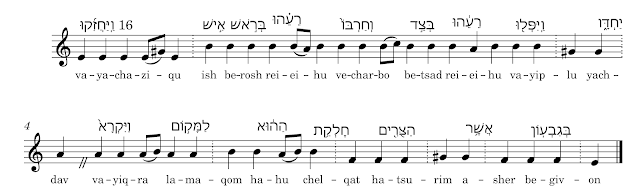
2 Samuel 2:16 is the end of a story of mutual destruction.

וַֽיַּחֲזִ֜קוּ אִ֣ישׁ ׀ בְּרֹ֣אשׁ רֵעֵ֗הוּ וְחַרְבּוֹ֙ בְּצַ֣ד רֵעֵ֔הוּ וַֽיִּפְּל֖וּ יַחְדָּ֑ו
וַיִּקְרָא֙ לַמָּק֣וֹם הַה֔וּא חֶלְקַ֥ת הַצֻּרִ֖ים אֲשֶׁ֥ר בְּגִבְעֽוֹן

vikziqu aiw braw riyhu vkrbo bxd riyhu viiplu ikdiv 
viqra lmqom hhua klqt hxurim awr bgbyon

And they were resolute, each by the head of his friend, and his sword in the side of his friend,
and they fell as one, and that place is called, the sharing of the neck, that is in Gibeon.

In my translation, I suggest that the roots are (xvr) צור and (klq) חלק. These are both multi-faceted roots which require various glosses in English depending on the context.

klq: share, divide, flatter, smooth (as in speech)

xvr: rock, neck, fortify, siege, et al.

Some gloss the name as 'Field of ' this or that. Field is not a gloss I would use for klq since it is used for another common root and I try to reduce overlaps of one English gloss applying to multiple Hebrew roots. So I rendered the phrase for the name of the place as 'the sharing of the neck'.

What should be an embrace of comradeship is a deadly embrace. Mutual destruction. The Bible is not prescriptive in a verse like this.

The music is a declamation and after the rest - in this case of mutual destruction, a matter of fact consequence. 

2 Samuel 2:16 - not a compliment to the valiant


Sunday, 9 October 2022

Does God hate divorce?

Claude Mariottini again asks a question on Bible translation. This struck me as a good one. And it raised questions about my own translating -- as it should. James McGrath also noted Claude's post on Twitter. I'm following war correspondents so I read Twitter more often these days.

Here's the verse. 

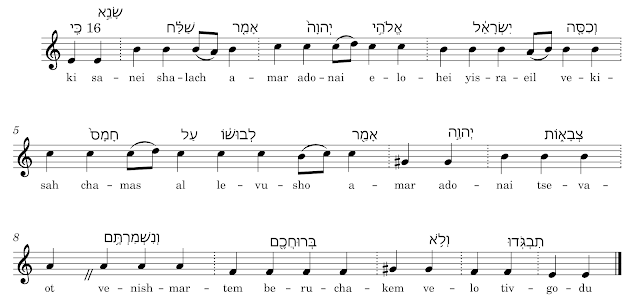
ci-wna wlk amr ihvh alohi iwral vcish kms yl-lbuwo amr ihvh xbaot // vnwmrtm brukcm vla tbgodu

There is emphasis on the hate in the music with its declamatory rise to the dominant. This follows an appeal on the 6th as reciting note - supporting the narration, says Yahweh the God of Israel. Then it continues on the dominant with further appeal concerning the consequences of the action that is hated. The phrase comes to a rest with the parallel repetition of says Yahweh of hosts. The phrasing suggests that כִּֽי־שָׂנֵ֣א שַׁלַּ֗ח ci-wna wlk should be read in parallel with וְכִסָּ֤ה חָמָס֙ עַל־לְבוּשׁ֔וֹ vcish kms yl-lbuwo. Is the vav additive or contrastive? I.e. should it be rendered and or but? Translations that mess with the word order will force a single reading. 

What is the object of hate? Is it right to translate it as a direct object when there is no marker in the Hebrew. (It might well be fine. See below.) And who is doing the hating? Equally when the text says vcish kms yl-lbuwo, who is doing the covering of violence with his clothing? Is Yahweh speaking of himself in the third person?

Malachi 2:16, my rendering:
For he hates to send away, says Yahweh, the God of Israel,
but he covers violence with his clothing, says Yahweh of hosts.
So be guarded in your spirit, and do not act treacherously.

Reading around, notice (as Claude also point out) the repetition of the root /bgd/ - to act treacherously (verses 10, 11, 14, 15, 16). When there is unfaithfulness, it is accompanied by treacherous behaviour, and the violence demands cover

I find here the repetition of 'meaningful' glosses to be confusing. There are multiple roots interpreted as divorce in the canon. What we have here is 'sending away', /wlk/, (shalach). This can have the force of the idea of divorce. It is a very commonly used word and it does not usually imply divorce. In any case, the root /grw/ I (and others) is already in use for divorce, so I would not use it here.

Interestingly, the archaic KJV uses divorce (divorcement) four times, always in the form derived from /crt/ and divorced 3 times for /grw/. I combed out these tangles: /grw/ is also frequently used and has the sense of expel (a sense that /wlk/ could also carry but I maintain the distinction of these two roots in translation as I do for 98% of the nominal and verbal roots). /crt/ is cut. It too could 'mean' divorce - but it doesn't usually 'say' that.

So what's going on here? Claude suggests citing other scholars with reason that it might be a generic continuous thought - one who hates and sends away covers his garment with violence.

This is extreme in my opinion. This is saying that Yahweh is laying down a consequence of hating and sending away. Perhaps, but the reversal of the object (I read covers violence with his garment) seems contorted. There is no direct object marker. Malachi is speaking prophetically and poetically, and the object marker is used proportionally less frequently in prophetic speech and poetry than narrative. 

The range of proportionality of the use of the object marker /at/ is from 39.9 per 1000 words in Exodus to 3.6 in Proverbs. Psalms is 7 per 1000, Malachi is 21.7 -- somewhere in the middle. So I am inclined to keep the word order, and yes I think the prophet is reporting Yahweh's speech in the third person, gently indicating the cost that Yahweh assumes to cover violence in the treachery of misappropriated covenant promises.

This is both a tender and a terrible passage. Terrible because treachery and putting the covenant partner away are part of our inner dialogue, and tender because God is our protector and our partner's protector in spite of ourselves, and Yahweh takes on the burden of our actions. That seems to make sense of the conundrum in verse 17.

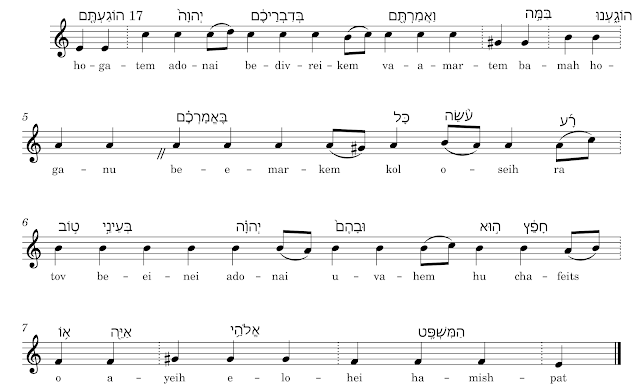
Malachi 2:17 Consider the tenderness of the final verse
and its engagement of the contradictions of human nature.

The war on a vast scale and individual divorces on a personal scale both show us the need to learn to read and sing, but we cannot correct every piece of gratuitous violence with a song.

Friday, 7 October 2022

BS Carnival 199?

Did anyone see a Biblical Studies carnival for September? I note a few interesting links. Jim posted his carnival again from a year ago - Plus ça change...

So what's up from last September (2022) -- 

Not the standard carnival...

Hebrew Scriptures

I did a bunch of posts at the end of the month -- some of them responding to Claude Mariottini e.g. on Jezebel and his scheduled posts on the difficulties of translation. The one on dung you might find interesting.

A post that started my work this past fortnight was responding to Ken Schenck on the accents of the Hebrew Bible. In my search for easier ways to appreciate the Hebrew Bible, I stress the music as an essential element of learning.

The Torah site had its usual set of excellent posts - particularly this one on Hannah. "Why did the biblical author digress from the course of his tale to build up Hannah as a personality of dignity and memorable talents, when the historical or theological purposes of the tale do not require it?"

New Testament

Don Lowe on μονογενὴς and how "This word played a major role in the formation of historic Christian doctrine."

The Synoptic problem got a post here.

Marg Mowczko has a post on the Samaritan woman.

James McGrath has found himself in Oxford for a few months continuing his work on John the Baptist.  James Davila points out an article related to McGrath's work here. 

Other

The Eye (no -- not Tolkein) by Deborah Forger. "What might the eye, the sense of sight, and the desire of many in the ancient world to see God tell us about points of continuity and discontinuity between Jews and Christians in antiquity?"

Brent Niedergall posted on Phillip Long's new Book, The Book of Enoch for Beginners.

In Memoriam

The month was dominated by the Queen's death and funeral. James McGrath posted on the music here.

There was a lot more -- and some of it struck me as I noted it during the month -- but I didn't take any notes and haven't the time to pursue it further. Add comments if you have memories of September posts you would like to note.


Monday, 3 October 2022

Jonah - pondering bits and pieces of this story

Yesterday, there was an article here by Rabbi Bob (not me) on responses to Jonah by Kimhi and other sages. Kimhi notes that there is no mention of Israel. Answer: Nineveh on one warning turned completely from their evil compared to Israel, "rebuked from dawn to dusk" who do not turn. Radak then says that God granted the Ninevites mercy (even more so when they are many). He is seconded by R. Yehoshua ben Shuib.

These two are then contrasted with Don Isaac Abravanel and R. Meir Leibush ben Yechiel Michel Wisser who note that Nineveh is being preserved to correct Israel. (Maybe an unstated part of the story line.) Ibn Ezra is reported as noting the god-fearing nature of the Ninevites (3:3). That's interpreting Elohim as God rather than gods in this one verse -- a bit of a stretch.

Jonah is a very short book, full of subtlety and complexity. It is hard to sort out the motivations of each character.

I note a second article on Jonah by Yitzhak Peleg today -- He explains that Jonah is the focus of Yom Kippur. Both the writers use repentance as their gloss for תשובה. I never gloss this root wvb as repent, because repent is a religious word whose meaning in the modern mind has been associated with various theories of God. I always use the direct sense of the word: to turn towards or away from. Whether one is turning to the good or turning away from what is not good, turn is an active verb - not a religious thought process. 

What is Yahweh God doing with this tale? Peleg calls it a didactic lesson. Both articles are worth the read.

The music at the beginning shows an autocratic call in verse 2 -- preceded by a drum roll -- ornamentation around the tonic. Jonah was not your typical obedient prophet in whom the word of God burned till he paid attention, and we don't hear any initial complaint from him. His actions speak his response -- he obeyed the first part, he arose, but he ran in the other direction.

The first thing God does in this book is make the word happen to Jonah. It's the same phrasing as for Samuel or Nathan or Elijah and a few others in the stories in 1 Kings. This phrasing is more frequent in Jeremiah (27 times) and Ezekiel (43) and Zechariah (7). But it doesn't occur at all in Isaiah. Isaiah uses oracle 25 times. Jeremiah, Ezekiel and the twelve, even more frequently -- over 300 times. Is happen active or passive action on Yahweh's part? This word (to be) could just be: and the word of Yahweh was for Jonah. I used happen, since the gloss fits in a lot of other places as well. Who knows how the word of some mysterious being - whether autocrat or not - comes to a person? Perhaps happen is picking up on what happens, and oracle is more direct speech.

Several words refer to the deity. God (al) is used as a word only once in Jonah (4:2). God (Elohim) is used in every chapter - 16 times altogether. The sailors, the pilot, Jonah, the king, the Ninevites all refer to the generic God. Yahweh God is used once (Jonah 4:6). The authoritative God appoints and speaks only in chapter 4. The narrator (ah, another mysterious character - the omniscient story teller) is the one who tells us who's doing what to whom. The narrator tells us that Yahweh is Jonah's God (2:2) and Jonah's psalm confirms it (2:7).

Yahweh is the origin of the words, and Yahweh is the face (presence) that Jonah is running from, the target of prayer, fear and offerings from the sailors, and vow and attribution from Jonah. Yahweh is not part of the Ninevite section. 
In chapters 1 and 2, Yahweh:
  • makes the word happen
  • hurls the great wind on the sea
  • appoints a great fish
  • answers Jonah
  • hears Jonah's voice and brings him up from destruction
  • talks to the fish
In chapter 3, God sees and sighs, and refrains from the evil designated for Nineveh.

Then in chapter 4, it is a bit more complex. In the face of Jonah's anger, and his prayer for death, Yahweh asks whether this is good. Then it is 'God' who
  • appoints a tender plant and makes it come up over Jonah
  • appoints a worm
  • appoints a sultry east wind
  • and then asks if it is good to be burning with anger
Finally Yahweh speaks about Jonah lamenting the lesser - the tender plant - now withered, and therefore how much more should Yahweh not spare the greater - Nineveh.

The music of the final speech of Yahweh is so lyrical. The shape of it mimics part of the Duruflé requiem (the rise from tonic to the sixth then tonic to the fifth). Yahweh's final speech is one of my favorite bits from my arrangements. It's the 12 8 rhythm that does it. I always have Yahweh speak with multiple parts since I think the word happens to us through the interactions and pressures of many voices. The final speech begins at bar 164.

Here are the questions raised for me:
  • Jonah finds himself saved from the great fish, but is he saved from himself?
  • What is Nineveh thinking except to escape from the judgment? It will continue with its incorrigible imperial desires.
  • Is it then enough to say that this is a lesson in universal mercy? Or that this is about Israel?
  • Why does Jesus use the sign of Jonah? It's a much bigger story than the '3 days'. 
  • Does this story have application to us today? Who is Jonah? Who is the imperial power whose evil deeds are in Yahweh's face? 
  • Is God's character as portrayed acceptable or is it just one of many ploys in the narration?
Russia today is trapped in its merciless religious and imperial framework. Iran is trapped in its fear of women. China is trapped in its need for uniformity. Half the US is trapped in its own lies. We are all trapped in the climate crisis. How far away are we from turning away from the evil that has come up in our own faces? Is there a prophet who would preach to us?

There are many reasons to run away and hide - not least because, like Nineveh, there is a deeper problem to be fixed - the violence that is in our own hands. Is there a multi-voiced word to us: sanctions, drought, floods, storms, death, destruction? Perhaps we, like Jonah, must be part of the solution.

Doesn't seem to be any magic here. Nor does it stop future violence. A prophet today might well sit on the sidelines and hope for 'change'. And the sidelines are a sultry wind destroying our tender plantings, our supply lines, our water, pollination, and growing seasons. 

The chapter on Nineveh makes no mention of mercy or kindness. Nineveh's turning is a 'who knows' gamble in terms of belief, and a self-protective move, but it does stop the stench of its imperialism momentarily. This is a pragmatic and political move and it works.

So God sighs over the evil that was designated for them. And it was not done. I don't find myself sighing about anyone's imperialistic tendencies - whether it be a nation, or a religion, or myself. The enforcing of power over another is anathema to the gospel.

The end of the story leaves Jonah silent with respect to the question reasoning from lesser to greater that God asks. Silence is not an option. Kindness comes up twice in the story: First in the comment of the Psalm in chapter 2:9: 
Those who keep vain futility,
forsake their kindness.

Then in Jonah's citation of Exodus 34:6 and his excuse for stalling and running away:
(4:2b) For I know that you are a gracious and compassionate God, slow to anger and of abundant kindness, and who sighs over evil.

We had better hope that this is the case for Jonah and ourselves as well.

Sunday, 2 October 2022

Cook: Introduction to Aramaic

Jim Davila points out a new CUP volume, Biblical Aramaic and Related Dialects, An Introduction. The 23 page introduction available in the preview is worth the read if you want a quick overview of the language and its use in the Bible. 

Friday, 30 September 2022

The music of a word

Here's a little more analysis of that five-letter word - viamr - your hebrew-dle for the week. It's used 2079 times out of the 5491 times that amr appears in the Hebrew canon. It has a number of distinct vowel patterns - and also distinct accents with these vowel patterns. It's small enough in this high level extract from the concordance to analyse by hand.

The music is varied. The same accent is not always used. In fact I think almost every accent is used with this word in the Bible.

Here are some examples that begin with vav and a schwa (:) and the accent is on the third syllable, and the aleph is silent - 6 of those. (My mapping of the vowels from Hebrew to English is here.)

viamr _:_o__a-֗_ 1 Hab 2:6(10)
viamr _:_o__a-֣_ 3 e.g. Isa 44:16(14)
viamr _:_o__a-֥_ 1 2Kgs 9:17(21)
viamr _:_o__a-_֙ 1 Isa 44:17(10)

Then (below) there are 16 instances of v with an /a/ sound, and the accent on the first syllable, or the first and second syllables (it's music).  The first example from Job below is the very common up and down 'revia-mugrash' giving a lighter accent on the first syllable.

The qarne (horn) on 2 Kings 9 verse 27 is striking and will produce a slowdown on the first syllable and probably an unaccented accent when the vocal line returns to the subdominant.
Unexpected accent on the first syllable of viamr in 2:Kings 9:27
In the remainder of the next table, the three examples are moving to a new reciting note on the first syllable.

viamr _a-֝_o֗__e_ 1 Job 36:10(4)
viamr _a-֠_o__e_ 12 e.g. 2Kgs 9:27(12)
viamr _a-֤_o__e_ 1 Gen 32:17(7)
viamr _a-֥_o__e_ 1 Jdg 10:11(1)
viamr _a-ֽ_o__e_ 1 2Sa 13:15(14)

The ones below are generally one accent but sometimes two on the second and third syllables. You can see there are lots of them with various accents. I am choosing a few that exhibit some of the variations. 
viamr _a-_o֔__e_ 15
viamr _a-_o֕__e_ 116
viamr _a-_o֖__e_ 97
viamr _a-_o֗__e_ 131
viamr _a-_o֙__e_֙ 140 e.g. Gen 48:19(3)
The setting in Gen 48:19 for viomr.
Note the dots: the yod has a dagesh and the aleph an o.
The remaining quarter circle above the aleph is the accent and it's repeated.
The distinct placement is not treated as significant in this deciphering key.

Next we have 1500 or so that are all accented on the second syllable. And another 100+ that are accented on the third syllable. I am going to miss them out of this list because it is becoming tedious.  But here's one that is unique - and it's a good place to end - splitting the word over three reciting notes right at the end of the verse. A spondee for emphasis.
Stressing syllables 2 and 3 in the final statement of Judges 12:5.

Names and shapes of all the accents are here. The full list for amr is here.

Can you begin to imagine how many research papers are required to expose the uniqueness of all this music.