Thursday, 26 September 2024

The shofar psalms - what is their shape

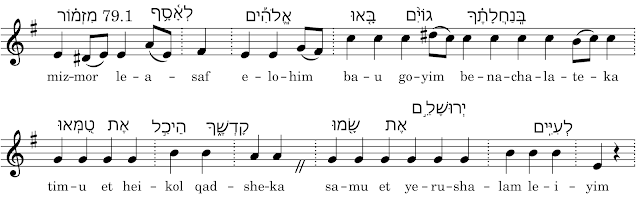
You will remember the shape: 

Definitely designed for a wind instrument like trumpet or shofar.

The psalms with the shofar incipit only occur in the first three books so I thought as aa break from looking at everything at once, I should examine these 8 psalms in more detail. The link in the first column will show you the music.

PSALMSyllablesdef#gABC
36237.0025.3211.3920.6817.3021.943.38For the leader. Of a servant of Yahweh. Of David.

444951.2120.8118.1818.3819.1918.383.84For the leader. Of the children of Korah, an insight.

471731.7319.6519.0820.2312.7217.349.25For the leader. Of the children of Korah. A psalm.
49358.0019.8312.2922.3516.4820.398.66For the leader. Of the children of Korah. A psalm.
61163.0022.7012.8817.1817.7924.544.91For the leader with strings. Of David.
69734.6819.6218.1213.9021.2520.306.13For the leader. Upon lilies. Of David.

81310.0021.2911.6120.9722.5820.003.55For the leader on musing, of Asaph.

85241.8322.8212.4515.7724.4819.504.15For the leader. Of the children of Korah. A psalm.

Notice the variety of tenor with this incipit (0 on f#). Conclusion: the incipit does not determine the tenor. The tenor does not specify mode. By mode I mean the sharpening or not of selected tones in the scale.

Does the tenor tell us about the mood? To see that we need to examine the psalms as a whole. So here are brief introductions. What are the common characteristics of these psalms?

  • Psalm 36 is one of two oracles in the psalter, the other being psalm 110.
  • Psalm 44 is the corporate lament with its emphasis on the first person plural.
  • Psalm 47 has the ascension verse 6 including the phrase 'with the voice of the shofar'. Notice that psalm 48 on the city of God is surrounded by these two shophar psalms, both of them with the rarer tenor on g. 
  • Psalm 49, the riddle of the preciousness of ransom, contrasts the city of God with the dust-bowls of humanity.
(An aside: The fact that there are ornaments and significant recitations on g in the poetry tells us why the default mode for the poetry (f# g natural) is different from that for prose (f g#). There are no ornaments on the third degree of the scale in the prose books with the exception of the chapters containing the decalogue, Exodus 20 and Deuteronomy 5, and Genesis 35:22. In this one verse on filial deceit, the ornaments are remarkable for their presence. There is significance to the music -- it is not one of God's afterthoughts. The music should be an integral part of learning of the text. Where it is lacking, there will be misinterpretation.)

  • In psalm 61, singing psalms forever is the fulfillment of the psalmist's vow.
  • In psalm 69, the psalmist is sinking in overflowing floods. Each of these words recurs for the first time in the psalter in this psalm.
  • Psalm 81 anticipates the Jubilate (psalm 100).
  • Psalm 85 reflects the revelation to Moses in the kiss of righteousness and peace. These last three psalms have the tenor of A - at rest.

This interval of a fifth e to B and B to e is much more heavily used in the poetry (60% of verses) than the prose (26%). As a final cadence, B e, munah to silluq, is frequent in the poetry (35% of verses in Psalms, 46% in Job and Proverbs) compared to the prose - once only in 1 Chronicles 1:53 -- and who knows, this might be a slip of the stylus. In these 8 poems, the final cadence is 'B e' in 45% of the verses. Perhaps this is significant -- hard to tell with such a small sample.


Tuesday, 24 September 2024

Book 3 - Psalms 73 to 89

Summary: tenor on e - 2, f# - 5, g - 1, A - 7, B - 2, C - 0.

There are 17 psalms in Book 3. The final psalm is a great lament over the failure of the monarchy. Initially, I am still examining the 'tenor' in these psalms. I am still looking for clues to consider the tone or feel of the psalm related to the frequency of syllables on the five or six major reciting pitches.

And possibly also the tone in relation to the other bits and pieces of data evident in the first verse, and anything else one might consider given the nature of the date from reading the psalm.

The tenor is A (26.48% highlighted) the ambitus from e to C
PSALM Syllables d e f# g A B C
73 472 .00 17.80 20.97 14.41 26.48 16.31 4.03 A psalm of Asaph.
Surely God is good to Israel, to the pure in heart.
f#
74 463 .00 18.57 25.49 20.09 14.25 17.28 4.32 An insight of Asaph.
Why O God? will you reject us in perpetuity?
Will your anger fume against the sheep of your pasture?
A - I note that poetry has unique ways of returning to the tonic
- the fall from munah to silluq never occurs in the prose books.
75 210 1.43 19.52 16.19 16.67 25.71 15.71 4.76 For the leader. Do not destroy.
A psalm of Asaph. A song.
B
76 222 .45 19.82 16.67 18.47 17.57 26.58 .45 For the leader. On strings.
A psalm of Asaph. A song.
B - with 'low key' incipit
77 391 .51 20.46 18.41 12.02 19.44 23.27 5.88 For the leader. For Jeduthun. Of Asaph, a psalm.
on A -- at rest! -- Introducing the longest poem (119 is 22 short poems)
78 1354 .37 19.72 17.06 15.95 24.37 17.73 4.80 An insight of Asaph.
Listen my people to my instruction.
Bend your ears to the sayings of my mouth.
e
79 341 2.93 23.17 22.87 10.85 11.14 15.84 13.20 A psalm of Asaph.
O God the nations have come into your inheritance. They have defiled even your holy temple.
They have set up Jerusalem in shambles.
A
80 379 .00 18.21 19.00 9.76 24.80 21.90 6.33 For the leader. On lilies.
A testimony of Asaph, a psalm.
A - another double illuy - the shofar melody
81 310 .00 21.29 11.61 20.97 22.58 20.00 3.55 For the leader on musing, of Asaph.
f# - the deliberation tone - not a mode but a mood
82 144 .00 22.92 27.78 18.75 15.28 12.50 2.78 A psalm of Asaph.
God takes a stand in the divine assembly,
in the close combat of gods he judges.
e - I wonder why the incipit is sometimes tied to the first words of the psalm and sometimes not
83 314 .00 22.29 18.79 19.75 21.02 16.88 1.27 A song. A psalm of Asaph.
f#
84 271 5.17 17.34 22.88 15.50 20.66 13.28 5.17 For the leader, at the Gittite settlement.
Of the children of Korah. A psalm.
A
85 241 .83 22.82 12.45 15.77 24.48 19.50 4.15 For the leader. Of the children of Korah. A psalm.
f#
86 381 .26 20.21 27.30 14.70 13.12 18.37 6.04 A prayer Of David.
Bend Yahweh your ear. Answer me,
for I am poor and in need am I.
g
87 116 .00 24.14 13.79 25.00 18.97 15.52 2.59 Of the children of Korah. A psalm. A song.

His foundation is on the holy hills.
A
88 377 .00 17.77 14.59 13.26 25.46 25.20 3.71 A song. A psalm of the children of Korah.
For the leader in illness to jam.
An insight of Heyman the Ezrahite.
f#
89 949 .00 18.44 21.07 19.70 20.55 18.12 2.11 An insight. Of Ethan the Ezrahite.

Monday, 23 September 2024

Book 2 - Psalms 42 - 72

Are the first lines of psalms of Book 2 (musically) different from those of Book 1 that we have seen so far in this series? Overall tenor of the chant: d: 0, e: 11, f#: 9 (+1 tie), g: 2, A: 6, B: 3, C:  0. 2/3 of the book is quite subdued or deliberative as to reciting note. One might expect this with the nature of the opening laments, 42-44. There are some more hopeful psalms in the book like the series from 45 to 48. I put this series out to you all, if indeed anyone sees it in real time, for analysis. It is a long and complex analysis. I will list the psalms again ordered by their recitation pitches to see if other patterns arise.

3 more books to present in this musical form.
42:1 is one of 11 with this shape

PSALM Syllables d e f# g A B C
42 312 3.53 29.49 27.56 8.01 10.26 9.62 11.54 For the leader. An insight of the children of Korah.
43 continues 42, so it is without incipit

43 145 4.83 27.59 21.38 7.59 6.21 13.10 19.31 Judge me O God and strive my strife with a nation without one who is merciful.
From a deceitful and unjust person secure me.
44:1 is one of 8 verses with this musical shape.

44 495 1.21 20.81 18.18 18.38 19.19 18.38 3.84 For the leader. Of the children of Korah, an insight.

There are 30 instances matching the musical shape of this verse; 4 psalms 45, 60, 69, 80 are on a lily.

45 393 .51 24.17 16.54 20.10 13.74 19.59 5.34 For the leader upon lilies, of the children of Korah.
An insight. A song of two beloved.

This musical shape occurs 13 times. In Book 2, psalms 45, 46, 48, 65-68 are labelled 'song'.

46 233 .86 25.32 22.32 18.03 14.59 18.88 .00 For the leader of the children of Korah.
For young women. A song.

g is the tenor

47 173 1.73 19.65 19.08 20.23 12.72 17.34 9.25 For the leader. Of the children of Korah. A psalm.
This simple shape is unique - 47 and 48 are joined at the hip by the opening note
A is the tenor

48 270 1.11 14.07 18.89 17.41 19.63 15.56 13.33 A song. A psalm of the children of Korah.
back to g as the tenor

49 358 .00 19.83 12.29 22.35 16.48 20.39 8.66 For the leader. Of the children of Korah. A psalm.
back to A

50 436 .00 19.95 13.53 17.43 21.79 19.95 7.34 A psalm of Asaph.
The God of Gods, Yahweh, spoke and he called earth
from the rising of the sun to its going down.
f#

51 403 .00 17.62 23.08 14.89 18.11 19.85 6.45 For the leader. A psalm of David,
f#
52 221 2.26 23.08 25.34 12.67 13.57 18.55 4.52 For the leader. An insight of David.
e

53 168 5.36 31.55 22.62 8.93 13.69 13.69 4.17 For the leader. In illness. An insight of David.
A

54 157 .00 12.10 17.20 22.93 24.20 14.01 9.55 For the leader. On strings. An insight of David.
f#

55 470 .85 17.66 18.72 18.09 14.04 18.30 12.34 For the leader. On strings. An insight of David.
A leap of the 6th -- compare psalm 18
56 278 4.68 20.14 10.79 17.99 20.86 18.35 7.19 For the leader. On the dove dumbed by distances. Of David. A miktam,
when the Philistines in Gath grasped him.

B

57 260 3.08 14.62 20.00 11.92 14.62 23.85 11.92 For the leader. Do not destroy. Of David, a miktam,
when he ran away from the face of Saul in the cave.

f#

58 235 1.28 21.28 34.47 11.06 11.06 19.57 1.28 For the leader. Do not destroy. Of David, a miktam.
f#

59 409 2.93 20.29 22.00 17.11 13.94 18.34 5.38 For the leader. Do not destroy.
Of David, a miktam,
when Saul sent and they watched the house to have him executed.

B continuing psalm 59

60 279 .72 15.41 11.47 16.85 17.20 29.75 8.60 For the leader on a lily. A witness.
A miktam of David, for teaching.
B

61 163 .00 22.70 12.88 17.18 17.79 24.54 4.91 For the leader with strings. Of David.
e

62 257 3.89 26.46 17.51 7.78 21.01 13.62 9.73 For the leader. For Jeduthun. A psalm. Of David.
f#

63 230 1.30 20.87 23.91 14.78 18.70 19.13 1.30 A psalm of David,
when he was in the wilderness of Judah.
e

64 196 .00 28.57 19.39 9.69 17.35 22.96 2.04 For the leader. A psalm of David.
f#

65 288 4.17 17.71 23.26 13.54 21.88 14.24 5.21 For the leader. A psalm of David. A song.
e continuing psalm 65

66 376 .00 19.95 18.09 18.35 19.15 18.88 5.59 For the leader. A song. A Psalm.

Raise a shout to God all the earth.
e

67 138 .00 26.81 25.36 10.14 25.36 11.59 .72 For the leader. On strings. A psalm. A song.
f#

68 766 1.96 15.01 29.11 14.36 13.71 11.75 14.10 For the leader. Of David. A psalm. A song.
A

69 734 .68 19.62 18.12 13.90 21.25 20.30 6.13 For the leader. Upon lilies. Of David.

A in what way does psalm 70 complete psalm 69?
70 127 2.36 19.69 14.96 9.45 24.41 21.26 7.87 For the leader. Of David. To remember.
f#

71 512 1.17 20.51 23.24 12.50 18.16 15.04 9.38 In you Yahweh I take refuge.
I will never be ashamed.
tie between e and f# - each one has exactly 80 syllables on it

72 383 2.35 20.89 20.89 14.10 20.10 14.62 7.05 Of Solomon. O God your judgments to the king, give,
and your righteousness to the son of the king.

Sunday, 22 September 2024

Psalms 22 - 41

Psalm 22 - f# - Connection to psalm 21? Before I knew the music, I had seen this.
See my previous post from Seeing the Psalter page 78
PSALM Syllables d e f# g A B C
22 616 1.62 20.13 20.62 14.77 19.81 20.29 2.76 For the leader on the hart of the dawn. A psalm of David.
Psalm 23 - f# - Again the incipit shows itself part of the psalm and its music
I suggested that the f# is deliberation, perhaps here it is also pending
Could the shape of the music indicate an overall sense of the poem?

23 134 4.48 18.66 32.84 11.94 11.19 14.93 5.97 A psalm of David.
Yahweh is my shepherd. I will not lack.
Psalm 24 - A - at rest - a suitable tenor for the entry to the temple
24 199 .00 14.07 13.07 16.58 22.61 20.10 13.57 of David, a psalm.
The earth is Yahweh's and her fullness,
the world and those sitting in her.
Psalm 25 - e - This is an acrostic celebrating the prior psalm;
the music does not explicitly indicate the connection.

25 375 .00 23.20 13.07 21.60 20.53 15.20 6.40 Of David.
א I will lift up my self to you Yahweh,
Psalm 26 - A - a very short incipit

26 212 .00 18.40 9.43 20.75 25.00 24.53 1.89 Of David. Judge me Yahweh, for I myself have walked in my completeness,
and in Yahweh I trust. I will not vacillate.
Psalm 27 - e - a very short incipit 

27 357 3.92 30.81 18.49 14.29 10.92 14.57 7.00 Of David. Yahweh my light and my salvation, whom will I fear?
Yahweh from strength my life, whom will I dread?

Psalm 28 - f# - a very short incipit

28 228 4.39 15.35 25.00 11.40 15.35 14.47 14.04 Of David. To you Yahweh will I call. My rock, do not be silent with me.
If you are becalmed with me,
then I will be governed with those going down into a pit.
Psalm 29 - f# - a slightly longer incipit

29 201 1.49 14.43 36.32 11.94 15.92 17.41 2.49 A psalm of David.
Ascribe to Yahweh children of gods.
Ascribe to Yahweh glory and strength.
Psalm 31 - f# - this musical shape occurs 11 times in the Psalter

31 549 7.10 19.49 30.24 12.57 11.66 10.93 8.01 For the leader. A psalm of David.
Psalm 32 - e - the first 'insight'

32 258 3.88 27.91 19.38 11.24 15.50 15.50 6.59 Of David, an insight.
Happy transgression borne away, sin covered.
Psalm 33 - B - Proclamation - this is the unique psalm in Book 1 that lacks an inscription

33 364 .00 18.13 18.41 19.51 22.53 20.33 1.10 Shout for joy, righteous ones, in Yahweh.
To the upright praise is lovely.
Psalm 34 - A - another acrostic where the music does not signal the connection to the prior psalm

34 391 .00 18.16 13.81 15.86 26.60 23.27 2.30 Of David, when he feigned his madness in the face of Abimelek,
and he expelled him and he walked away.
Psalm 35 - f#

35 568 2.11 18.31 22.71 14.08 20.42 18.31 4.05 Of David. Contend, Yahweh, with my contenders.
Fight those fighting me.
Psalm 36 - e - starts with a 12 syllable phrase on 'e'. The ornament is like a munah over the text.
 A fifth above the tonic is a natural harmonic for the shofar.
Psalm is labelled as an oracle in verse 2.

36 237 .00 25.32 11.39 20.68 17.30 21.94 3.38 For the leader. Of a servant of Yahweh. Of David.
Psalm 37 - B - the wicked acrostic

37 726 .55 16.94 12.12 22.59 24.24 17.08 6.47 Of David.
About evildoers do not burn.
Do not be jealous over doers of injustice.
Psalm 38 - e - to remember psalm 6

38 407 .00 23.34 19.16 15.23 21.87 18.43 1.97 A psalm of David. To remember.
Psalm 39 - e 

39 303 .99 25.41 20.79 6.60 14.52 21.12 10.56 For the leader. Of Jeduthun. A psalm of David.
Psalm 40 - connected to psalm 39 - reason? Note the reversal of ldvid mzmor.

40 469 2.13 18.12 29.85 8.96 14.50 14.07 12.37 For the leader. Of David, a psalm.
Psalm 41 - the only one with g as the tenor in Book 1

41 273 .00 18.68 19.41 20.51 14.29 14.29 12.82 For the leader. A psalm of David.